
Digital Transformation Training: How L&D Teams Modernize Without Overwhelming Their Workforce
Technology doesn't drive digital transformation, people do. Learn how L&D teams can deliver scalable, engaging digital transformation training that accelerates workforce adoption, reduces resistance to change, and helps organisations maximise the return on their technology investments
Key Takeaways
- The Core Problem: Legacy L&D workflows (one static update per year, reliance on dedicated designers) are too slow. Workflows change faster than generic training modules can be built.
- What L&D Teams Need: Fast authoring tools that convert existing company assets (SOPs, PDFs, slides) into trackable, scenario-based learning in days rather than weeks.
- Key Risk of Delayed Training: Rollout gaps cause employees to improvise, create operational inconsistencies across departments, and expose regulated industries (BFSI, Pharma) to compliance audit failures.
- The Solution (Kriya Stack): Enables subject matter experts (SMEs) to quickly build, update, and export SCORM-compliant, multilingual modules directly to any LMS (Cornerstone, Workday, Moodle, Docebo) without adding design headcount.
What Digital Transformation Training Actually Means for L&D Teams
Digital transformation isn't just a tech upgrade happening around your workforce for L&D teams, it's the mandate to actually train that workforce on the new tools, workflows, and ways of working fast enough to keep pace with the business.
That sounds straightforward on paper. In practice, most digital transformation training rollouts create exactly the kind of friction they're supposed to eliminate.
Why Most Digital Transformation Training Overwhelms L&D Teams
Most training infrastructure was built for a slower, more static world, one course, one audience, one update a year. Digital transformation doesn't work on that timeline.
Common complaints we hear from L&D and training managers:
- "We're rebuilding the same module every time a tool or process changes."
- "Our authoring tool needs a dedicated instructional designer for every update."
- "By the time a course ships, the workflow it's teaching has already changed again."
The intent behind most digital transformation initiatives is sound. The execution breaks down because the training layer can't move at the speed the rest of the organization is moving.
What L&D Teams Actually Need to Keep Up
Most L&D teams aren't asking for more dashboards. They're asking for a way to turn what's already sitting in their organization — SOPs, product docs, process decks, SME knowledge into training that ships in days, not weeks.
That means tools that:
- Let non-technical SMEs build and update courses without waiting on a designer
- Turn existing content (PDFs, slides, recorded walkthroughs) into structured, trackable training
- Export cleanly to whatever LMS the organization already runs
- Support scenario-based practice for change-heavy rollouts, not just passive video-and-quiz
- Scale across teams, functions, and languages without multiplying headcount
Whether the trigger is a new ERP, an AI tool rollout, or a full operating-model shift, the training layer should absorb that change and not become a bottleneck to it.
A common example: a mid-size BFSI company rolls out a new core banking platform to 600 employees across four cities. The old playbook looks like this, an instructional designer spends three weeks building a single generic walkthrough, it ships once, and by the time regional teams get to it, two of the workflows it covers have already changed. Employees end up learning the platform from colleagues instead of from training, which is exactly the kind of undocumented, inconsistent knowledge transfer that digital transformation is supposed to eliminate in the first place.
The fix isn't a better one-time course. It's a training process that can be updated by the SMEs closest to the change, in days rather than weeks, without routing every edit through a designer.
How Kriya Stack Supports L&D Through Digital Transformation
We built Kriya Stack's course builder around exactly this problem: getting training out the door at the same speed the business is changing.
Here's how the platform supports L&D teams through digital transformation:
- SME-led authoring: Upload existing docs, decks, or videos and generate a structured, SCORM-ready course without a dedicated designer in the loop
- Scenario-based practice: For process or policy changes that need judgment, not just recall, Kriya Stack turns SOPs and process docs into branching decision scenarios
- AI-generated video: Kriya Stack' Course Builder converts written process changes into animated walkthroughs when a live recording isn't practical
- Any-LMS export: Ships to Cornerstone, Workday, Moodle, Docebo, and other major LMS platforms with working completion tracking
- Built for scale: Multilingual support and cloud-native collaboration for organizations rolling out training across multiple teams or regions at once
This is designed for L&D teams at mid-to-large organizations, roughly 200 to 2,000 employees in sectors like IT/SaaS, BFSI, and Pharma, where digital transformation initiatives touch compliance, process, and tooling all at once.
Why This Can't Wait
Digital transformation initiatives are moving faster than most training infrastructure can support. Organizations are rolling out new tools and workflows on quarterly, sometimes monthly, cycles and training that takes six weeks to build is training that's outdated before it launches.
This gap shows up in three predictable ways:
- Knowledge gaps during the rollout window. Employees are expected to use a new tool or process before training on it actually exists, so they improvise, ask around, or fall back on the old way of doing things.
- Inconsistent execution across teams. Without a fast way to update training, different regions or departments end up working from different (and sometimes outdated) versions of the same process.
- Compliance and audit exposure. For regulated sectors like BFSI and Pharma, an outdated training record isn't just an inconvenience, it's a documented gap that shows up in an audit.
None of these are solved by hiring more instructional designers. They're solved by shortening the distance between "the process changed" and "the training reflects it."
The organizations that get this right aren't the ones with the biggest L&D teams. They're the ones whose training tools can keep pace with change instead of lagging behind it.
Build It Yourself, or Build It With Us
Every digital transformation training need falls into one of two paths:
- If you need something off-the-shelf — a general digital literacy or workforce readiness course you can deploy immediately — explore the course library.
- If you need it built around your organization's specific tools, processes, or rollout — which is the more common case for digital transformation — start building with Kriya Stack's course builder.
Most digital transformation training ends up in the second bucket, because the workflows being taught are unique to the organization.
Need a Ready-Made Digital Transformation Training Course?
Not every organisation has the time or resources to develop training from scratch. If your team is looking for a ready-made Digital Transformation Training course, Kriya Stack's Course Library offers professionally designed, SCORM-compatible courses that can be deployed quickly through your existing Learning Management System (LMS).
Our Digital Transformation Training course helps employees understand the fundamentals of digital transformation, build digital-first thinking, and prepare for organisational change. It's ideal for organisations looking to accelerate workforce readiness without investing weeks in course development.
👉 Explore our off the shelf Digital Transformation Training course
If your organisation requires training tailored to its own systems, processes, or digital initiatives, you can also create fully customised learning experiences using the Kriya Stack Course Builder.
Related Reading
If your team is scaling training delivery as part of a broader transformation effort, these go deeper on specific pieces of the problem:
- 5 Mistakes L&D Teams Make When Training at Scale — and How to Fix Them
- Best Interactive Employee Training Tools, Compared
Ready to Modernize Your Training Delivery?
If your organization is mid-transformation and your training stack hasn't caught up, book a demo and we'll walk through how to close that gap without adding headcount.
Related Articles
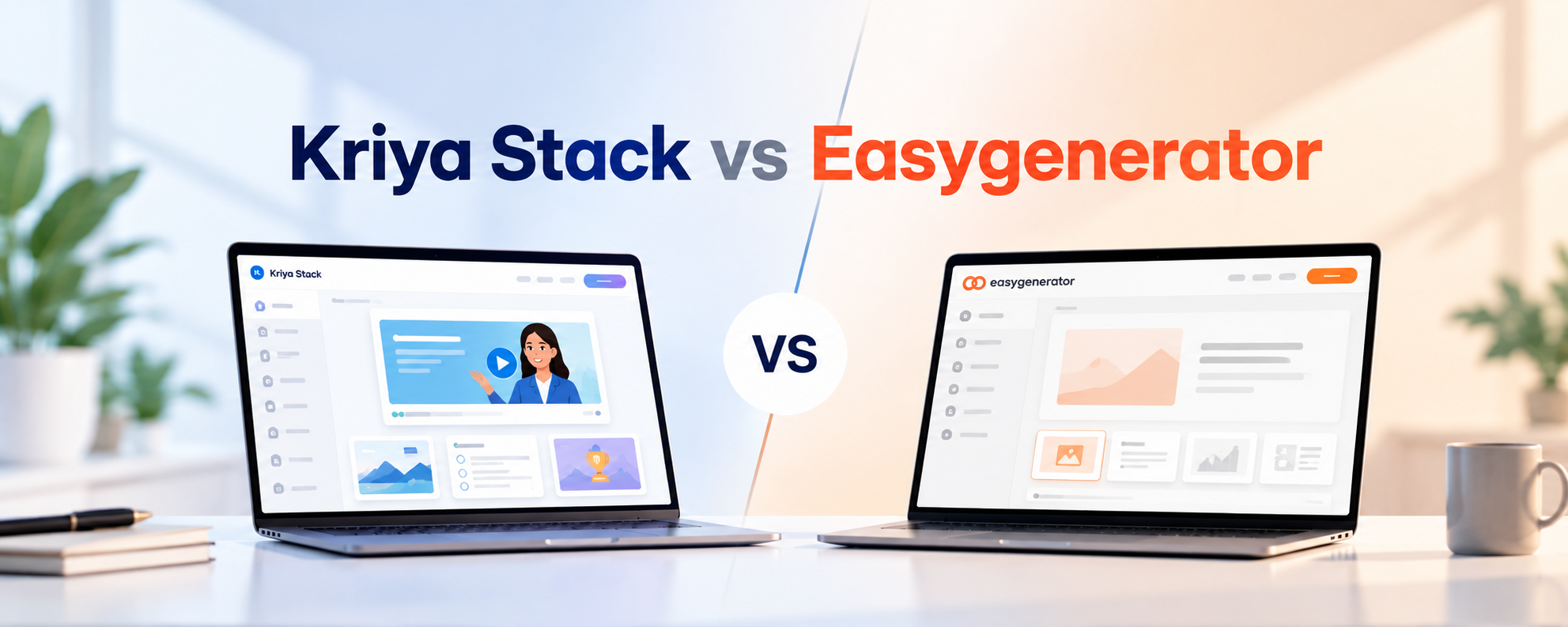
Kriya Stack vs Easygenerator: AI Course Authoring Tool Comparison
Compare Kriya Stack vs Easygenerator across AI course creation, no-code authoring, video, gamification, SCORM, analytics and multilingual learning.
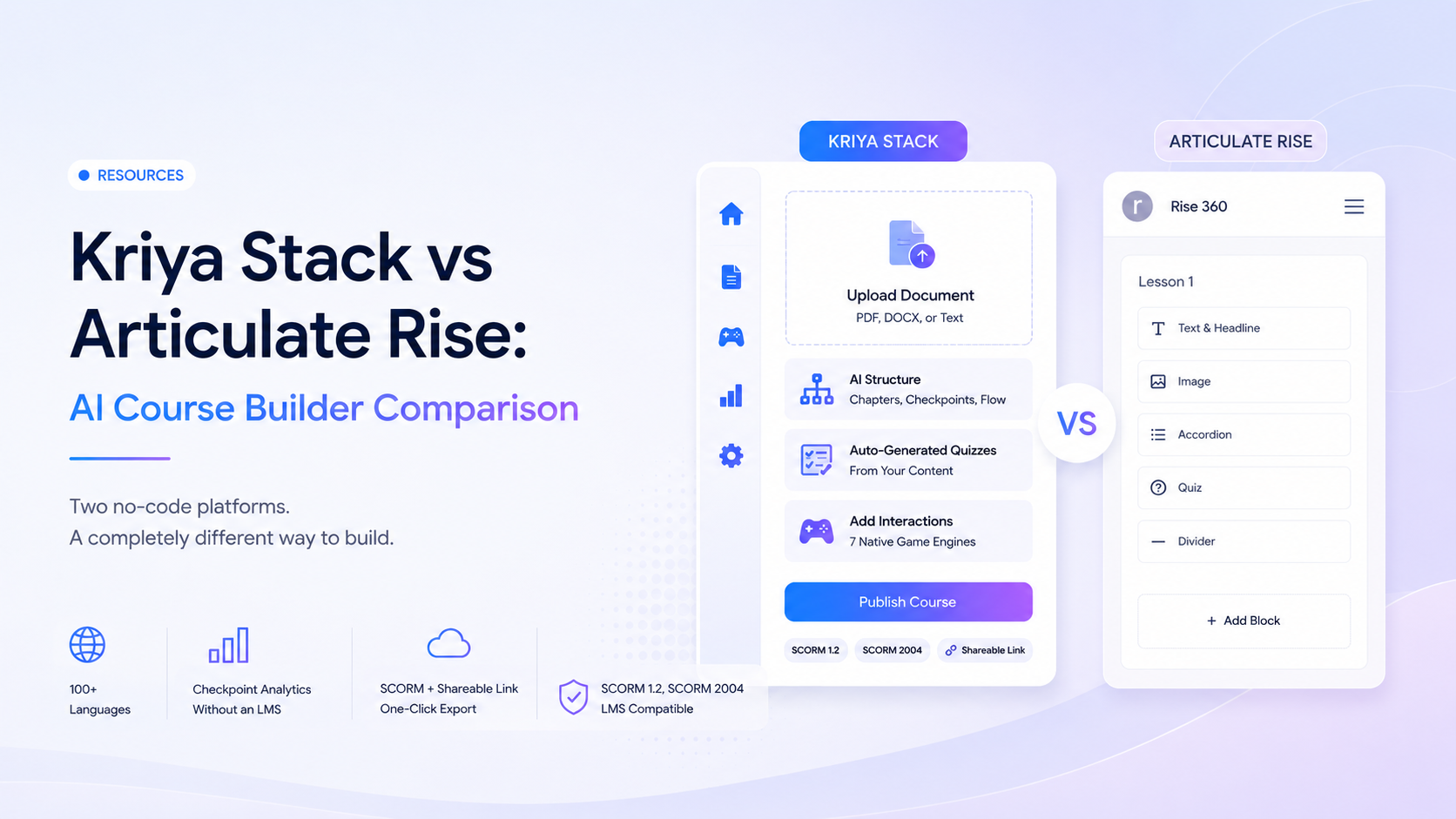
Kriya Stack vs Articulate Rise 360: AI Course Builder Comparison
Kriya Stack vs Articulate Rise: which AI course builder actually saves you time? We compare features, ease of use, and how fast each gets you from document to published SCORM course, no coding, no add-ons for languages or gamification.