
Why Gamification Fails in Corporate Training and How To Fix It
Most gamification initiatives don’t fail because the idea was wrong, they fail because the training infrastructure couldn’t support it. This blog breaks down the real reasons gamification falls flat in corporate training and what teams can do to fix it.
Why Gamification Fails in Corporate Training and How To Fix It.
You pitched it to leadership. You built the business case. You got the budget, hired a vendor, and launched with real enthusiasm.
And then it flopped and you have no clue why? Lets find out.
Completion rates didn't improve. Learners clicked through the badges indifferently. The leaderboard became a ghost town. By Q3, leadership was asking uncomfortable questions about ROI, and you were quietly wondering whether gamification was ever a real thing or just another L&D trend you'd chased too hard.
Here's what nobody told you: the gamification strategy probably wasn't the problem. Your LMS was.
The Failure Gets Blamed on the Wrong Thing
When corporate gamification initiatives fail, the post-mortem almost always points to one of two culprits: poor content design or learner disengagement. Occasionally someone mentions change management. Almost no one looks at the platform infrastructure.
That's a mistake.
Gamification in corporate training isn't just a content philosophy, it's a technical delivery challenge. Points, badges, leaderboards, branching scenarios, unlockable content, progress streaks, competitive cohorts, all of these require an LMS capable of tracking, rendering, and responding to learner behaviour in real time. If your LMS can't do that, even the best-designed gamified course will land flat.
The learner doesn't experience a "technical limitation." They experience a boring course.
What Gamification Actually Requires From Your LMS
Most L&D teams evaluate LMS platforms on the basics: SCORM compliance, reporting dashboards, user management, mobile access. These are necessary, but they're not sufficient for gamification to work.
Here's what gamification genuinely demands from your infrastructure:
Real-time data tracking
Gamification mechanics depend on instant feedback. When a learner answers correctly and earns points, they need to feel it immediately — not after a page refresh, not the next time they log in. LMS platforms that batch-process SCORM data or update scores asynchronously kill the dopamine loop that makes gamification effective.
Granular xAPI or SCORM 2004 support
SCORM 1.2, still the default on many legacy systems, was not designed with gamification in mind. It tracks completion and score — that's roughly it. Meaningful gamification requires xAPI (also called Tin Can), which can capture custom verbs: "unlocked," "challenged," "ranked," "streaked." Without xAPI support, your LMS is literally unable to understand what your gamified content is trying to tell it.
Dynamic leaderboards and social features
A leaderboard that updates weekly isn't a gamification feature — it's a spreadsheet. Real leaderboards update continuously, filter by team or cohort, and create visible competition. Delivering this requires LMS infrastructure that supports live data queries, not just static reporting exports.
Conditional content unlocking
One of the most effective gamification mechanics is progression-gating: learners unlock the next module, scenario, or challenge by demonstrating mastery of the previous one. Many LMS platforms support only linear course completion. They have no mechanism to conditionally release content based on performance criteria, rendering this mechanic impossible.
Reliable mobile rendering
Gamification is inherently casual and social. Learners check leaderboards the way they check scores. They want to complete quick challenge modules on their phones during downtime. An LMS with poor mobile rendering — or one that forces PDF downloads on mobile — makes the casual engagement that gamification depends on structurally impossible.
How to Diagnose Whether Your LMS Was the Problem
Before concluding that gamification "doesn't work for your organisation," run through this checklist.
1) Did your gamification vendor flag platform compatibility issues?
Reputable gamification content vendors will tell you upfront if your LMS can't support the mechanics they've built. If they didn't, ask them now. Ask specifically about xAPI support, real-time score syncing, and conditional module release.
2) Were badges and points appearing with a delay?
If learners had to complete a module, exit, and re-enter to see their updated score or badge, the feedback loop was broken. That delay is a technical problem, not a content problem.
3) Did leaderboards require manual updates?
If your L&D team was exporting reports and updating leaderboards manually, you were simulating gamification rather than delivering it.
4) Did completion data look wrong in your reports?
Gamified courses often include non-linear navigation and scenario branches. If your LMS was reporting these as incomplete because the learner didn't click "Next" through every slide in sequence, the tracking was misconfigured for the content format.
5) Did mobile users experience a different version of the course?
If learners on mobile couldn't access the gamified elements: interactive scenarios, branching decisions, timers, the experience was fundamentally broken for a significant portion of your audience.
If you answered yes to two or more of these, your LMS was the bottleneck, not your strategy.
The Real Cost of the Wrong Infrastructure
The visible cost of a failed gamification initiative is easy to calculate: vendor fees, multiple tools, content development hours, the budget that was signed off on. That's painful enough.
The invisible costs are worse. I am sure you would know that by now.
When gamification fails publicly inside an organisation, it damages the credibility of everyone who championed it. L&D teams that pushed for the initiative become cautious. Leadership becomes sceptical of the next engagement-focused proposal. And learners, who may have been genuinely curious about the approach form a lasting negative association with gamified training.
That credibility is hard to rebuild. And it was lost not because the strategy was wrong, but because the infrastructure couldn't execute it.
What a Gamification-Ready LMS Actually Looks Like
The good news is that the capability gap is real but solvable. When evaluating whether your current LMS can support gamification or when considering a new platform, here's the non-negotiable list:
xAPI support (not just SCORM 1.2). Your content needs to speak a richer language than SCORM 1.2 allows. xAPI is the standard. If your LMS doesn't have a built-in Learning Record Store (LRS) or a clean xAPI integration, gamification will always be constrained.
Native leaderboard and badge infrastructure. Some platforms support these natively; others require third-party plugins that add latency and break under load. Native is far more reliable.
Conditional release and branching. The LMS must be able to gate content based on performance, not just sequential completion. This is foundational to scenario-based and competency-gated gamification.
Real-time SCORM data syncing. Ask vendors specifically: how often does learner data sync? If the answer is "at session close" rather than "continuously," that's a red flag for gamified content.
Mobile-first rendering. Not "mobile responsive" — mobile-first. The gamification interface should feel native on a phone, not like a desktop layout that's been squeezed smaller.
A Note for L&D Leaders Who Took the Hit
If you championed gamification and it failed, and if any part of this post resonates, you weren't wrong about the strategy. Gamification in corporate training is backed by genuine learning science: self-determination theory, spaced repetition, immediate feedback, social learning. These are not trends. They are mechanisms.
What failed was the environment in which the strategy had to operate. That's an infrastructure problem, and it's fixable.
The teams that are running successful gamified training programmes right now are not doing anything radically different from what you tried. They have better-matched infrastructure. They're using platforms built specifically to support these mechanics or they rebuilt their delivery environment before launching.
You don't need a different strategy. You need a platform that can carry it.
Where Kriya Stack Comes In
Kriya Stack was built specifically for this gap. Every module created on the platform is SCORM-ready and gamification-native, meaning the mechanics that make gamification work (scoring, branching, unlocking, feedback loops) are built into the content architecture from the start, not bolted on.
If you're re-evaluating your L&D infrastructure after a gamification initiative that didn't deliver, we'd be glad to walk you through what a matched platform looks like in practice.
Book a Demo
Let's help you gamify your trainingsHave a question about gamification in corporate L&D, or want to diagnose whether your LMS is holding your strategy back? Write to us at kumar@kriyastack or connect on LinkedIn.
Read more on gamification, SCORM, and building training that actually works — explore our blog section
Related Articles
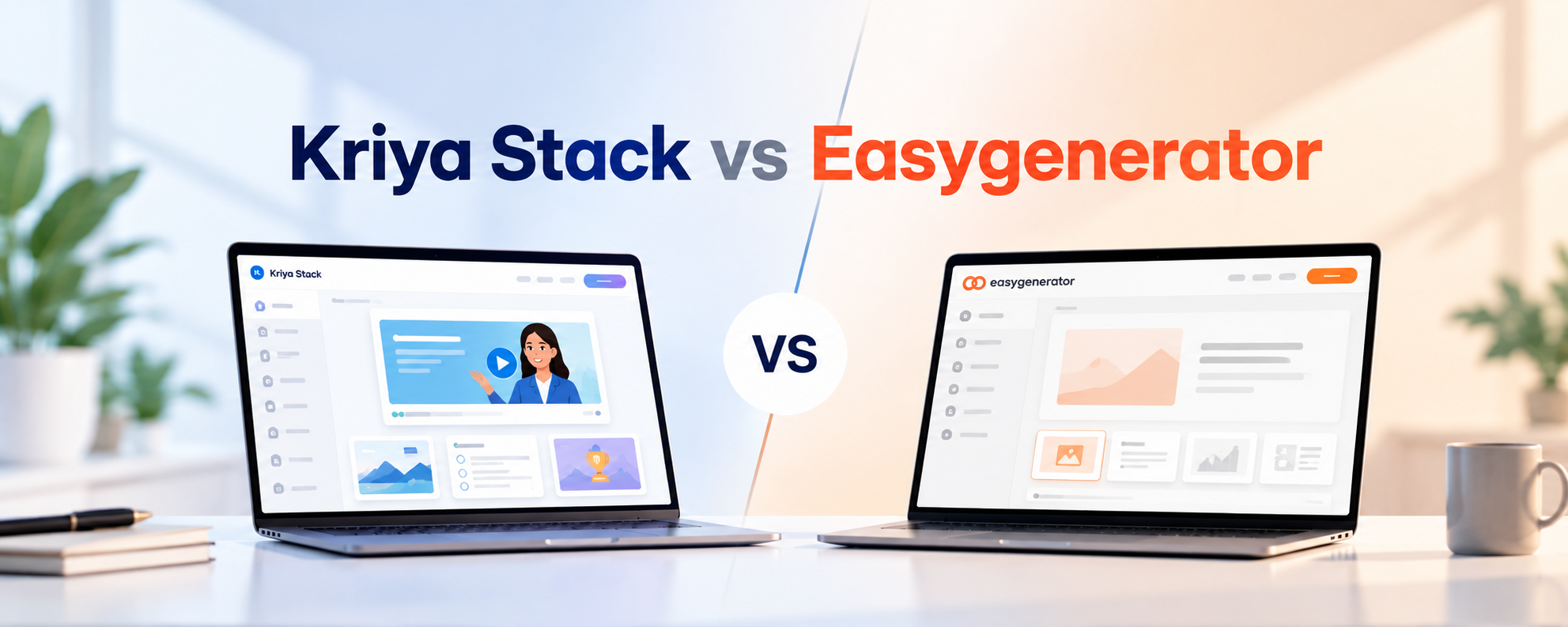
Kriya Stack vs Easygenerator: AI Course Authoring Tool Comparison
Compare Kriya Stack vs Easygenerator across AI course creation, no-code authoring, video, gamification, SCORM, analytics and multilingual learning.
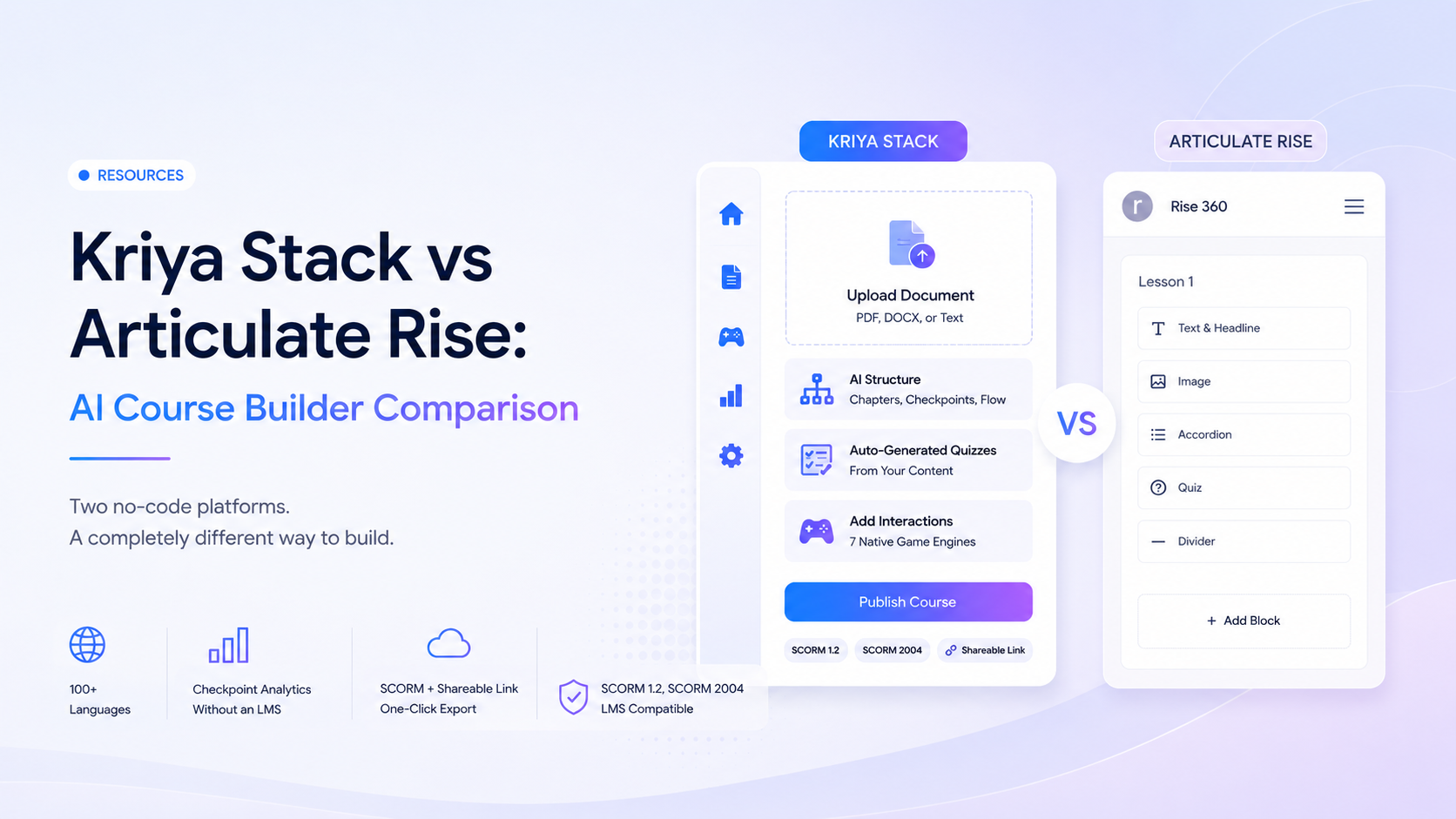
Kriya Stack vs Articulate Rise 360: AI Course Builder Comparison
Kriya Stack vs Articulate Rise: which AI course builder actually saves you time? We compare features, ease of use, and how fast each gets you from document to published SCORM course, no coding, no add-ons for languages or gamification.