HIPAA Training for Healthcare Employees: From Policy to Audit-Ready Learning
Key Takeaways
- Highest breach cost of any industry: Healthcare breaches average $7.42 million per incident, the highest of any sector tracked for 14 consecutive years.
- Enforcement isn't slowing down: HHS OCR has processed more than 370,000 HIPAA complaints since 2003, with per-violation penalties running from roughly $145 up to more than $2 million depending on the negligence tier.
- One course doesn't fit every role: A receptionist, a billing employee, a nurse, and an IT administrator all face different HIPAA risks and need training scoped to their actual PHI touchpoints.
- Scenario-based training builds judgment, not just recall: Practicing a real decision, such as how to respond to a records request, teaches more than memorizing a definition of PHI.
- Policies change, training has to keep up: HHS requires updated training within a reasonable period after a material policy change, which means the authoring workflow matters as much as the content.
- Completion isn't the same as documentation: Checkpoint-level analytics (assessment scores, scenario performance) give compliance teams stronger audit evidence than a pass/fail completion date alone.
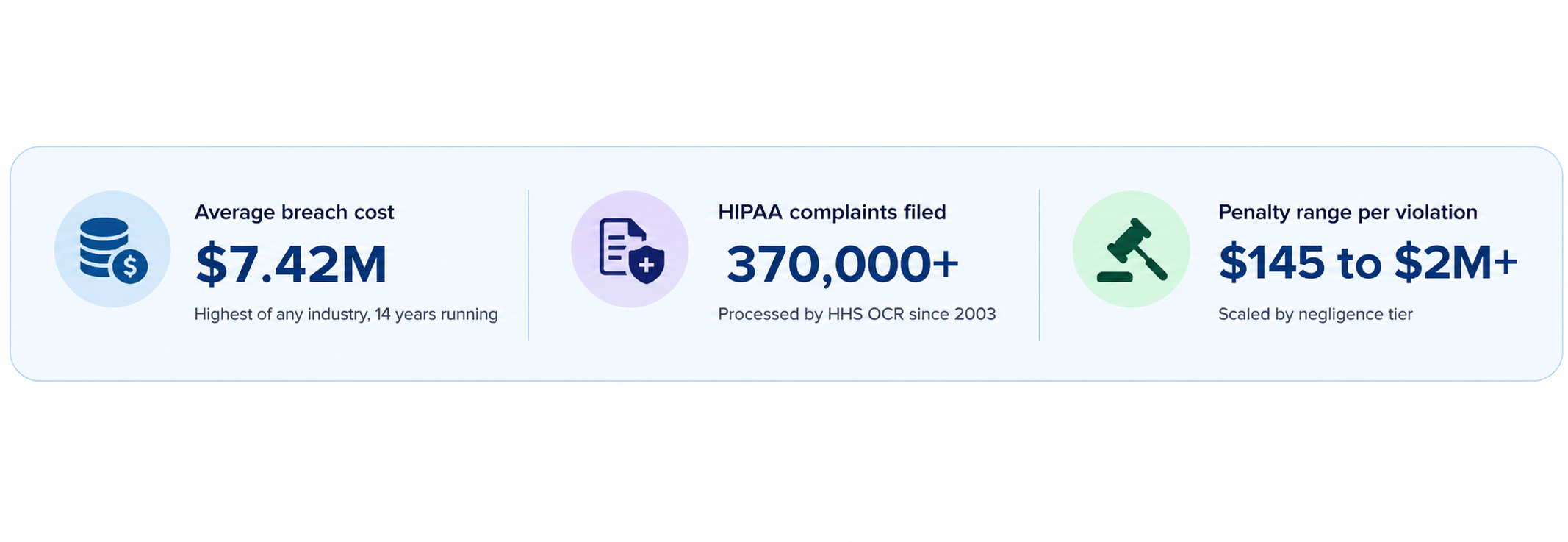
The cost of HIPAA non-compliance adds up fast: $7.42M average breach cost, 370,000+ complaints filed, and penalties of up to $2M+ per violation.
HIPAA Training Is More Than an Annual Compliance Course
Healthcare organizations don't have a shortage of HIPAA policies. They have a harder problem: turning those policies into training that employees can actually apply to the situations they encounter at work.
A receptionist handling a patient request, a billing employee opening a claim, a nurse communicating patient information, and an IT administrator managing access to electronic health information do not encounter the same HIPAA risks.
Getting this wrong isn't a paperwork problem. Workforce training gaps are a recurring finding behind OCR breach investigations.
For healthcare L&D and compliance teams, that creates a practical challenge: how do you turn policies and procedures into relevant, role-specific training, and keep that training documented and current as those policies change?
Kriya Stack helps training teams turn existing documents into interactive learning experiences with AI-generated course structures, scripts, scenarios, assessments, knowledge checks and more. Courses can be reviewed by subject-matter experts, published as SCORM 1.2 or SCORM 2004 packages, and deployed through an existing LMS.
For organizations that need training immediately, Kriya Stack also provides ready-made HIPAA courses that can be deployed without building the content from scratch.
HIPAA workforce training is not simply a matter of putting the HIPAA regulations into a slideshow.
Under the HIPAA Privacy Rule, covered entities must train workforce members on policies and procedures concerning protected health information as necessary and appropriate for their functions. New workforce members must receive the applicable training within a reasonable period, and workforce members affected by a material change in relevant policies or procedures must also be trained within a reasonable period. The organization must document that the training was provided.
OCR's audit protocol reflects this operational reality. It instructs auditors to review training processes and documentation, including samples of training provided to new hires and training associated with material changes to policies and procedures.
That means healthcare L&D teams have to think about HIPAA training as an ongoing learning process, not a once-a-year checkbox.
The training program has to answer four practical questions:
- Who needs training?
- What does each role need to know?
- When does the training need to happen or be updated?
- How can the organization demonstrate that the training happened?
The challenge becomes significantly harder as the organization grows across hospitals, clinics, locations, departments, shifts, contractors and different workforce functions.
Why One HIPAA Course Doesn't Fit Every Healthcare Employee
A healthcare organization may have thousands of employees, but they don't all interact with PHI in the same way.
Consider the difference between a front-desk employee and an IT administrator. The front desk may need to recognize when patient information can be disclosed over the phone. An IT administrator may need to understand access controls, authentication, security procedures and how to escalate suspicious activity.
A generic course can introduce everyone to the same HIPAA concepts. But role-specific scenarios are what allow employees to practice applying those concepts to their actual work.
| Workforce group | Where HIPAA issues can arise | Useful training focus |
|---|---|---|
| Clinical staff | EHR access, patient conversations, handoffs, records | PHI handling, appropriate access, disclosure, incident reporting |
| Front desk & reception | Patient verification, phone calls, visitors, printed records | Identity verification, disclosures, minimum necessary practices |
| Billing & administration | Claims, invoices, patient records, email | Secure handling, sharing and transmission of PHI |
| HR | Employee and patient-related information | Confidentiality, access boundaries, organizational procedures |
| IT & security | User accounts, systems, logs and ePHI | Security awareness, access, suspicious activity and escalation |
| Contractors | PHI exposure varies by service | Organization-specific procedures and responsibilities |
| Managers | Workforce oversight and escalation | Policy application, incident escalation and employee responsibilities |
HHS's HIPAA audit protocol specifically evaluates whether security awareness and training programs are reasonable and appropriate for workforce members to carry out their functions.
The implication for L&D: role-based training isn't simply a personalization feature. It is a practical way to connect training to the responsibilities employees actually perform.
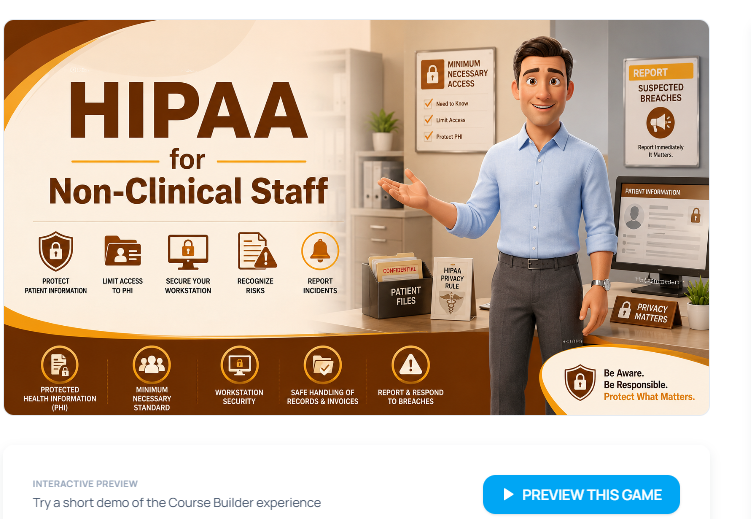
Preview the HIPAA training experience: Explore interactive, scenario-based learning designed to help non-clinical healthcare staff protect patient information, follow HIPAA requirements, and respond appropriately to potential breaches.
Test Your HIPAA Knowledge
See how interactive, scenario-based learning can turn HIPAA concepts into practical decisions. Try a quick True or False game designed for healthcare employees.
Preview This GameWhat HIPAA Training Looks Like in the Real World
The difference between passive compliance training and useful compliance training often comes down to one thing: does the learner have to make a decision?
Instead of asking "What is PHI?", a scenario-based course can ask:
Scenario 1: The patient information request A caller says: "I'm the patient's spouse. Can you tell me whether they're still in the hospital?" The employee must determine the appropriate response based on the organization's procedures. The learning objective isn't simply memorizing a definition. It is learning how to apply the organization's privacy procedure to a real request.
Scenario 2: The wrong recipient An employee realizes that patient information was sent to the wrong email address. The course asks: what should you do next? Possible decisions can lead to different explanations and escalation paths. The learner practices recognizing a potential incident and following the organization's reporting procedure.
Scenario 3: The unnecessary record access An employee has legitimate system credentials but opens a patient's record even though the information isn't required for their work. The learner has to distinguish between "I can access this record" and "I need to access this record to perform my job." That distinction makes the training relevant to actual workplace behavior rather than simply regulatory terminology.
Scenario 4: Suspicious communication A healthcare employee receives an email requesting patient information and containing an unusual link. The learner must decide whether to respond, open the link, forward the request, report it, or follow the organization's security procedure. OCR's HIPAA audit protocol specifically addresses security awareness training around topics such as malicious software, suspicious login activity and password practices.
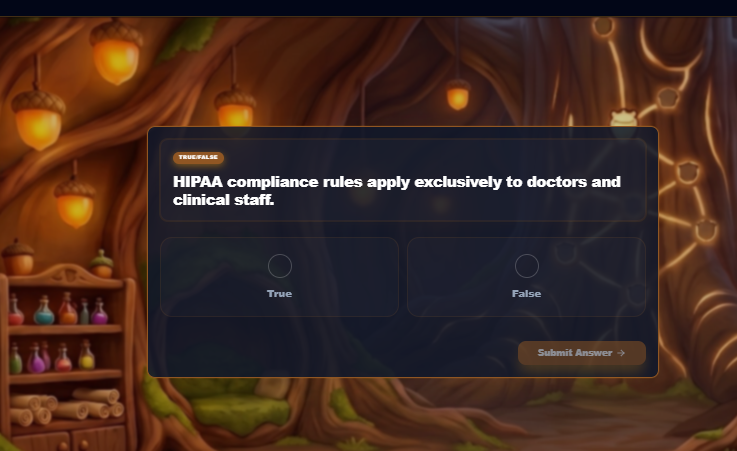
Test your HIPAA knowledge: A true-or-false interactive game helps employees reinforce key concepts around PHI, privacy, security, and HIPAA-compliant workplace practices.
From a HIPAA Policy Document to an Interactive Course
For many L&D teams, the hardest part isn't knowing that training is required. It is producing the training.
A compliance or privacy team may already have the source material: HIPAA policies, privacy procedures, security procedures, breach-response procedures, employee handbooks, communication policies, access-control procedures, organizational standards. But those documents aren't necessarily designed to teach employees. Someone still has to turn them into: policy, learning objectives, instructional content, scenarios, assessments, course, LMS package.
That's where an AI course authoring workflow can reduce the manual production work.
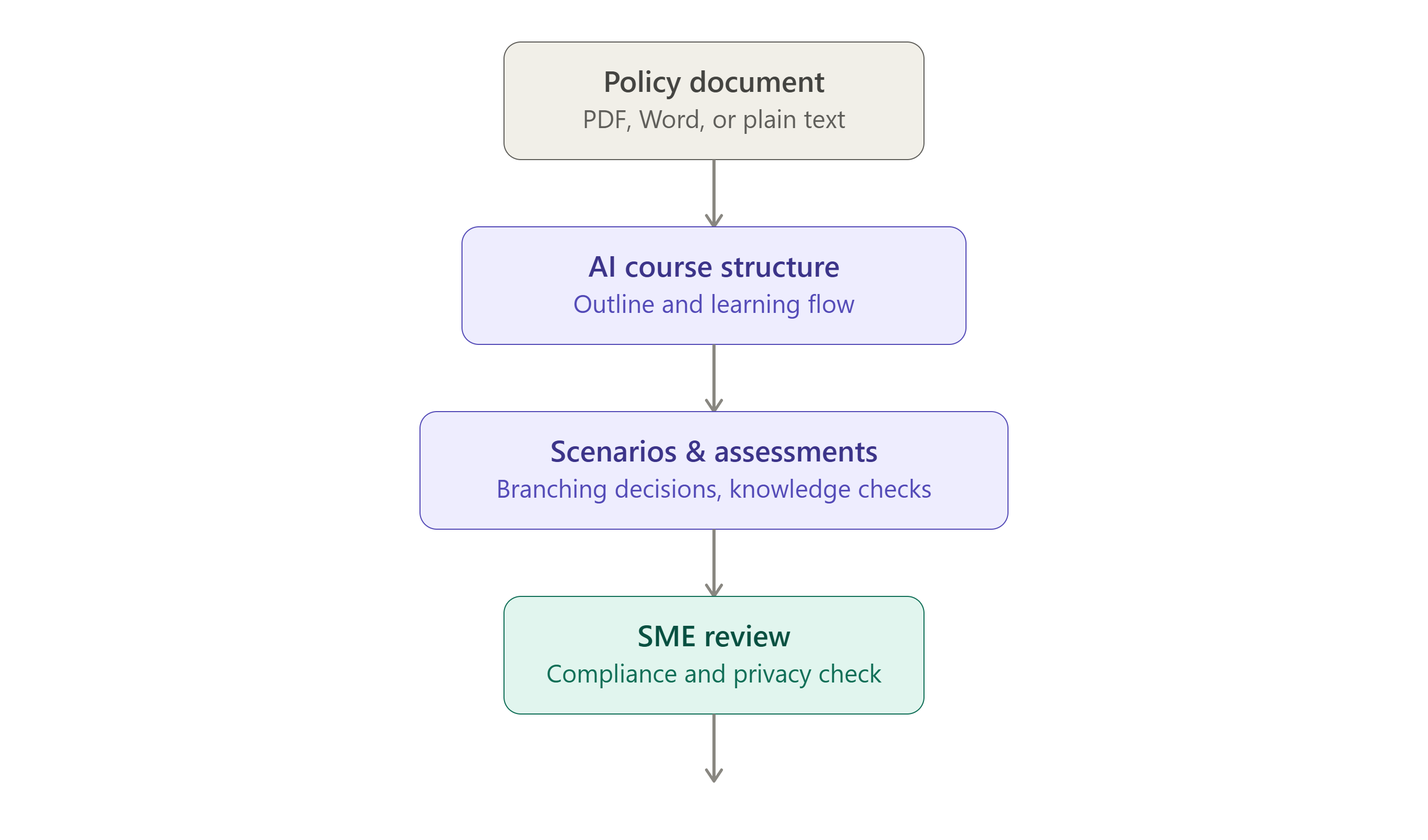
From policy to compliant learning: Kriya Stack converts policy documents into structured AI courses, scenario-based assessments, and SME-reviewed training content.
How the workflow works with Kriya Stack
Step 1: Start with the source material. Upload the organization's training content in supported formats such as PDF, Word or plain text. The source remains the basis for the course rather than requiring the L&D team to recreate the policy manually.
Step 2: Generate the course structure. Kriya Stack's AI can turn source content into a structured learning experience, helping create the course outline and learning flow.
Step 3: Turn rules into learning interactions. Instead of presenting every requirement as static text, the course can incorporate scenarios, branching decisions, knowledge checks, quizzes, interactive activities, video checkpoints, and assessments.
Step 4: Review before deployment. AI-generated content should not replace the organization's compliance, privacy or subject-matter review. A healthcare organization can review the generated training against its approved policies and procedures before publishing it.
Step 5: Publish to the LMS. Once approved, the course can be exported as SCORM 1.2 or SCORM 2004 and deployed through the organization's existing LMS.
Step 6: Track learner activity. Instead of treating completion as the only signal, Kriya Stack provides checkpoint-level analytics, including plays, unique learners, completion, scores and activity-level performance.
Where the time actually goes
The value isn't simply "AI creates a course." The bigger opportunity is reducing the number of manual steps between an approved policy and a deployable learning experience.
| Where time is spent | Traditional workflow | Kriya Stack workflow |
|---|---|---|
| Course design & scripting | Interpret policy, write outline and script from scratch, days to weeks per course | AI-generated structure and script from your uploaded source document |
| Scenarios & assessments | Designed and written individually | Generated from source content, then reviewed |
| Media | Coordinate external production | Generate checkpoints as needed |
| Packaging & deployment | Author and package manually, upload to LMS | Publish SCORM package, deploy through existing LMS |
| Tracking | Completion date only | LMS records plus checkpoint-level learning analytics |
The goal isn't to remove human judgment. The goal is to move human judgment to the parts that require it: accuracy, policy interpretation, instructional quality and approval, instead of spending that time rebuilding content mechanically.
Create Your Training
Convert PDFs or Word docs into interactive modules with quizzes, games, and scenarios using our AI-powered SCORM authoring tool in minutes. Used by training teams globally.
Build NowWhat Happens When a HIPAA Policy Changes?
This is one of the most important operational considerations for healthcare training teams. HIPAA training doesn't exist independently of organizational policies and procedures. If a relevant policy changes, the training may need to change with it. HHS specifically requires training for workforce members whose functions are affected by material changes to relevant policies or procedures, within a reasonable period after the change becomes effective.
Without an efficient authoring workflow: Policy changes, compliance reviews the change, L&D receives the revised policy, an instructional designer identifies affected content, the script is revised, scenarios and assessments are revised, an SME reviews the course, media is revised, the course is republished, the new version is uploaded to the LMS, and affected employees are reassigned. That can become a substantial production exercise.
With Kriya Stack: Policy changes, upload the revised source document, generate a new course version, review the changes with the appropriate SME or compliance team, publish the updated SCORM package, deploy through the LMS, and track completion of the updated training.
Kriya Stack does not replace the compliance review process. It helps reduce the content-production work required to turn an approved policy change into a new learning experience.
Ready-Made or Custom? Two Ways to Launch HIPAA Training
Not every organization needs to build its HIPAA training from scratch. Kriya Stack supports two approaches.
Option 1: Deploy a Ready-Made HIPAA Course For organizations that need training immediately, ready-made SCORM courses can be purchased and deployed without building a course internally. For example, Kriya Stack's HIPAA Compliance Training for Non-Clinical Staff is a video-based interactive SCORM course designed for non-clinical healthcare staff, including HR, billing, administration and reception roles.
Best for: new training programs, standard workforce training, non-clinical teams, organizations that need immediate deployment, and teams without time for custom course development.
Option 2: Build Custom HIPAA Training From Your Own Policies Organizations with their own procedures can use Kriya Stack's AI Course Builder to create a custom learning experience from their source material.
Best for: organization-specific procedures, role-specific training, internal privacy policies, custom breach-response procedures, healthcare networks with different workflows, and training programs that need regular updates.
This distinction matters because HIPAA training is not necessarily identical from one organization to another. The regulation establishes requirements, but an organization's internal policies, procedures, systems and workforce responsibilities determine how employees are expected to perform their jobs.
What Should a Healthcare HIPAA Training Program Cover?
A practical HIPAA learning path can combine regulatory concepts with the situations employees are most likely to encounter.
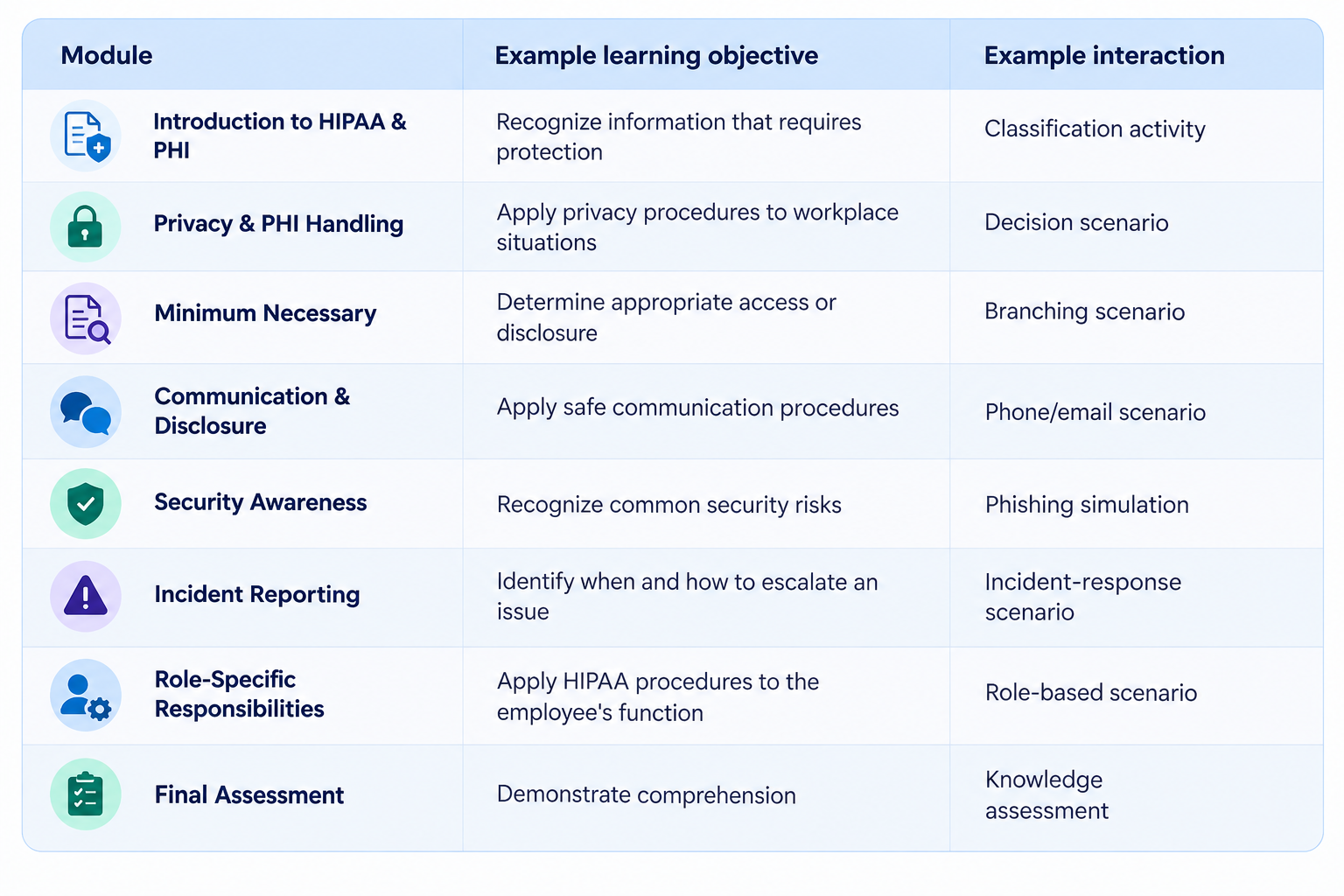
Example HIPAA training structure: Each module combines a clear learning objective with an interactive activity to reinforce practical compliance skills.
The exact curriculum should be aligned with the organization's policies, procedures, workforce functions and training requirements.
From "Completed" to "What Did the Learner Actually Do?"
For L&D teams, completion is necessary, but it isn't the entire learning story.
A traditional report might tell you: Employee: Jane Smith. Course: HIPAA Training. Status: Completed. Date: September 3.
An interactive course can provide additional learning information. For example: Employee: Jane Smith. Course version: HIPAA Training v2.1. Completion: September 3. Assessment: 92%. Scenario performance: 5/6. Knowledge check: 90%. Course status: Passed.
Kriya Stack's analytics include checkpoint-level information such as unique learners, completion, average score and per-activity performance. This doesn't mean that checkpoint analytics alone constitute HIPAA compliance documentation. It means the L&D team can have more learning evidence available alongside its LMS and organizational records than a simple completion checkbox.
What OCR Looks for in HIPAA Training
Healthcare organizations should not design training around trying to "pass an audit." They should design a training process that is defensible because it is actually connected to their workforce and policies.
OCR's audit protocol identifies several areas relevant to training, including:
- Whether workforce members receive required training
- Whether new workforce members are trained within the required timeframe
- Whether employees affected by material policy changes receive training
- Whether training is documented
- Whether security awareness training covers relevant organizational responsibilities
- Whether training materials are reviewed and kept current
The protocol also distinguishes between privacy, security and breach-notification requirements rather than treating HIPAA as one generic training topic.
A stronger L&D process therefore connects: policy, training requirement, affected workforce, learning content, review and approval, training delivery, completion and assessment records, and updated training when requirements change.
HIPAA Training Implementation Checklist for Healthcare L&D
Before launching or refreshing a HIPAA workforce training program, L&D teams can work through this checklist:
Workforce
- Identify workforce groups that interact with PHI
- Identify different PHI touchpoints by role
- Identify new-hire training requirements
- Identify contractors or other workforce populations that need training
Content
- Review current HIPAA policies and procedures
- Identify organization-specific requirements
- Map training content to workforce functions
- Add realistic workplace scenarios
- Add knowledge checks and assessments
- Define passing requirements
Review
- Have compliance/privacy SMEs review the content
- Confirm scenarios reflect actual organizational procedures
- Confirm terminology and escalation paths are correct
- Approve the final course before deployment
Deployment
- Publish the course in the required LMS format
- Assign training to the appropriate workforce groups
- Set completion requirements
- Monitor learner progress
Documentation
- Maintain training records
- Track course/version information
- Retain relevant assessment/completion information
- Document training associated with material policy changes
Continuous improvement
- Review training when policies change
- Update training when workforce responsibilities change
- Review learner performance
- Identify recurring knowledge gaps
- Publish new course versions when appropriate
How Kriya Stack Fits Into the HIPAA Training Workflow
Kriya Stack isn't a HIPAA compliance program. It is the learning creation and deployment layer that can sit between your organization's approved source material and the LMS.
Kriya Stack supports AI-assisted course creation from documents, interactive learning formats, SCORM publishing and analytics in one workflow.
Need help with designing trainings?
A 15 minute walkthrough is all it takes to change the way you create your trainings
Book DemoThe Bottom Line
HIPAA training is not difficult because healthcare organizations lack policies. It is difficult because policies have to become learning experiences that work for different people, different roles and different workplace situations, and those learning experiences have to stay aligned with changing organizational procedures.
A strong HIPAA training program needs more than a quiz and a completion certificate. It needs role-relevant content, realistic decision-making scenarios, knowledge checks and assessments, organization-specific procedures, human compliance/SME review, LMS-compatible deployment, training documentation, and a practical process for creating updated course versions.
Kriya Stack helps healthcare L&D teams move from policy documents to deployable interactive training without rebuilding every course manually. Start with a ready-made HIPAA course when you need immediate deployment. Or upload your own training material and use the AI Course Builder to create a custom learning experience around your organization's policies and workforce.
Continue Exploring HIPAA & Healthcare Training
HIPAA training is one part of a broader healthcare learning and compliance program. Depending on your workforce, risks, and training requirements, you may also need training covering cybersecurity, insider threats, access management, phishing awareness, and other workplace responsibilities.
Need HIPAA Training for Your Entire Workforce?
Whether you need ready-made HIPAA training or want to build courses around your organization's own policies, Kriya Stack helps you create, deploy, and track interactive learning at scale.
Need training for a large workforce or multiple locations? Contact us for bulk pricing and volume licensing options.
Train Your Entire Workforce at One Flat Price
Scale HIPAA training across teams, locations, and shifts with one flat price and unlimited learners, no per-user licensing costs.
Get Bulk PricingRelated Training
Explore additional training that can complement your HIPAA program:
- HIPAA Compliance Training for Non-Clinical Healthcare Staff — Interactive training for HR, billing, administration, reception, and other non-clinical roles.
- Healthcare Insider Threat Awareness & HIPAA — Build awareness around inappropriate access, data handling, and insider-risk situations.
- Advanced Social Engineering & Phishing Awareness Training — Strengthen employee awareness of phishing and social engineering risks.
- Password & Access Management Training — Reinforce secure password, account, and access practices.
- Cybersecurity Awareness Training — Broader security awareness training for healthcare and other organizational environments.
Sources & Further Reading
- HHS/OCR HIPAA Audit Program
- 45 CFR §164.530 — Administrative Requirements (Training)
- HHS HIPAA Privacy Rule guidance
- HHS HIPAA Security Rule guidance
- HHS OCR HIPAA Enforcement Highlights
- IBM Cost of a Data Breach Report 2025
Important: HIPAA training requirements depend on the organization's status, applicable HIPAA provisions, workforce functions and policies. This page is educational content, not legal advice.
FAQ
Frequently asked questions
HIPAA training teaches healthcare workforce members how to protect protected health information (PHI), follow organizational privacy and security policies, handle disclosures appropriately, and respond to potential incidents. Training should be appropriate to employees’ functions and responsibilities
Yes. Covered entities must train workforce members on policies and procedures relating to PHI as necessary and appropriate for their functions. New workforce members and employees whose functions are affected by material policy changes must also receive applicable training within a reasonable period, and the training must be documented
HIPAA does not establish a universal annual training interval under the Privacy Rule. It requires training for new workforce members within a reasonable period and for employees affected by material changes to relevant policies and procedures. Organizations may establish their own recurring training schedules based on their policies, risks, and operational requirements.
A practical HIPAA training program can cover PHI identification and handling, privacy and disclosure practices, minimum necessary access, secure communication, workstation and information security, incident reporting, breach awareness, and role-specific responsibilities. The exact curriculum should reflect the organization's policies and workforce functions.
Yes. HIPAA training should be aligned with the functions employees perform and the PHI they access. Nurses, physicians, receptionists, billing teams, HR staff, IT administrators, and contractors may encounter different privacy and security risks, so role-specific scenarios can make training more relevant and actionable.
HIPAA SCORM training is HIPAA compliance training packaged using the SCORM standard so it can be deployed through a compatible learning management system (LMS). SCORM packages allow organizations to assign training and receive learner activity and completion data through their LMS. Kriya Stack provides HIPAA training in SCORM format for LMS deployment.
Yes. SCORM-based HIPAA training can be uploaded to a SCORM-compatible LMS and assigned to the appropriate workforce groups. This allows organizations to use their existing learning infrastructure rather than requiring employees to access training through a separate platform. Kriya Stack supports SCORM 1.2 and SCORM 2004 course publishing.
Kriya Stack offers flat-price, unlimited-learner options for eligible training, helping organizations avoid per-learner licensing costs when deploying training at scale. For bulk or workforce-wide requirements, contact Kriya Stack for bulk pricing .
No. Training is one component of a broader HIPAA compliance program. Organizations also need appropriate policies, procedures, safeguards, access controls, workforce practices, incident processes, and other required compliance measures. Kriya Stack provides a training authoring, deployment, and analytics platform; it does not itself make an organization HIPAA compliant.
Yes. Organizations can use their approved privacy, security, access-control, communication, and incident-response policies as the foundation for organization-specific training. Kriya Stack's Course Builder can help turn source documents into structured learning experiences, scenarios, assessments, and SCORM courses, with appropriate SME and compliance review before deployment.