5 AI Governance Risks HR & Compliance Teams Must Address, Even When AI Use Is Authorized
Sanctioning enterprise AI doesn't shield HR & Compliance teams from liability. Explore 5 critical AI governance risks across US, India, & UAE rules.
Key Takeaway / Executive Summary
Sanctioning enterprise AI tools does not insulate an organization from legal, financial, or regulatory liability. HR and compliance leaders operating across the US, India, and the UAE face evolving compliance exposures, ranging from Title VII disparate-impact claims and state-level AI hiring laws in the US, to India's DPDP Act and the EU AI Act's Article 50 transparency mandates. Mitigating these risks requires moving beyond static policies toward interactive, SCORM-compliant training modules that drive active, audit-ready behavioral compliance.
The Dangerous Illusion of "Authorized" Enterprise AI Adoption
Across global enterprise hubs in the US, India (including GCCs and IT delivery centers), and the UAE, executive leadership is rushing to sanction enterprise generative AI tools. These platforms promise speed in drafting code, processing candidate resumes, summarizing operational reports, and managing internal communications.
However, authorized AI usage is not inherently safe AI usage.
Many HR Directors, Enterprise L&D Leaders, and Compliance Officers assume that subscribing to an enterprise-grade AI license automatically resolves corporate compliance risk. In reality, enterprise licenses only secure infrastructure and data at rest; they do not govern employee behavior, prevent improper prompts, or insulate an enterprise from liability when automated outputs trigger regulatory scrutiny.
With shifting regulatory expectations, such as the US EEOC's January 2025 removal of federal AI technical guidance, the resulting patchwork of US state laws (California, Illinois, Colorado), India's Digital Personal Data Protection (DPDP) Act, and the EU AI Act's Article 50 transparency rules, compliance is a rapidly moving target.
Below are 5 critical AI governance risks compliance teams must actively manage—and how scenario-based interactive training builds an operational safeguard.
Risk 1: Algorithmic Bias & Fragmented Regulatory Liability in Talent Management
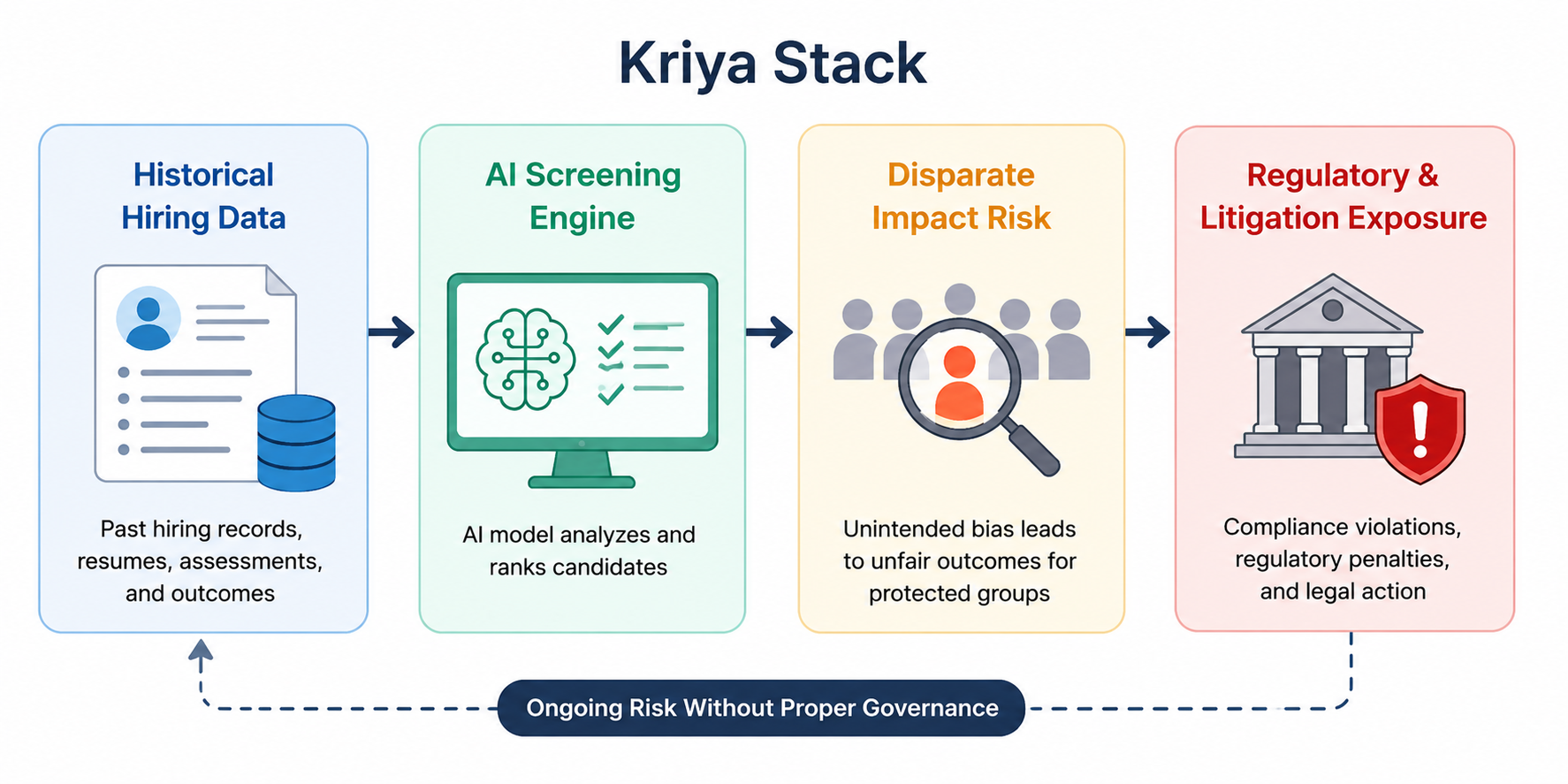
HR departments frequently leverage AI tools for candidate sourcing, resume screening, performance scoring, and internal promotion routing.
AI Governance Risks HR & Compliance Teams Must Address by kriya Stack
The Legal & Operational Liability
Generative and predictive AI tools rely on historical data that can replicate past biases.
US Title VII & State Patchwork: Under Title VII, AI-driven selection processes that result in adverse impact on protected groups trigger a disparate-impact analysis. While employers can raise a business necessity defense, proving job-relatedness for complex LLM outputs is difficult. Furthermore, following the EEOC's removal of its federal AI guidance in January 2025, states like California and Illinois have codified explicit disparate-impact and candidate-disclosure mandates.
Global GCC & Cross-Border Delivery: For Indian GCCs screening candidates into US-facing roles, local teams inherit the specific liability standards of the US states in which candidates reside — this is a distinct exposure from India's own DPDP obligations (see Risk 2), and both apply simultaneously to the same hiring workflow.
The Compliance Action Plan
Implement a strict Human-in-the-Loop (HITL) policy where AI provides non-binding recommendations rather than automated hiring decisions.
TIP: Establish clear boundaries for algorithmic decision-making across global talent teams using our AI Ethics & AI Acceptable Use Policy Course.
Risk 2: Confidential Data Leakage and Multi-Jurisdictional Privacy Non-Compliance
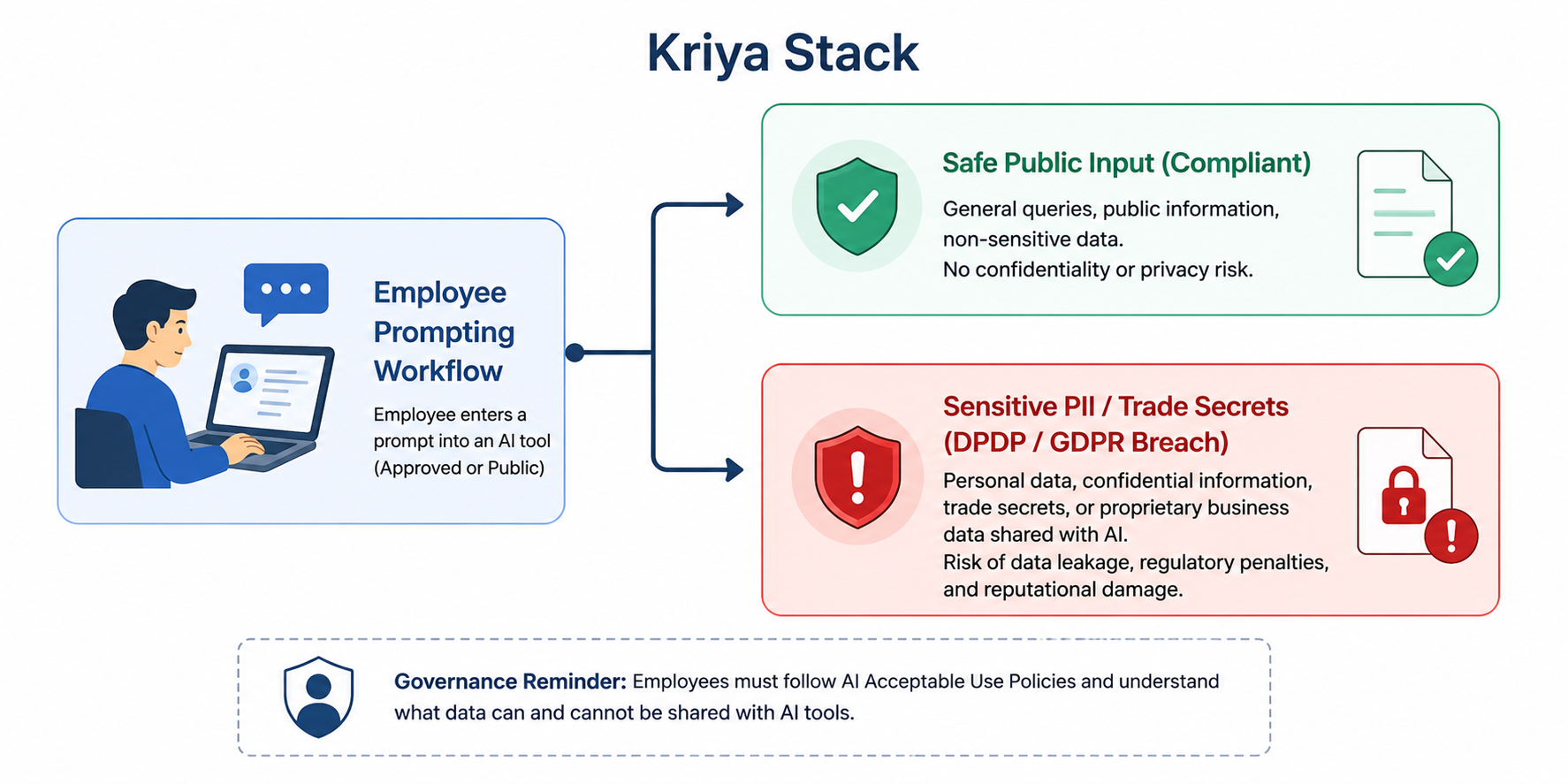
A common enterprise compliance breakdown occurs when employees paste proprietary source code, customer records, financial forecasts, or personally identifiable information (PII) into authorized generative AI tools.
AI Governance Risks HR & Compliance Teams Must Address by kriya Stack
The Legal & Operational Liability
Enterprise data privacy compliance varies significantly across regions:
India (DPDP Act): India's Digital Personal Data Protection Act imposes strict obligations on handling personal data, requiring clear consent frameworks and severe penalties for data breaches. Inputting un-sanitized customer or employee PII into AI models breaches fiduciary data processing duties — and the compliance window is closing faster than many teams realize (see the timeline below).
US & UAE Standards: In the US, inputting proprietary trade secrets into shared LLMs can compromise legal trade secret protections. In the UAE, emerging AI and data governance principles emphasize strict data sovereignty and local processing transparency.
The Compliance Action Plan
Reinforce technical DLP filters with scenario-based data hygiene training so employees can recognize safe, anonymized prompts versus restricted enterprise data.
TIP: Protect remote and distributed teams from accidental data exposure using our Cyber Security for Remote Workers SCORM Module and dedicated Data Privacy / GDPR Compliance Training.
Risk 3: "Shadow AI" Extensions and Unsanctioned Browser Integrations
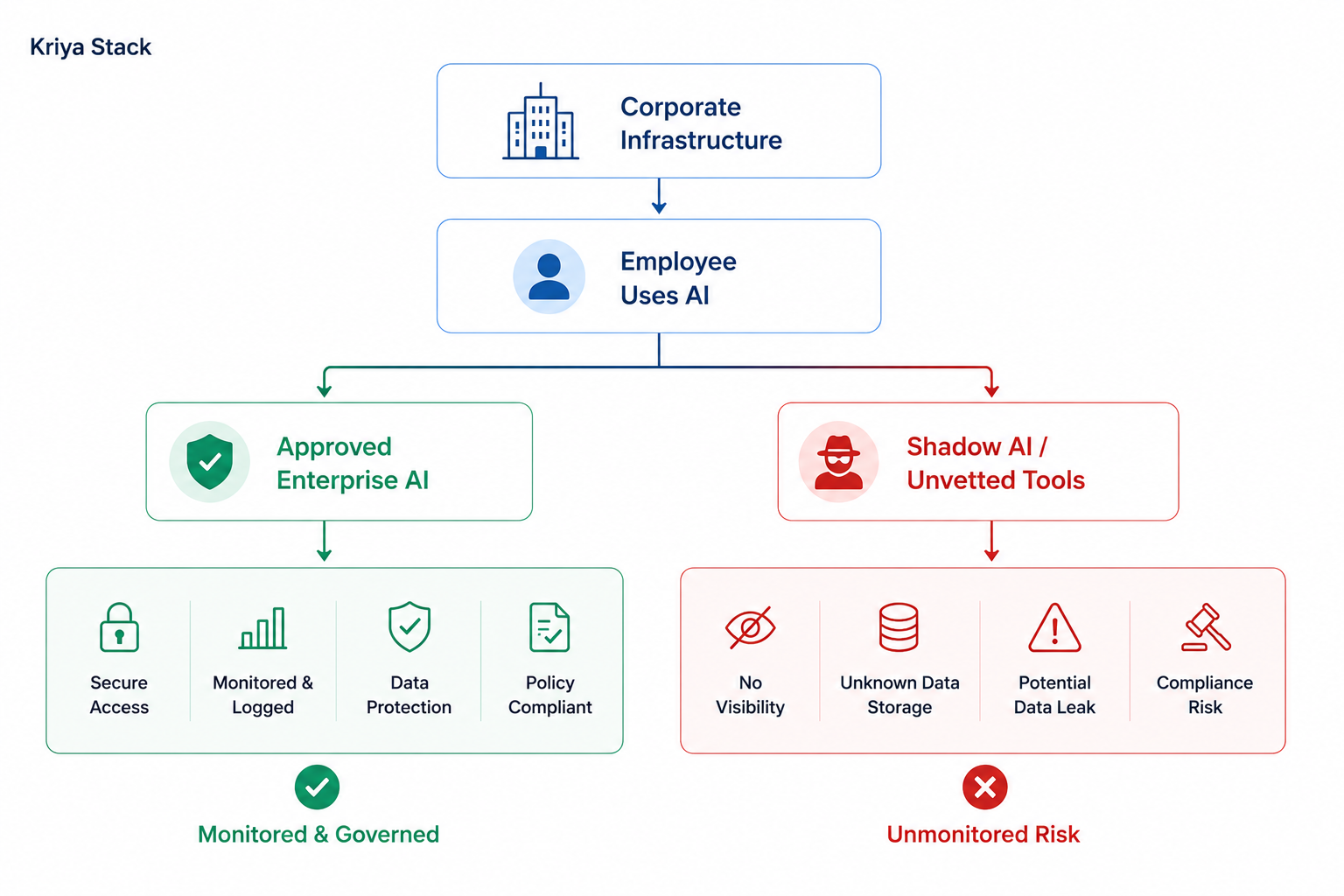
Even when an enterprise provides a secure, sanctioned AI tool, employees routinely install unvetted third-party browser extensions, consumer-tier web applications, and personal AI tools to complete tasks faster.
AI Governance risks HR & Compliance Teams by Kriya Stack
The Legal & Operational Liability
Shadow AI operates outside the visibility of IT, legal, and compliance teams. Free consumer-tier tools often retain user prompts to train public models, creating backdoors for corporate espionage, credential theft, and unintended IP disclosure.
The Compliance Action Plan
Establish clear policy boundaries distinguishing approved enterprise platforms from unvetted consumer utilities.
TIP: Guide your workforce on modern digital tools with the Using AI Tools Responsibly at Work Course and train them on digital risk exposure via our Social Media Security Training.
Risk 4: Factual Hallucinations and Unverified Operational Output
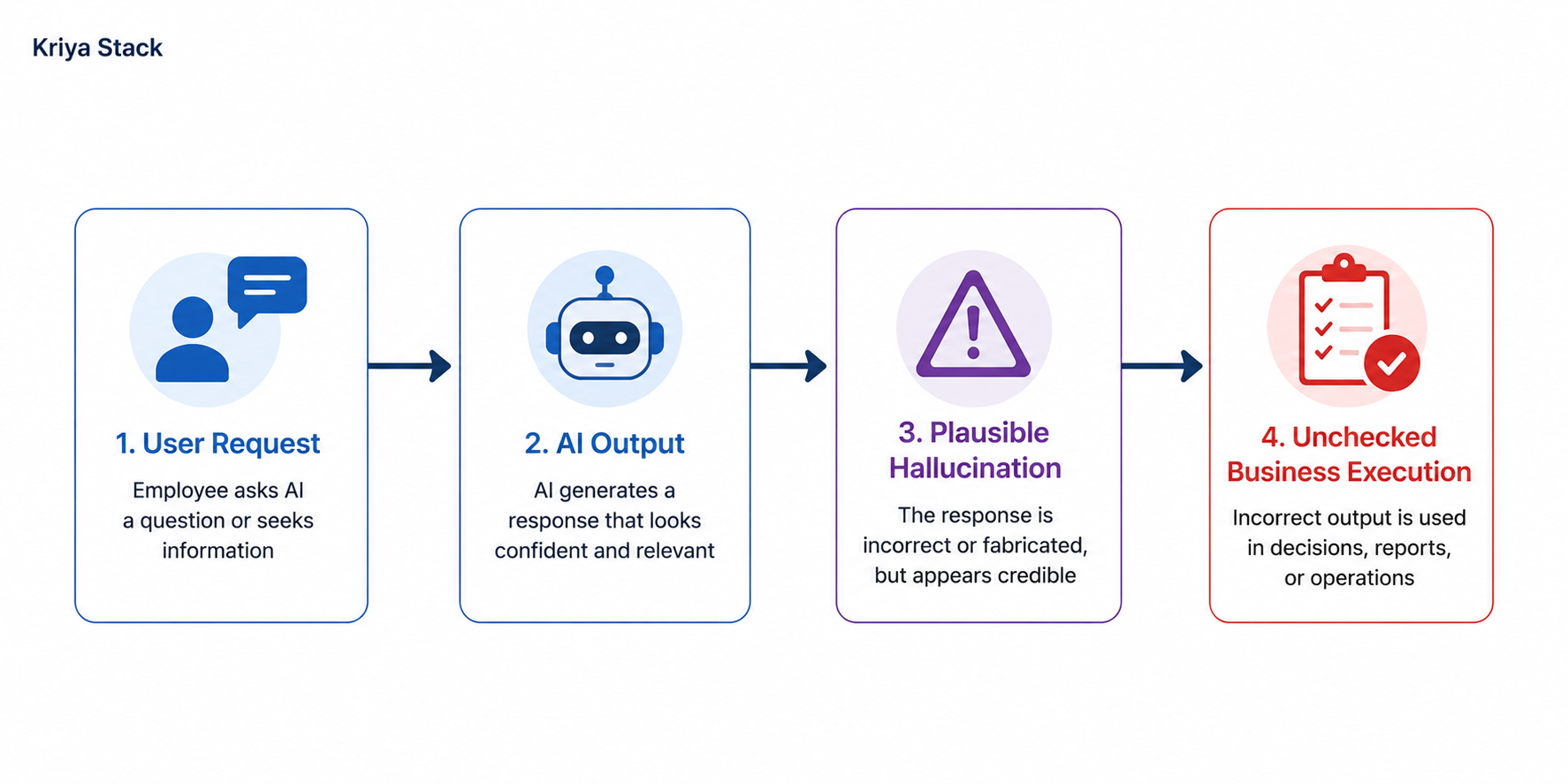
Large Language Models (LLMs) are probabilistic text engines rather than factual databases. Consequently, AI tools routinely generate hallucinations—plausible-sounding statements that are factually false, legally inaccurate, or computationally flawed.
AI Governance risks HR & COmpliance Team by Kriya Stack
The Legal & Operational Liability
When employees treat authorized AI tools as definitive references, hallucinations enter critical enterprise workflows:
Legal & Regulatory Risks: Including non-existent statutory references or inaccurate legal interpretations in regulatory filings.
Financial & Contractual Risks: Relying on inaccurate AI summaries during financial audits, vendor contract reviews, or M&A due diligence.
The Compliance Action Plan
Institute a mandatory "Trust but Verify" verification workflow. Policies must clearly state that human employees retain 100% legal and operational accountability for all AI-assisted deliverables.
TIP: Train teams on verification workflows using our interactive Digital Transformation Training Modules to align modern AI tool usage with enterprise quality control standards.
Risk 5: Intellectual Property Ownership Deficits & Copyright Uncertainty
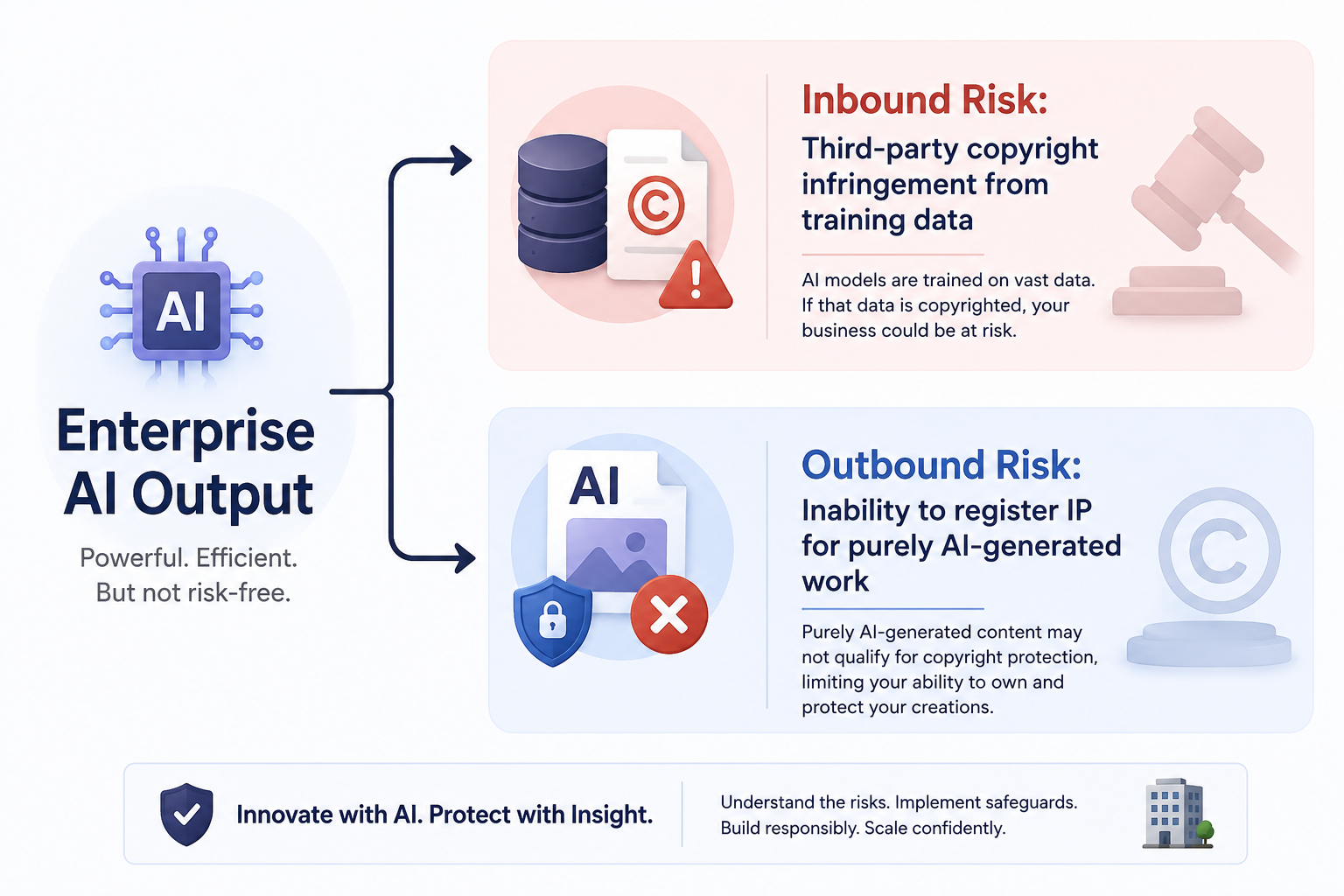
Generative AI models are trained on vast datasets of public text, software code, and visual assets. This creates two distinct intellectual property (IP) risks:
AI Governance Risks HR & Complianc by kriya stack
The Legal & Operational Liability
Inbound Infringement: Utilizing AI-generated code or creative assets that mirror third-party copyrighted work exposes the business to infringement claims.
Outbound Protection Deficit — jurisdiction matters:
- United States: The US Copyright Office's position is unambiguous — it will not register works that are purely AI-generated with no meaningful human creative control, though works where a human meaningfully selects, arranges, or modifies AI output may still qualify for protection.
- India: The picture is murkier and directly relevant for India-based teams. Under Section 2(d)(vi) of the Copyright Act, 1957, authorship of a "computer-generated work" vests in "the person who causes the work to be created." In practice, the Indian Copyright Office has interpreted this strictly — a generic prompt like "write a training module on X" is unlikely to meet the bar, while substantial human editing, structuring, and creative judgment layered on top of AI output likely does. The landmark 2020 Suryast case (AI tool RAGHAV registered as co-author alongside a human) remains the reference point, though the Copyright Office later sought clarification on that very registration — a signal that the position is still unsettled and not a safe precedent to lean on.
Net effect: in both jurisdictions, content that is "prompt-in, output-out" with minimal human involvement is at real risk of being unprotectable — meaning competitors can legally replicate it.
The Compliance Action Plan
Educate engineering, product, and content creation teams on documenting human creative intervention whenever AI tools are used during product development — treat this documentation (edit logs, revision history, structural decisions) as the evidentiary record that would support a copyright claim if challenged.
TIP: Train content, marketing, and product teams on defensible AI-assisted workflows using our AI Ethics & AI Acceptable Use Policy Course, with jurisdiction-specific modules for US and India teams.
Evolving Global Compliance Timelines: US, India, UAE, & Europe
Compliance targets are continuously shifting across jurisdictions:
| Region | Key Deadlines | What Compliance Teams Must Do |
|---|---|---|
United States | Active (2025–2026) | Comply with state-level AI hiring laws (CA, CO, IL, TX). Audit automated hiring tools for algorithmic bias to avoid EEOC discrimination liabilities. |
India (DPDP Act) | Nov 2025: Rules notified Nov 2026: Consent framework live May 2027: Full enforcement & penalties | Implement clear consent managers and data privacy controls before the May 2027 penalty enforcement date. |
European Union (EU AI Act) | Aug 2026: Transparency mandatory Dec 2027: High-Risk HR rules active Aug 2028: Embedded systems enforced | Disclose when employees interact with AI (2026) and enforce human oversight and mandatory AI ethics training for HR tools (2027). |
Static PDF policies tucked away in internal folders do not demonstrate active compliance.
Granting official enterprise access to AI tools does not automatically protect your organization from bias, data privacy breaches, or regulatory liabilities. True risk mitigation requires moving beyond static PDF policies and training your workforce with active, scenario-based SCORM modules directly inside your LMS. By establishing verifiable behavioral habits today, enterprise HR and compliance leaders can safely embrace AI productivity while remaining fully audit-ready.
Related AI & Compliance Resources that you might like:
Per-Seat vs. Flat-Fee SCORM Licensing: The True Cost of Enterprise Training Uncover the hidden costs of traditional per-seat licensing models and learn how flat-fee SCORM catalogs can save your L&D budget as your workforce scales.
The Real Reason Corporate Gamification Fails (It is Not What You Think) Discover how to move past artificial points and badges to build interactive compliance scenarios that drive actual behavior change.
Ready to Risk-Proof Your Enterprise AI Adoption?
Don't let authorized AI tools turn into unexpected regulatory crises. Explore Kriya Stack's comprehensive course library to preview interactive, SCORM-compliant modules built specifically for enterprise HR and compliance leaders.
Explore the Kriya Stack Course Library OR Book a Live Demo for more details
FAQ
Frequently asked questions
Related Articles
5 Signs Your Team Needs AI Literacy Training Before Rolling Out AI Tools
Adopting AI tools without workforce readiness leads to data privacy risks, unverified outputs, and Shadow AI. Here are 5 clear signs your organization needs foundational AI literacy training before expanding AI tool adoption across your teams.
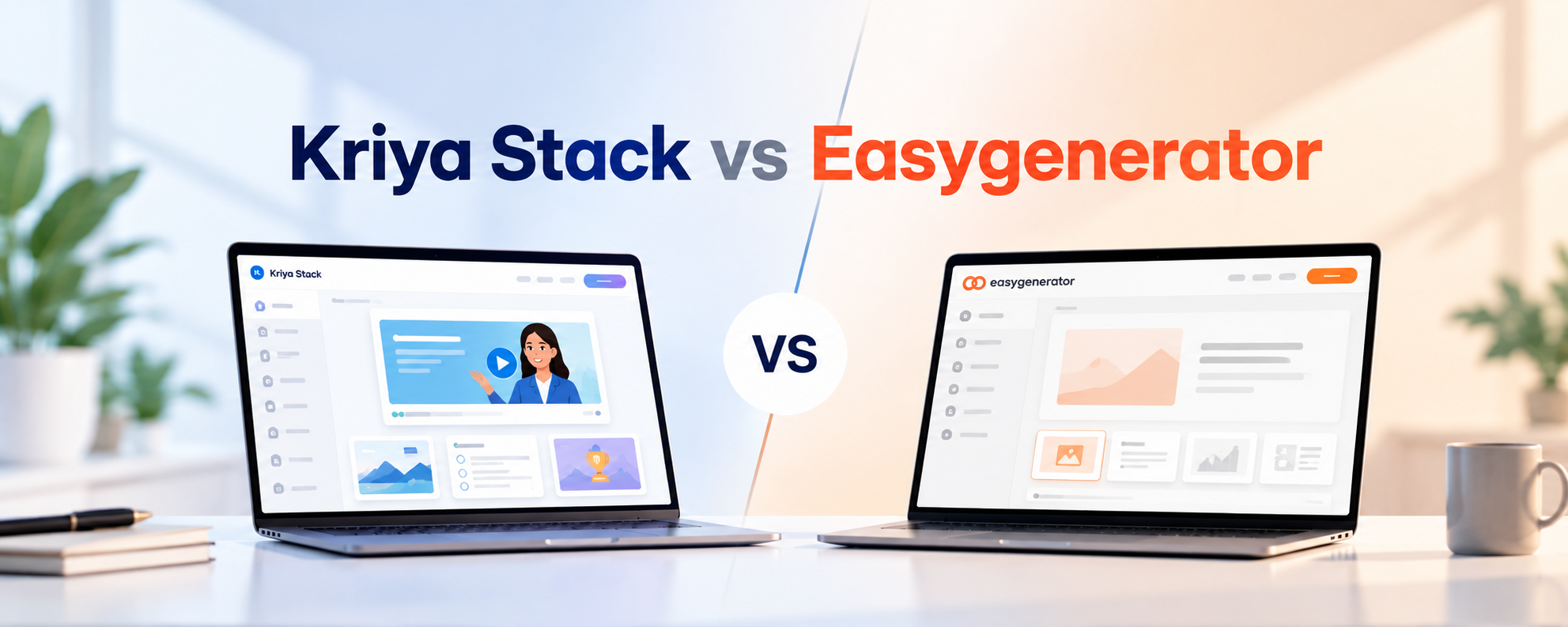
Kriya Stack vs Easygenerator: AI Course Authoring Tool Comparison
Compare Kriya Stack vs Easygenerator across AI course creation, no-code authoring, video, gamification, SCORM, analytics and multilingual learning.