Per-Seat vs. Flat-Fee SCORM Licensing: The True Cost of Enterprise Training
Per-seat licensing charges you every time you grow, rehire, or retrain. Flat-fee doesn't. Here's the real math on what each model costs at scale and the hidden operational costs that never make it onto the invoice
Key Takeaways
- Per-seat licensing charges per learner, per year so cost scales with headcount and turnover, even when the training content itself hasn't changed.
- Flat-fee licensing charges once per course, with no per-learner cap, cost per learner drops as you scale instead of rising.
- Beyond the sticker price, per-seat models carry hidden operational costs: unused license waste, tier-jump penalties at threshold headcounts, and ongoing administrative tracking.
- At small scale the two models can look similar. At 500+ learners, or with high turnover, the gap becomes the difference between a predictable line item and a recurring budget problem.
The Context: A Pricing Model You Inherited, Not Chose
Most L&D and HR teams evaluate training vendors on content quality and SCORM compatibility, and treat pricing as a single number to compare at the pilot stage. That works fine when you're licensing a course for 50 or 100 people. It stops working once training scales to a full department or company — because per-seat and flat-fee pricing don't scale the same way, and the divergence usually isn't visible until the renewal invoice arrives.
The two models are really two different bets. Per-seat pricing bets your headcount stays roughly flat. Flat-fee pricing bets it doesn't. For most growing organizations — especially in high-turnover functions like retail, ops, or customer service that second bet is the safer one.
How the Two Models Work
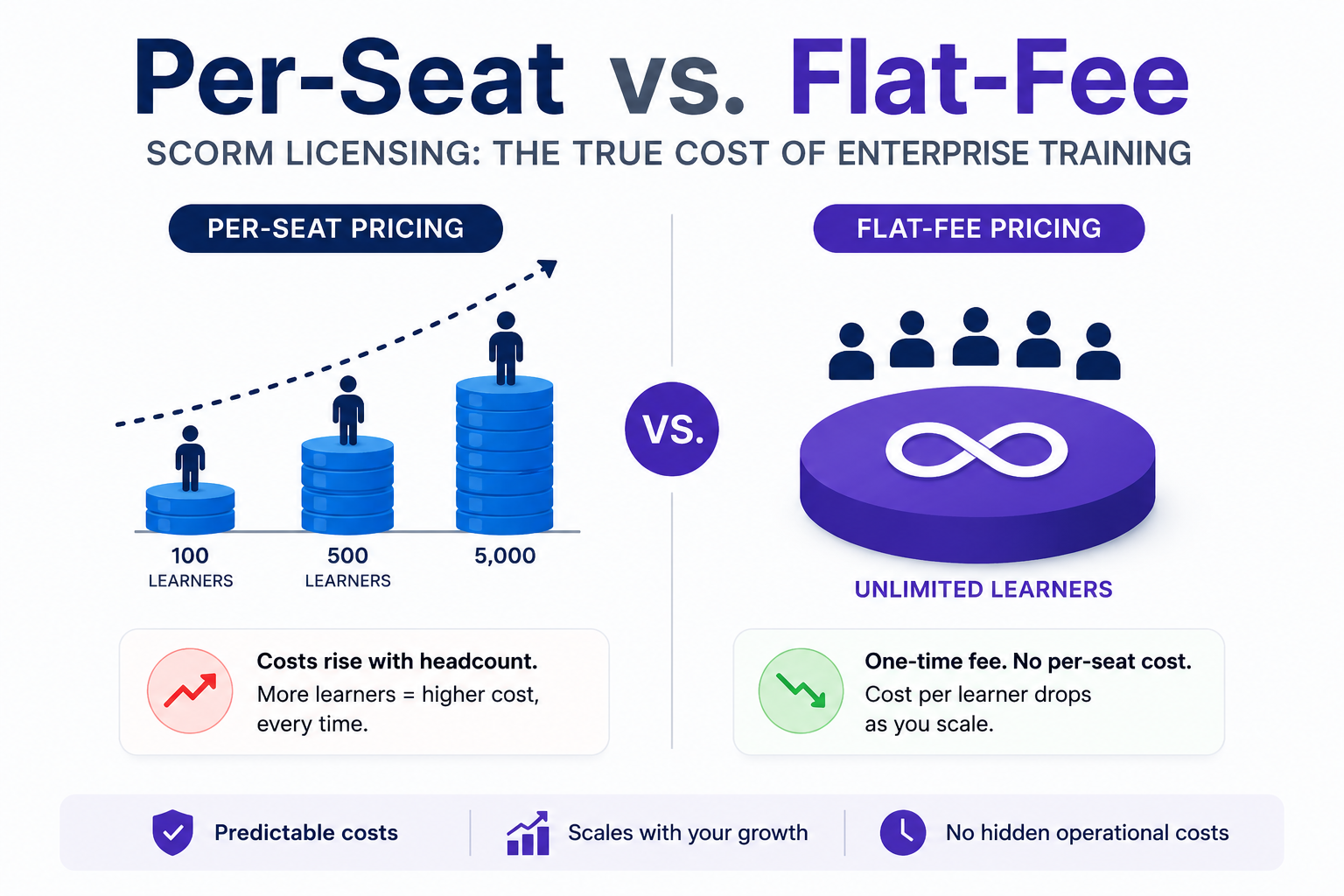
Per-seat (per-learner) licensing charges a fee for every individual assigned a course, typically renewed annually. The bill moves in lockstep with headcount: hire 100 people, and you're re-purchasing seats for all 100, whether or not you've bought any new content.
Flat-fee licensing charges once for a course license, with no per-learner cap. Every course in Kriya Stack's Course library like GDPR Compliance Training, Responsible AI Training, AI Literacy for non-technical employees, and others is priced once (currently ₹19,999, roughly $240 USD) and deployable to unlimited learners under that single license, whether 50 employees complete it or 5,000.
| Learners | Illustrative per-seat model (~$30/learner/yr | Kriya Stack flat-fee model |
|---|---|---|
100 | $3,000/yr | ~$240 (₹19,999), once |
500 | $15,000/yr | ~$240 (₹19,999), once |
5000 | $150,000/yr | ~$240 (₹19,999), once |
Illustrative industry-average rate, not a specific competitor's published price — actual per-seat vendor rates vary. The point is the direction each model moves as headcount grows, not the exact figure.
At 100 learners, per-seat can still look competitive, which is exactly why it gets chosen at pilot stage. The gap shows up at renewal, once the pilot succeeds and rolls out company-wide.
Which Model Actually Fits Your Situation
Not every organization is equally exposed to the per-seat penalty. A quick way to self-assess:
- Stable headcount, low turnover, single course → the two models may land close enough that other factors (content quality, support, integration) should decide it.
- High turnover roles (retail, ops, customer service, BPO) → flat-fee wins clearly, since per-seat models charge you again every time you replace someone.
- Seasonal or hiring-surge patterns → flat-fee avoids the scramble to buy ad-hoc seats mid-cycle, often at a premium outside the standard renewal window.
- Multi-entity or multi-region rollout → flat-fee removes the need to negotiate separate seat tiers per subsidiary or office, since one license covers all of them.
- Company-wide compliance mandate (train everyone, not a subset) → this is where per-seat pricing is most punishing, since "everyone" is exactly the headcount per-seat models charge the most for.
If two or more of these apply to your organization, the per-seat model is very likely costing you more than the sticker price suggests.
Three Hidden Costs Per-Seat Pricing Doesn't Put on the Invoice
- Unused seat waste. Buying a 500-seat tier for 320 actual employees means paying for 180 seats nobody uses.
- Tier-jump penalties. Many vendor contracts have hard thresholds crossing from 499 to 501 users can push the account into the next pricing tier and meaningfully increase the total bill.
- Administrative tracking. Someone has to audit active licenses, revoke seats for departed employees, and reconcile usage before each renewal time that flat-fee licensing removes entirely, since there's no per-seat count to manage.
Pro Tip: When comparing vendors, ask for pricing at three headcount scenarios: current size, 2x, and 5x, not just today's number. If a vendor can't give a straight answer for what training at 5x scale would cost, that's the answer.
Where This Plays Out in Practice
Flat-fee pricing matters most in the situations enterprise L&D teams hit most often: a compliance course that needs to reach everyone, not a subset; a hiring surge that temporarily spikes headcount; or a multi-entity organization deploying the same course across subsidiaries of very different sizes. Per-seat pricing turns each of these into a budget negotiation. Under a flat-fee license, the course costs the same whether it's deployed to one team or the whole company and there's no per-seat count to track or true up at renewal.
See flat-fee pricing in practice: Every course in the Kriya Stack library is priced once, unlimited learners, no per-seat renewals.
Stop paying more every time you grow, rehire, or retrain. Flat, unlimited-learner pricing on every course in the library with no per-seat fees, no renewal surprises. Browse the Course Library →
Off the Shelf Course Library
Launch engaging employee training in minutes with ready-to-deploy, interactive video courses built for corporate learning and seamless LMS integration.
Browse Course LibraryLooking to create your own training instead of buying ready-made? Course Builder uses AI-powered authoring to help you build SCORM-ready modules with quizzes, scenarios, and interactive elements. For more details you can Book a Demo or opt for Free Trial
Getting the most ROI out of your licensing model requires flawless technical deployment to your LMS. To ensure your packages track progress, completion statuses, and quiz scores accurately without technical glitches, check out ourcomplete SCORM export guide. If you are unsure which format fits your current Learning Management System infrastructure, read our detailed comparison onSCORM 1.2 vs. SCORM 2004to avoid common LMS reporting issues before deploying your courses.
Related Articles

7 Leadership Training Areas Every Manager Should Master
7 leadership training areas every manager should master, from delegation and feedback to psychological safety, conflict resolution, mental health and harassment prevention.

5 Signs Your Team Needs AI Literacy Training Before Rolling Out AI Tools
Adopting AI tools without workforce readiness leads to data privacy risks, unverified outputs, and Shadow AI. Here are 5 clear signs your organization needs foundational AI literacy training before expanding AI tool adoption across your teams.