
Third-Party Risk Training for Employees: A Practical Compliance Checklist
Learn how employees can identify third-party risks, spot suspicious vendor activity, protect sensitive data and follow a practical compliance checklist to strengthen your organisation’s risk management programme.
Key Takeaways
- Third-party risk extends beyond procurement: Employees across departments can expose organisations to vendor-related risks through everyday decisions.
- Recognise common warning signs: Suspicious payment requests, unusual access requests, unexpected emails and unauthorised data sharing require attention.
- Follow approved procedures: Employees should comply with vendor onboarding, data protection, cybersecurity and contractual requirements.
- Report concerns promptly: Clear escalation channels help organisations respond to potential incidents before they cause greater harm.
- Make training practical: Realistic scenarios, interactive knowledge checks and role-specific learning help employees apply policies at work.
- Measure more than completion: Assessment results, employee decisions and incident trends can help identify gaps in training effectiveness.
Why Third-Party Risk Awareness is Important For Your Organisation
Third-party relationships help organisations operate more efficiently. Businesses rely on vendors, suppliers, contractors, consultants and technology providers to deliver services, manage data and support everyday operations. But every external relationship can introduce risk.
An employee might share confidential information with an unapproved vendor, overlook a suspicious payment request or give a contractor access to internal systems without following the required process. These seemingly routine decisions can expose an organisation to cybersecurity incidents, data breaches, fraud, regulatory violations and reputational damage.
This is why third-party risk management cannot sit exclusively with procurement, legal or compliance teams. Employees who interact with external parties need to understand their responsibilities, recognise warning signs and know when to escalate a concern.
Third-party risk training helps employees understand what to look for, what actions to take and when to seek guidance. This guide covers the essential training areas, a practical employee compliance checklist and ways to build a more effective awareness programme.
What Is Third-Party Risk Management?
Third-party risk management (TPRM) is the process of identifying, assessing, monitoring and managing risks associated with external organisations that provide products or services to a business.
Third parties can include:
- Suppliers and service providers
- IT vendors and cloud service providers
- Contractors and temporary staff
- Consultants and professional advisers
- Outsourced business process providers
- Business partners, distributors and agents
The risks vary depending on the services provided, the information shared and the access granted. A supplier delivering office stationery, for example, presents a different risk profile from a technology provider processing customer information.
Third-party risk management typically involves vendor due diligence, risk assessments, contractual controls, ongoing monitoring and appropriate offboarding procedures. Employees support these controls by following approved processes, protecting information, identifying warning signs and reporting concerns.
Organisations can reinforce these responsibilities through Third-Party Vendor Risk Management Training, which is directly relevant to employee awareness of vendor-related risks.
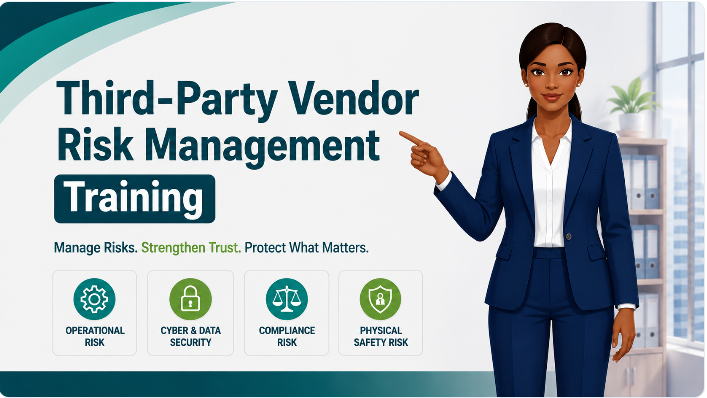
Third-Party Vendor Risk Management Training: Help employees identify vendor risks, strengthen compliance, and protect organisational trust.
Explore Third-Party Risk Training
Explore ready-made third-party risk, compliance and cybersecurity training courses to help your organisation manage vendor-related risks, protect sensitive data and strengthen compliance practices. Off the Shelf, video based Interactive training for yoir employees.
Preview HereWhy Do Employees Need Third-Party Risk Training?
Even a well-designed vendor management policy can fail if employees do not understand how it applies to their daily work.
Consider these situations:
- A marketing employee sends customer information to a new agency without confirming whether sharing is authorised.
- A finance employee receives an urgent request to change a supplier's bank account details.
- A project manager gives a contractor access to internal systems without following the approval process.
- An employee accepts an expensive gift from a supplier involved in a contract decision.
- A team member notices a suspicious email from a familiar vendor but does not report it.
Each situation creates a potential risk, even if the employee has no intention of violating company policy.
Effective training helps employees understand organisational rules, practise making decisions in realistic situations and respond consistently when something appears suspicious.
Third-Party Risk Training Checklist for Employees
Organisations can use this checklist to assess whether their employee awareness programme covers the essential behaviours.
| Training area | What employees should know | Example of a warning sign |
|---|---|---|
| Vendor approval | Follow approved onboarding and procurement procedures | A colleague asks you to bypass mandatory approval |
| Data protection | Share information only through authorised channels | A vendor requests unnecessary customer records |
| Cybersecurity | Follow access, authentication and file-sharing rules | A vendor sends an unexpected login link |
| Fraud and payment security | Verify unusual financial requests through trusted channels | A supplier requests an urgent bank account change |
| Ethics and conflicts of interest | Follow rules on gifts, hospitality and conflicts | A vendor offers an expensive gift during contract negotiations |
| Contract compliance | Follow agreed terms and internal procedures | A vendor asks to use an unapproved subcontractor |
| Incident reporting | Recognise concerns and report them promptly | A vendor discloses a possible security breach |
| Ongoing monitoring | Flag significant changes and recurring issues | A supplier repeatedly fails to meet critical security requirements |
| Vendor offboarding | Follow access removal and information-handling procedures | A former contractor retains access to company systems |
This checklist should be adapted to the organisation's industry, risk exposure, internal policies and applicable legal requirements. It is an employee-awareness guide, not a replacement for formal third-party due diligence.
8 Essential Areas to Cover in Third-Party Risk Training
1. Vendor onboarding and approval procedures
Employees should know that engaging a new vendor is not simply a matter of finding a suitable supplier and agreeing on a price.
Depending on the organisation's process, a vendor may require procurement approval, due diligence, contract review or a security assessment before work begins.
Training should explain:
- How to request approval for a new vendor.
- Which teams must review higher-risk relationships.
- Why mandatory approval steps must not be bypassed.
- Where to find approved vendor lists and onboarding procedures.
Example: A project is running behind schedule, and a manager wants to hire a consultant immediately without completing the standard approval process. Employees should know how to raise the request through the approved route rather than creating an informal workaround.
2. Data privacy and confidential information
Third parties may need access to business information to deliver a service. That does not mean they should automatically receive everything they request.
Employees should understand how to handle customer records, employee information, financial data, confidential documents and intellectual property.
Training should cover:
- Sharing only information authorised for a specific purpose.
- Using approved file-sharing and communication channels.
- Checking recipients before sending sensitive documents.
- Following rules for access, retention and deletion.
- Escalating accidental disclosures or suspected data breaches.
Organisations handling personal data should align their training with applicable privacy obligations and internal data-handling policies.
Explore GDPR Compliance Training for a related learning topic covering data protection and privacy awareness.
3. Cybersecurity and access management
A third party may have access to company systems, applications, networks or information. If that access is misused or compromised, the consequences can extend beyond the vendor itself.
Employees should know how to:
- Follow approved procedures for granting or requesting vendor access.
- Avoid sharing passwords or authentication codes.
- Recognise suspicious links, attachments and unexpected login requests.
- Report suspected phishing or compromised vendor accounts.
- Follow offboarding procedures when vendor access is no longer required.
ISO 27001 Information Security Awareness Training is relevant to this area because it supports broader information security awareness.
Training should also make clear that employees must not approve unusual access requests simply because they appear to come from a familiar vendor.
4. Fraud, phishing and suspicious payment requests
Third-party relationships can create opportunities for fraud, bribery, conflicts of interest and improper financial arrangements.
Employees who work with suppliers, distributors, consultants or agents should understand the organisation's rules on gifts, hospitality, commissions, conflicts of interest and financial approvals.
Warning signs may include:
- An unexpected request to change bank details.
- Pressure to make a payment outside normal procedures.
- An offer of expensive hospitality during a procurement decision.
- A request to split invoices to avoid an approval threshold.
- An email asking for credentials or confidential information.
- A payment request involving unclear services or unusual intermediaries.
Employees should follow verification procedures and report concerns to the designated team rather than investigating independently or accusing someone of misconduct.
The Advanced Social Engineering & Phishing Awareness Training course is a useful related resource for building awareness of deceptive messages and social engineering tactics.
5. Contractual obligations and approved ways of working
Employees who manage day-to-day vendor relationships need to understand the boundaries established by contracts and internal policies.
For example, a vendor may be prohibited from using subcontractors without approval or from processing certain information outside an agreed environment.
Training should help employees recognise when a proposed change requires review.
They should know how to respond when a vendor:
- Requests broader system access.
- Changes its delivery process.
- Introduces a new subcontractor.
- Asks to use information for a different purpose.
- Requests an exception to an agreed procedure.
Employees should refer material changes to the appropriate contract owner, procurement team, legal counsel or risk function rather than making informal commitments.
Accurate documentation is equally important. Record Keeping and Documentation Training is relevant to helping employees understand the importance of maintaining appropriate records and following documentation procedures.
6. Incident reporting and escalation
Recognising a risk is only useful if employees know what to do next.
Organisations should provide clear instructions on how to report suspected incidents, policy breaches and unusual vendor behaviour.
Training should answer three questions:
- What should I report? Examples include suspected data exposure, suspicious payment requests, security incidents and potential conflicts of interest.
- Who should I contact? Identify the relevant reporting channel, such as information security, compliance, procurement or the incident response team.
- How quickly should I act? Explain the organisation's reporting timelines and emergency procedures.
Employees should not wait until they have proof of wrongdoing. If something appears suspicious, they should report it through the designated channel and preserve relevant information according to company procedures.
7. Ongoing vendor monitoring
Third-party risk does not end when a contract is signed.
A vendor's ownership, security posture, financial stability, subcontractors or service delivery may change over time. Employees who work with vendors may notice these changes before a formal review takes place.
Training should encourage them to flag:
- Recurring service failures.
- Unexpected changes in access requirements.
- Security concerns or suspicious activity.
- Requests that conflict with agreed procedures.
- Changes that may affect contractual or operational obligations.
Formal monitoring and reassessment remain the responsibility of designated risk owners. Employees contribute by reporting relevant observations promptly.
8. Vendor offboarding and termination
When a relationship ends, organisations need to manage access removal, information return or deletion, outstanding obligations and the transition of services.
Employees should understand that vendor offboarding is a controlled process, not simply the end of a project.
Depending on their role, they may need to confirm that access is no longer required, return company assets, transfer records or notify the relevant internal team.
Training should reinforce the importance of following documented offboarding procedures rather than assuming access and information will be handled automatically.
Strengthen Your Third-Party Risk Management Training
Help employees recognise vendor-related risks, follow compliance procedures and protect sensitive business information. Explore Kriya Stack’s ready-made compliance and cybersecurity courses to strengthen your organisation’s risk management programme.
Explore Course LibraryHow Should Organisations Deliver Third-Party Risk Training?
A checklist is useful, but distributing a document alone does not establish whether employees can apply the rules in practice.
A more effective programme combines policy awareness with realistic decision-making exercises.
| Training method | How it helps | Example |
|---|---|---|
| Short learning modules | Introduces key rules without overwhelming employees | A short introduction to vendor approval |
| Scenario-based learning | Lets employees practise decisions in context | Responding to an urgent bank account change request |
| Interactive knowledge checks | Tests understanding of common risks | Identifying which vendor request requires escalation |
| Role-specific training | Focuses on risks employees are likely to encounter | Additional exercises for procurement and finance |
| Refresher activities | Reinforces important behaviours over time | A short vendor-risk awareness challenge |
| Assessments and reporting | Helps identify gaps and guide follow-up training | Reviewing repeated mistakes in payment verification |
Training should reflect how employees actually work. A procurement specialist may need deeper coverage of due diligence and supplier oversight, while a general employee may primarily need to understand information-sharing rules and reporting procedures.
Organisations can also use realistic scenarios to test whether employees can distinguish between routine vendor requests and situations that require verification or escalation.
How to Measure Whether Training Is Working
Training completion is an important administrative measure, but it does not prove that employees can recognise and respond to third-party risks.
Organisations should consider tracking a combination of indicators:
- Training completion and assessment results.
- Performance on realistic risk scenarios.
- Recurring misunderstandings or incorrect decisions.
- Timeliness of incident reporting, where measurable.
- Patterns in vendor-related incidents and audit findings.
- Completion of corrective or refresher training.
These indicators should be interpreted in context. An increase in reported concerns, for example, may reflect improved awareness rather than an increase in underlying misconduct.
The goal is to identify where employees need clearer guidance, better procedures or additional practice.
Turn Third-Party Risk Policies into Practical Employee Training
Most organisations already have vendor management policies, cybersecurity requirements, data protection rules and reporting procedures. The challenge is helping employees understand how those documents apply to everyday decisions.
Kriya Stack helps organisations create interactive, scenario-based learning experiences from their training content. Teams can use quizzes, interactive activities and knowledge checks to reinforce important decisions, then deploy SCORM-ready modules through a compatible learning management system.
Explore the Compliance Training use case to learn how organisations can turn compliance requirements into structured employee learning experiences.
The objective is to make policies easier to understand, practise and apply, not simply to ask employees to read another document.
Final Thoughts
Third-party risk management depends on more than vendor assessments, contracts and compliance reviews. It also depends on the everyday decisions employees make when working with external organisations.
A practical training programme helps employees understand their responsibilities, protect information, recognise suspicious requests and report concerns through the correct channels.
Start by using the checklist in this guide to identify gaps in your current programme. Then tailor training to employee roles, reinforce the highest-risk behaviours and review performance regularly.
The objective is not to make every employee a third-party risk specialist. It is to help each person recognise the risks relevant to their role and take the right next step.
If you’re looking to build your own third-party risk training tailored to your organisation’s vendor policies, compliance requirements and internal processes, Kriya Stack’s AI-powered Course Builder can help you transform existing documents into interactive courses with quizzes, scenarios and engaging learning activities in minutes.
Export your courses in SCORM 1.2 or SCORM 2004 format to deploy them through your existing LMS and track learner progress.
Build Your Own Third-Party Risk Training
Have your own vendor policies, compliance requirements or risk management procedures? Use Kriya Stack’s AI-powered Course Builder to turn your documents into interactive training with quizzes, scenarios and engaging learning activities tailored to your organisation.
I want to create trainingRelated Resources
Third-party risk management is closely connected to cybersecurity, data protection and responsible technology use. Explore our guide to interactive cybersecurity training courses for employees to learn how organisations can strengthen employee awareness of security threats.
If your teams work with external AI tools or technology providers, our articles on AI governance risks for HR and compliance teams and Shadow AI in the Indian workplace offer further insights into managing technology-related risks and building responsible employee practices,
FAQ
Frequently asked questions
Training should use realistic examples of vendor impersonation, business email compromise, fraudulent invoice requests and changes to supplier bank details. Employees should practise verifying unusual requests through a trusted, independently obtained contact method rather than replying to the suspicious email or using the contact details provided in it. Training should also explain when to report suspected phishing or fraud and how to preserve relevant evidence.
Employees should not share the information until they have verified the request and confirmed that the disclosure is authorised. They should check the vendor's approved access, the business purpose and the organisation's data-sharing procedures. If the request appears unusual or exceeds the vendor's authorised access, employees should contact their manager, information security or compliance team. Any suspected unauthorised disclosure should be reported through the organisation's incident reporting process.
Yes. All employees need a baseline understanding of vendor-related risks, but the depth of training should reflect their responsibilities and level of access. Procurement teams may need to understand vendor onboarding and due diligence procedures; finance teams need to recognise payment fraud and suspicious invoice changes; IT teams need to understand vendor access controls and security incidents. Employees who manage contracts or sensitive information may require additional role-specific instruction.
Employees should follow the organisation's approved procedures and avoid authorising new subcontractors or data-sharing arrangements independently. They should refer the change to the designated vendor owner, procurement, legal, privacy or security team for review. Organisations should ensure that applicable contractual requirements, data protection obligations and security controls extend to relevant subcontractors before access or processing is approved.
Organisations can assess knowledge checks, scenario-based decisions, training completion, incident reporting patterns and recurring errors involving vendor processes. For example, a scenario can test whether an employee verifies an unexpected bank account change before acting. Results should be reviewed alongside incident and audit findings. Completion rates alone do not demonstrate that employees can recognise risks or follow the correct procedures.
Yes. Organisations can deploy SCORM-compatible third-party risk training through a compatible learning management system (LMS), allowing them to manage course assignments and track supported data such as completion status and assessment scores. SCORM 1.2 and SCORM 2004 are commonly used formats for this purpose. Actual reporting capabilities depend on the course configuration and the LMS. Organisations should verify that the required tracking data is supported before deployment.
Yes. Organisations can deploy SCORM-compatible third-party risk training through a compatible learning management system (LMS), allowing them to manage course assignments and track supported data such as completion status and assessment scores. SCORM 1.2 and SCORM 2004 are commonly used formats for this purpose. Actual reporting capabilities depend on the course configuration and the LMS. Organisations should verify that the required tracking data is supported before deployment.
Third-party risk training teaches employees how to recognise and respond to risks arising from relationships with vendors, suppliers, contractors and other external service providers. It commonly covers data protection, cybersecurity, fraud prevention, ethics, vendor approval and incident reporting.
The scope depends on the organisation's risk profile. Procurement, finance, IT, legal, compliance and vendor-management teams may need specialised training, while other employees should understand the policies and reporting procedures relevant to their work with external parties.
Related Articles

7 Leadership Training Areas Every Manager Should Master
7 leadership training areas every manager should master, from delegation and feedback to psychological safety, conflict resolution, mental health and harassment prevention.

5 Signs Your Team Needs AI Literacy Training Before Rolling Out AI Tools
Adopting AI tools without workforce readiness leads to data privacy risks, unverified outputs, and Shadow AI. Here are 5 clear signs your organization needs foundational AI literacy training before expanding AI tool adoption across your teams.