
7 Leadership Training Areas Every Manager Should Master
7 leadership training areas every manager should master, from delegation and feedback to psychological safety, conflict resolution, mental health and harassment prevention.
Why Managers Struggle When They First Step Into Leadership
A top performer is promoted on Monday. By Friday, she is doing her team's work on top of her own because explaining a task feels slower than finishing it herself. Feedback waits for the annual review. Two people stop speaking up in meetings. One of them starts quietly interviewing elsewhere. HR hears about none of it until the resignation letter arrives.
If you work in HR, L&D or people leadership, you have probably seen some version of this many times. The cause is rarely a bad manager. It is often a capable person who was given authority without the right management toolkit.
The research backs that up. Gallup estimates that managers account for at least 70% of the variance in team engagement, yet its 2025 global workplace report found that only 44% of managers say they have received management training.
This guide looks at seven everyday manager problems, the leadership training areas that can help address them, and what good management practice looks like. Where a ready-made course fits, it points to the matching course in the Kriya Stack Leadership library, but the advice stands on its own.
Why Leadership Training Matters for Managers
Most managers are promoted for technical results, not necessarily for people-management skills. The role they step into asks for different capabilities: delegating, giving feedback, handling conflict, noticing when someone is struggling, and making fair decisions about other people's careers. Few organisations teach these skills before the promotion happens.
The cost shows up at the top as well. Gallup's 2025 global report found that manager engagement fell from 30% to 27% in 2024 while engagement among individual contributors held flat, and it identified the decline in manager engagement as the main reason overall engagement slipped.
Gallup also reports that employer-provided training lifts manager thriving from 28% to 34%, and recommends training every manager to cut extreme manager disengagement in half. An overstretched, untrained manager cannot effectively engage a team, and the 70% figure shows how far that effect can travel.
What the Research Says About Manager Training
| Finding | Figure |
|---|---|
| Manager share of variance in team engagement | At least 70% |
| Managers who say they have received management training | 44% |
| Global manager engagement, 2023 to 2024 | Fell from 30% to 27% |
| Employees who received meaningful feedback in the past week and are fully engaged | 80% |
| Top-ranked of five team dynamics in Google's research | Psychological safety |
| Workdays lost each year to depression and anxiety | About 12 billion, costing nearly US$1 trillion |
| Weekly time per US employee spent dealing with conflict | 2.8 hours |
| Managers who feel skilled at conflict vs employees who agree | 31% vs 22% |
| Executive teams in the top vs bottom quartile for gender diversity: likelihood of outperforming financially | 39% higher |
| Workplaces in India that must set up a POSH Internal Committee | 10 or more employees |
Two of these figures need context. The CPP conflict study dates from 2008, so it is better used to show a pattern rather than a current estimate of the cost of conflict. The McKinsey finding is a correlation: companies with more gender-diverse executive teams were more likely to outperform, but the finding does not prove that diversity caused the outperformance.
The 7 Manager Challenges Leadership Training Can Solve
Each problem below follows the same pattern: what it looks like, what it can cost, and what good management practice involves. The corresponding training area is then linked to the specific capability managers need to develop.
1. New Manager Training: When Managers Do Everything Themselves
The new manager keeps the interesting work, redoes tasks that were delegated and works late to catch up. The team reads this as a lack of trust and gradually stops taking initiative. Delegation and coaching were never part of the job the manager was promoted from, so under pressure they fall back on what they know: doing the work themselves.
What helps is a small set of repeatable habits: handing over a task with a clear outcome and deadline, checking in without hovering, and asking questions instead of immediately supplying answers. Managers also need to become comfortable with the fact that someone else may complete a task differently without necessarily doing it incorrectly.
Management Training for New Managers covers delegation, coaching, feedback and psychological safety in one module. It is designed as a practical starting point for newly promoted managers and team leads.

Management training for new managers covering leadership, coaching and effective team management
Preview this training here: Management Training For New Manager
2. Feedback Training: When Feedback Only Happens at Review Time
A manager means well but saves feedback for the annual review. By then, the issue may be six months old and the employee is blindsided. Another manager avoids difficult conversations altogether because they are worried about damaging the relationship.
Gallup found that 80% of employees who had received meaningful feedback in the past week were fully engaged. It describes meaningful feedback as frequent, focused and future-oriented, often taking place several times a week.
That points to a habit rather than an event. Managers need a simple structure for short feedback conversations so they are not improvising under pressure, while employees also need to learn how to receive feedback without immediately becoming defensive.

Interactive workplace training on giving and receiving effective feedback using a practical Behavior, Impact and Next Step framework.
Preview Giving and Receiving Feedback Training that teaches the BIN framework for both sides of the conversation, making it relevant to individual contributors as well as managers.
3. Psychological Safety Training: When Nobody Speaks Up Until It Is Too Late
A junior engineer spots a flaw and says nothing. A sales representative hides a missed target until quarter-end. Problems surface late, when they are most expensive to fix.
In Google's research into what makes teams effective, psychological safety — the shared belief that you can take an interpersonal risk without being punished — ranked first among five team dynamics.
Psychological safety is built through what managers do in ordinary moments: asking for dissenting views, thanking people who bring bad news, admitting their own mistakes and encouraging constructive disagreement. It does not mean lowering standards.

Psychological safety in the workplace encourages open communication, constructive discussion and a culture where employees feel safe to share ideas and concerns.
Preview Psychological Safety Training for the Workplace that covers trust, open communication, active listening and constructive disagreement through interactive videos, games and a quiz. It can be used with whole teams rather than only managers.
4. Mental Health Training for Managers: When a Struggling Employee Goes Unsupported
A reliable team member starts missing deadlines and snapping in meetings. The manager notices but worries about overstepping, so they wait. WHO and ILO estimate that depression and anxiety cost about 12 billion workdays a year, representing nearly US$1 trillion in lost productivity.
Managers are not counsellors and should not try to become one. Their role is to notice a change, open a supportive conversation, point the employee toward available support and keep the connection going.

Mental health training for managers focused on employee well-being, supportive conversations and creating a psychologically safe workplace.
Preview Mental Health Training for Managers that builds a 4-Pillar Support Framework around exactly those moves: Notice, Listen, Support and Connect. The aim is not to turn managers into mental health professionals, but to help them recognise when something has changed and respond appropriately.
5. Conflict Resolution Training: When Small Disputes Become Big Ones
Two colleagues disagree about who owns a project. The manager hopes it will blow over. Weeks later, one avoids the other, meetings are tense and a third person has become the go-between.
CPP's study found that US employees spent 2.8 hours a week dealing with conflict, and that 31% of managers rated themselves as skilled at handling it while only 22% of employees agreed. Even allowing for the age of the study, the perception gap is useful: managers may believe they are handling conflict effectively while their teams experience the situation differently.
Conflict itself is not necessarily the enemy. In the same study, 81% of US workers had seen positive outcomes from conflict, with those outcomes linked to conflict management training.
Good conflict management means finding the root cause — whether that is workload, unclear roles or clashing working styles — hearing each side separately when appropriate, and then agreeing on concrete next steps.
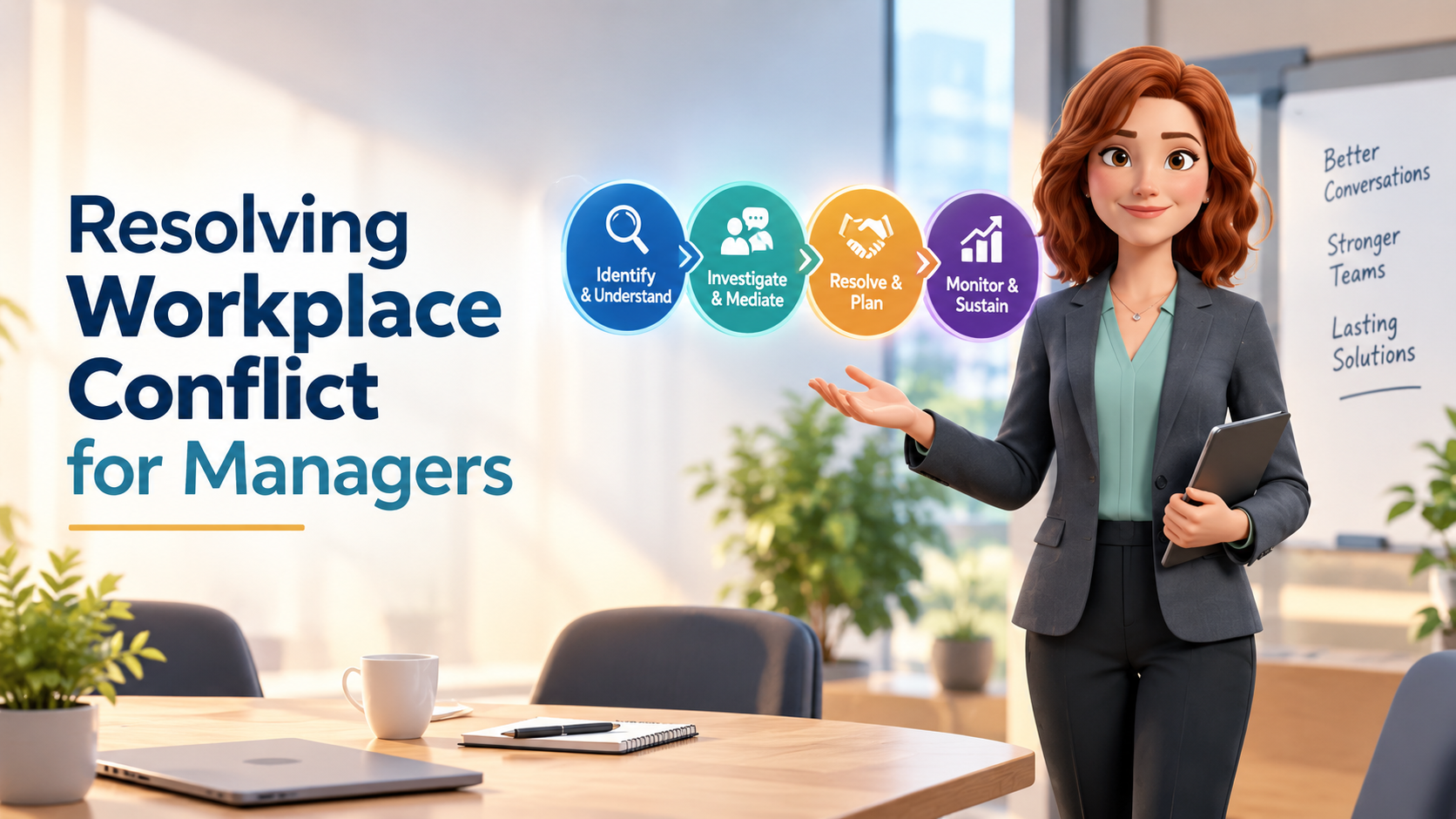
Interactive conflict resolution training for managers focused on identifying workplace conflict, investigating root causes, resolving disputes and sustaining solutions.
Preview Conflict Resolution Training for Managers which covers identifying root causes, mediation techniques and action planning.
6. Unconscious Bias Training: When Snap Judgments Shape Hiring and Appraisals
A hiring panel prefers the candidate who "feels like a good fit." Performance ratings drift toward the people a manager likes most, and stretch assignments go to the same few. None of this necessarily feels like bias from the inside, yet these decisions influence who gets hired, rated and promoted.
McKinsey's data links more diverse executive teams to a higher likelihood of outperforming. That finding is a correlation rather than proof of causation, but it provides a reason to look closely at how organisations make people decisions.
Good practice slows the decision down. Use the same criteria for every candidate, document evidence before the discussion, use structured interview scorecards and introduce a second perspective on important ratings. The goal is to make the process, rather than memory or instinct, carry more of the decision.
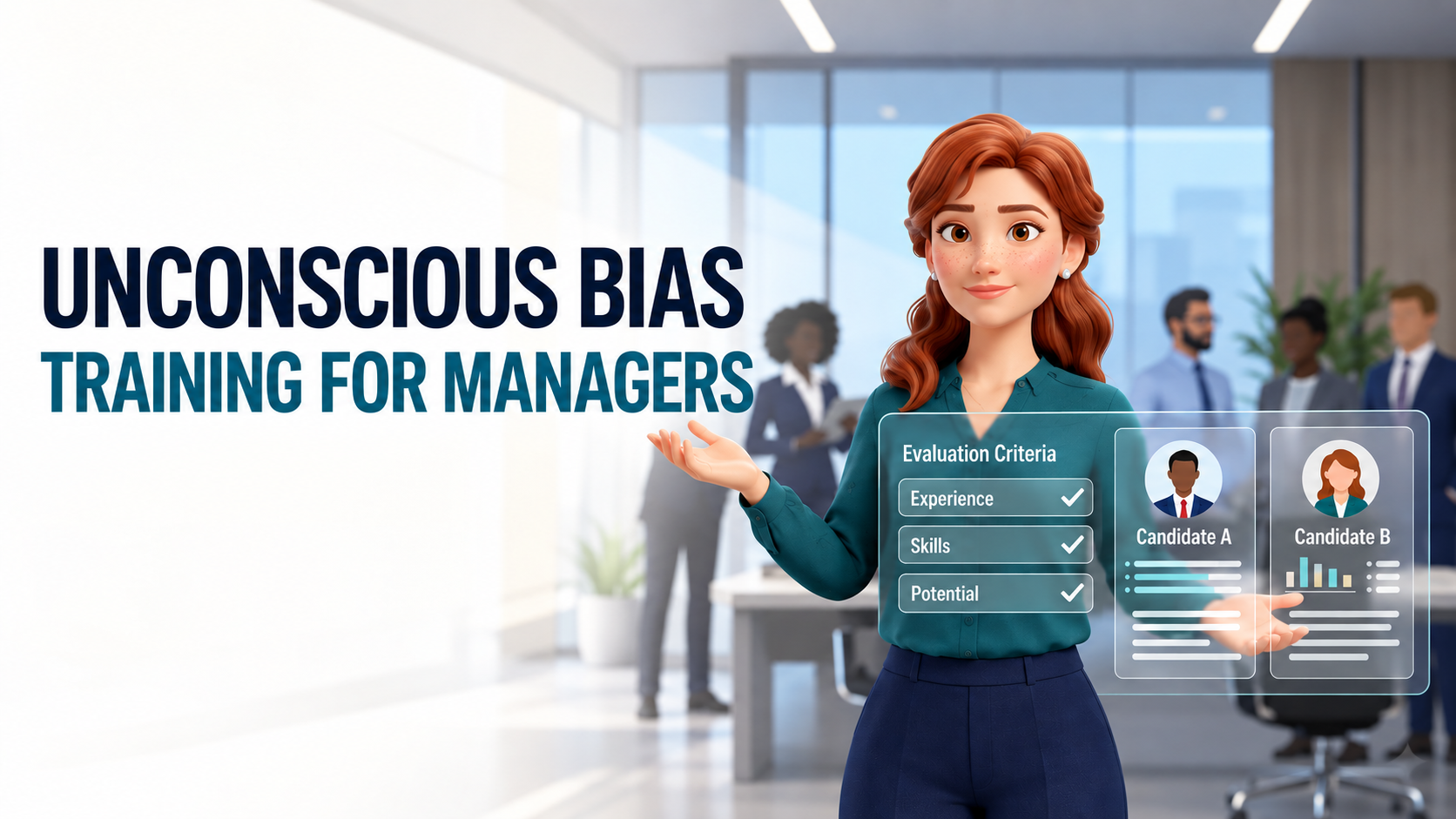
Unconscious Bias Training for Managers helps leaders recognize workplace bias and make fair, objective decisions based on skills, experience, and evidence.
Preview Unconscious Bias Training for Managers which gives managers, interviewers and HR teams a five-step process for making fairer decisions. Training should be treated as a starting point and paired with structured interview processes and calibrated performance reviews.
7. Harassment Prevention Training: When Misconduct Goes Unreported
Someone makes a "joke" in a team meeting. Colleagues look away. The manager is unsure whether it crosses a line, and the person on the receiving end does not know how, or to whom, to report it.
In India, the POSH Act, 2013 requires employers with 10 or more employees to establish an Internal Committee and sets requirements around workplace sexual-harassment prevention, awareness and complaints. The inquiry must generally be completed within 90 days, and non-compliance can attract penalties. The cultural cost of silence can be larger than the legal cost.
What helps is a shared understanding of unwelcome behaviour, clear reporting routes and employees who feel able to step in as bystanders.

Workplace Harassment Prevention and Professional Conduct training helps employees recognize inappropriate workplace behavior, promote respectful interactions, and build a safe and professional work environment.
Preview Workplace Harassment Prevention Training for Managers and Employees which covers recognising unwelcome behaviour, reporting safely and bystander action for employees and managers. A course supports an organisation's awareness programme but does not replace its policy or Internal Committee, so organisations should verify their specific obligations with qualified legal counsel.
How to Roll Out a Manager Training Program: 4 Steps for HR and L&D Teams
Training lands better when it answers a problem managers already feel. Rather than assigning every manager the same set of courses, HR and L&D teams can use existing organisational data to determine where training is most needed.
1. Start with your own signals. Pick two or three signals you already track, such as exit-interview themes, engagement pulse results by team, grievance or complaint counts, and how often managers hold one-to-ones. These can show which of the seven problems is costing your organisation the most.
2. Sequence training by need. Many organisations can begin with foundational capabilities such as new manager training and feedback, then move into team climate topics such as psychological safety and mental health. Higher-risk areas such as conflict, bias and harassment prevention can then be addressed ahead of the cycles where they matter most, such as hiring rounds and annual appraisals.
3. Space out the learning. One short module every fortnight can be easier to absorb than seven courses delivered in a single week. Ask each manager's own manager to raise the topic during one-to-ones, and use ten minutes in a team meeting to practise one skill from the training.
4. Measure after 90 days. Check completion and quiz scores in your LMS, then look at the signals from step one again. Look for changes in employee feedback, engagement, grievances, one-to-one frequency or other indicators relevant to your original problem. Judge the programme on those signals, not on completion alone.
Build or Buy: What's the Right Approach for Leadership Training?
Organisations don't have to choose between buying off-the-shelf training and spending weeks building courses from scratch. The right approach depends on how much customisation is needed and how quickly the training needs to be deployed.
For common management topics, ready-made courses can provide a faster starting point. The Kriya Stack Course Library offers self paced SCORM 1.2 courses with interactive videos, games and assessments that can be deployed directly through an existing LMS with a flat, unlimited-learner license.
Buy Off the Shelf Trainings For Your Organisation
Launch engaging employee training in minutes with ready-to-deploy, interactive video courses built for corporate learning and seamless LMS integration.
Explore Leadership TrainingsFor organisation-specific training, teams can use the Kriya Stack Course Builder to create their own courses in minutes. Instead of starting with a blank authoring tool and building every element manually, teams can turn their existing training content, documents or subject-matter expertise into structured, interactive learning experiences and customise them for their organisation.
The two approaches can also work together. Use ready-made courses for common leadership and compliance topics, and use the Course Builder when you need training built around your own policies, processes, products, systems or leadership framework.
Explore Kriya Stack Course Builder
Where to Start Your Leadership Development Program
You do not need all seven leadership training areas at once. Start with the management problem your own data points to, run one course with a pilot group of managers and learn what works before you scale.
If newly promoted managers are struggling with delegation, start with new manager training. If feedback is consistently delayed, begin with feedback training. If employees are reluctant to speak up, psychological safety may be the better starting point. If managers are struggling to respond when employees show signs of difficulty, mental health training can provide a practical framework.
The same principle applies to conflict, bias and harassment prevention: start with the problem, then select the training that addresses it.
You can preview the relevant courses in the Leadership category of the Kriya Stack Course Library or book a demo to see how they run in your LMS.
Sources
This version preserves the original article's substance while fixing the reading flow and heading hierarchy.
Related Articles

5 Signs Your Team Needs AI Literacy Training Before Rolling Out AI Tools
Adopting AI tools without workforce readiness leads to data privacy risks, unverified outputs, and Shadow AI. Here are 5 clear signs your organization needs foundational AI literacy training before expanding AI tool adoption across your teams.

Soft Skills Training for Employees: Types, Courses, and How to Build a Program in 2027
A practical guide to soft skills training for employees, what counts as training, which skills to prioritize, and how to choose between ready-made courses and custom programs.