
EHS Compliance Training Built for Manufacturing Plants
Interactive SCORM safety training for lockout/tagout, HazCom, and permit-to-work that reduces floor incidents and builds audit-ready compliance.
Key Takeaways
- Elevated Risk: Manufacturing TRIR (~3.4) exceeds the private-industry average (~2.7), with average injury costs around $40,000 per incident.
- Three Core Failure Points: Generic content, weak audit trails, and inconsistent contractor onboarding weaken safety programs.
- Scenario-Based Retention: Interactive decisions build practical floor judgment better than static slides or lectures.
- LMS Compatibility: SCORM packages deploy into existing platforms (Workday, Cornerstone, SAP) without software migrations.
- Audit Defense: Checkpoint analytics generate verifiable completion and response records automatically.
EHS Compliance Training Built for the Realities of the Manufacturing Floor
A manufacturing safety incident rarely traces back to a worker who didn't care. It traces back to a worker who wasn't trained the way the job actually happens — under time pressure, around moving equipment, with a supervisor two stations away and a checklist nobody had time to read twice.
Manufacturing carries one of the highest injury burdens of any sector in the United States. According to OSHA's data, workers in manufacturing face an elevated risk of serious injury compared to most other industries, and the sector consistently ranks among the highest for total recordable incidents. The Bureau of Labor Statistics estimates the all-private-industry Total Recordable Incident Rate (TRIR) at roughly 2.7, with manufacturing running significantly above that average, closer to 3.4. Every one of those incidents carries a direct operational and financial cost. The National Safety Council estimates the average workplace injury costs employers around $40,000 once medical expenses, lost productivity, and downtime are accounted for.
None of that is inevitable. It's a training problem, and it's a solvable one.
The Compliance Gap Most Manufacturing Teams Don't See Coming
EHS (Environment, Health & Safety) compliance in manufacturing isn't one training requirement — it's a stack of overlapping obligations:
- Hazard Communication Standard (HazCom): Ensuring workers recognize chemical hazards, SDS sheets, and GHS pictograms.
- Lockout/Tagout (LOTO): Controlling hazardous energy during maintenance or servicing.
- Permit-to-Work (PTW) Protocols: Standardizing high-risk authorizations for confined spaces, line breaks, and hot work.
- Personal Protective Equipment (PPE): Enforcing mandatory floor-level gear usage.
- Contractor & Third-Party Risk Management: Onboarding high-turnover vendors and temporary labor to site-specific safety standards.
| Failure Point | Operational Reality | Risk & Impact |
|---|---|---|
Mismatch with Floor Hazards | Generic safety modules satisfy minimal legal requirements but ignore line-specific risks (e.g., chemical lines vs. heavy assembly). | Workers memorize static rules for quizzes but forget them by the time an actual risk occurs. |
Weak Audit Trail | Reliance on physical sign-in sheets, paper binders, or basic LMS pass/fail flags. | Difficulty producing clear proof during an OSHA inspection to show who was trained and verified. |
Contractor Blind Spots | High vendor and temporary worker turnover skips rigorous onboarding due to project deadlines. | Host employers remain strictly liable under OSHA standards for contractor incidents on site. |
What Effective EHS Training Actually Needs to Do
Fixing this isn't about adding more training — it's about making the training that exists actually stick, and making it provable when it matters.
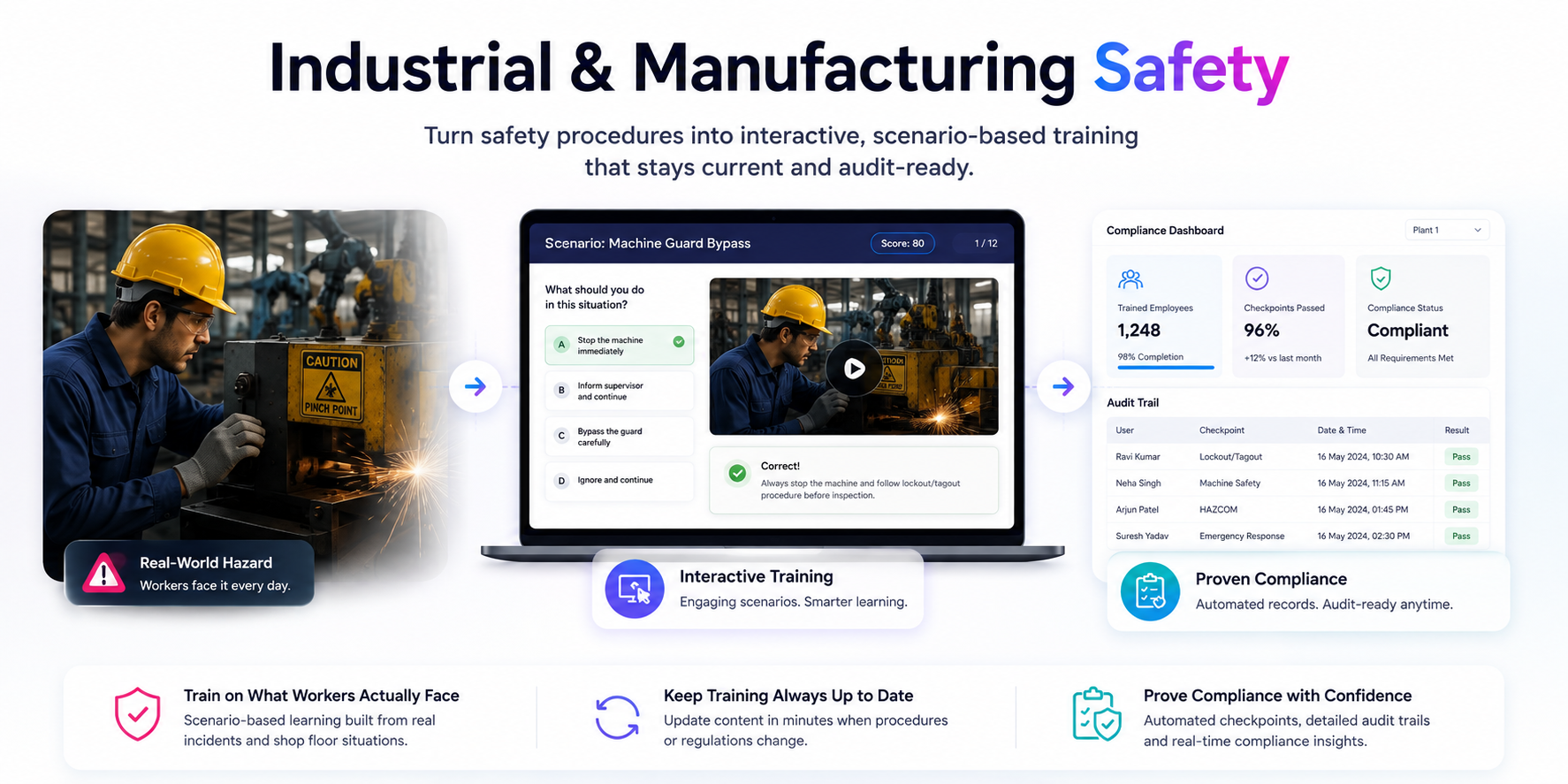
Industrial & Manufacturing Safety (EHS Compliance) — Turn real-world safety hazards and procedures into interactive, scenario-based training, keep content up to date, and track checkpoints and audit records for measurable EHS compliance.
- Reflect real scenarios, not abstract rules: Interactive, scenario-based training—where a learner makes a floor decision and sees the immediate consequence—builds critical judgment.
- Be fast to deploy and easy to update: Content must update quickly as machinery changes, procedures shift, or new hazards are identified.
- Produce documentation automatically: Checkpoints, completions, and quiz performance must log automatically for immediate export during OSHA inspections.
- Cover contractors with equal rigor: Vendor and temporary staff require rapid training pathways that can be completed prior to their first shift on site.
How Kriya Stack's Course Library Solves This
Kriya Stack's Course Library gives EHS and safety managers a faster path than building a training program from scratch or licensing generic safety courses.
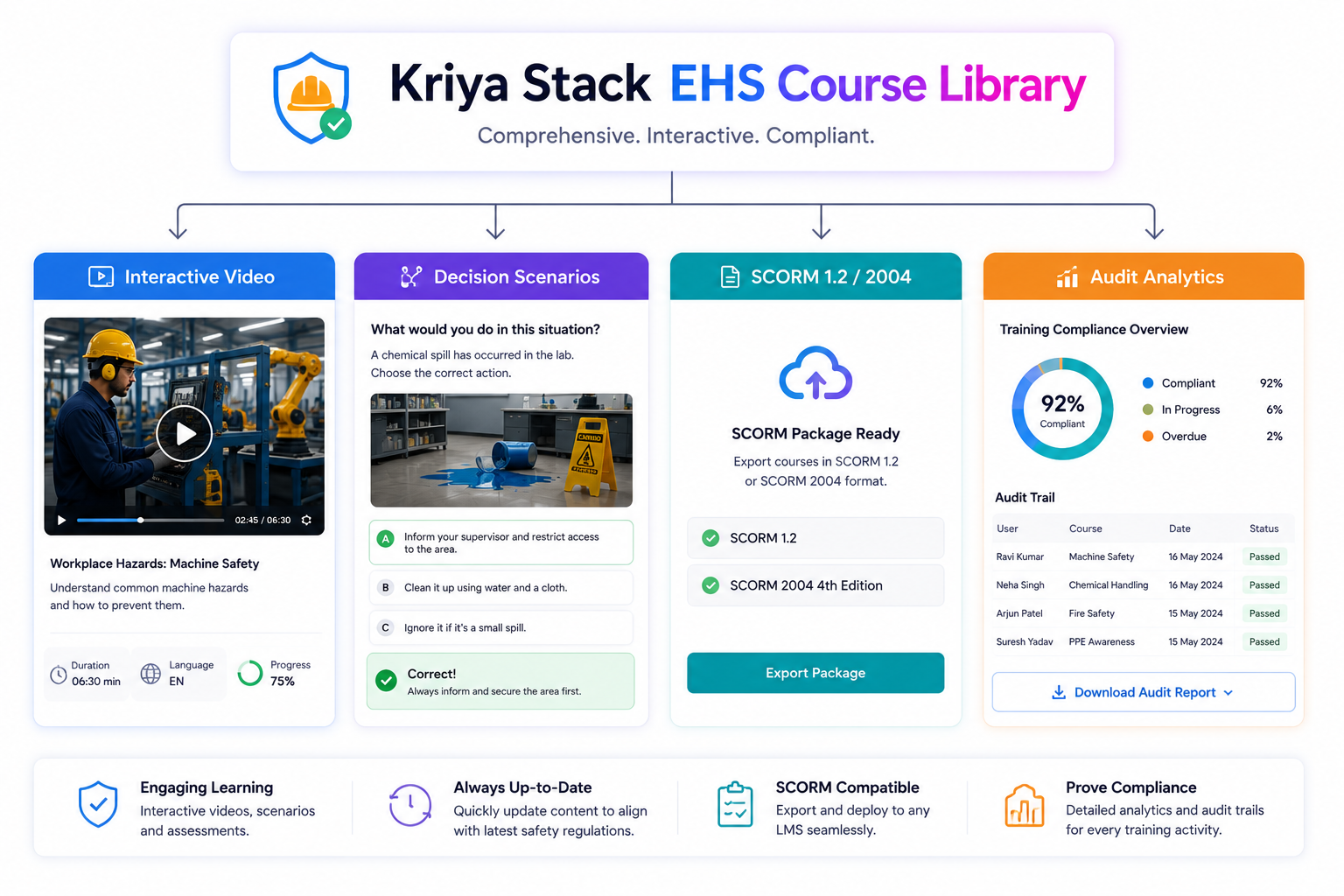
Kriya Stack EHS Course Library — Engage learners with interactive safety content, build decision-making through real-world scenarios, publish SCORM-compatible courses, and track compliance with audit-ready analytics.
Key Differences: Traditional vs. Kriya Stack Training
| Feature | Traditional Safety Training | Kriya Stack Course Library |
|---|---|---|
Format | Static slides, text PDFs, passive videos | Interactive video & decision-based simulations |
Deployment | Siloed platforms or physical sign-in sheets | Native SCORM 1.2 & 2004 export for any LMS (Workday, Cornerstone, SAP) |
Tracking | Simple completion flags (pass/fail) | Checkpoint-level analytics logging specific decision responses |
Contractor Onboarding | Multi-day delays or skipped safety clearances | Same-day purchase, preview, link assignment, and completion verification |
What Changes When Training Actually Works
Transitioning from passive compliance to interactive e-learning delivers measurable operational outcomes across plant facilities:
- Fewer Near-Misses Turning into Incidents: Scenario-practiced judgment carries directly over to the manufacturing floor.
- Faster, Less Painful Audits: Instantly export timestamped training records instead of sifting through paper binders.
- Shorter Ramp Time for New Hires & Contractors: Workers complete and verify safety clearances within hours without delaying line start dates.
- Lower Total Cost of Ownership: Centralized course libraries and quick updates eliminate costly video re-shoots or expensive custom software builds.
Relevant Courses for This Use Case
- Permit to Work High-Risk Safety Training: Covers the structured authorization process required before high-risk tasks—such as hot work, confined-space entry, and working at height can begin. It walks learners through real decision checkpoints rather than just listing static procedural steps (SCORM 1.2 / 2004 Ready).
- Contractor & Third-Party Risk Management: Addresses the exact blind spot most manufacturing EHS programs struggle with: onboarding contractors and temporary vendors quickly to the same safety standards as full-time staff without causing operational scheduling delays (SCORM 1.2 / 2004 Ready).
- OSHA HazCom Chemical Safety Compliance: Teaches floor personnel to identify all 9 GHS pictograms, navigate 16-section Safety Data Sheets (SDS), enforce proper secondary container labeling, and execute immediate chemical spill response protocols (SCORM 1.2 / 2004 Ready).
- Prevent Fatal Injuries with Enterprise Lockout/Tagout (LOTO) Safety Training: Teaches non-technical and maintenance teams to identify hazardous energy sources (electrical, hydraulic, mechanical), execute mandatory energy-isolation steps, manage group lockouts, and perform zero-energy checks before equipment servicing. (SCORM 1.2 / 2004 Ready)
- OSHA Workplace Safety Fundamentals SCORM Course: Delivers baseline OSHA hazard recognition, covers employer/employee shared safety responsibilities, hierarchy of risk controls, PPE applications, and hazard reporting protocols for general workforce onboarding. (SCORM 1.2 / 2004 Ready)
The Bottom Line
Manufacturing safety training fails when it is generic, slow to update, poorly documented, and inconsistent across contractor teams. Interactive, video-based SCORM training closes all four gaps simultaneously, protecting workforce health, lowering facility risk, and maintaining audit readiness.
Buy Ready-Made SCORM Courses
Launch engaging employee training in minutes with ready-to-deploy, interactive video courses built for corporate learning and seamless LMS integration.
Browse Course LibrarySources: OSHA (osha.gov/data/commonstats), Bureau of Labor Statistics Survey of Occupational Injuries and Illnesses, National Safety Council Injury Facts.
Read more blogs here: OSHA HazCom & Chemical Safety Compliance Guide for Manufacturing and OSHA Lockout/Tagout (LOTO) Compliance Guide for Manufacturing
FAQ
Frequently asked questions
Related manufacturing Stories

Sales Enablement at Scale: Interactive Training That Drives Revenue
Kriya Stack turns sales enablement into scenario-based practice: discovery calls, objection handling, and onboarding reps can rehearse before the real call, with ramp-time and revenue data to prove i