%20compliance%20training.jpg)
OSHA LOTO Compliance Guide: How to Deploy Training in Manufacturing
Master OSHA 1910.147 Lockout/Tagout requirements. Deploy off-the-shelf SCORM LOTO training courses to protect plant workers and pass safety audits.
OSHA Lockout/Tagout (LOTO) Compliance Guide: Mandatory Energy Control Standards & Training for Manufacturing
Key Takeaways
- Proven Safety Impact: Full compliance with OSHA 1910.147 prevents an estimated 120 fatalities and 50,000 injuries annually, making SCORM-based LOTO training a critical high-ROI safety investment.
- Three Employee Categories: OSHA mandates distinct levels of training for Authorized Employees (who apply locks), Affected Employees (who operate machinery), and Other Employees (who work in the area).
- Beyond Electrical: Hazardous energy control governs six primary energy sources: electrical, mechanical, hydraulic, pneumatic, chemical, and thermal (plus gravitational stored energy).
- Core Program Pillars: OSHA compliance requires written machine-specific energy control procedures, periodic annual audits, and documented employee training.
- Turnkey SCORM Solution: Industrial EHS teams can instantly fulfill annual LOTO training requirements using off-the-shelf SCORM modules that integrate directly into any LMS.
- Persistent Citation Risk: OSHA's Control of Hazardous Energy standard (29 CFR 1910.147) ranked #4 on OSHA's Top 10 most cited standards in FY 2025, with 2,562 violations, costing plant operators millions in annual fines
Managing industrial machinery during servicing, clearing jams, or conducting routine maintenance carries severe inherent risks. Unintended machine startup or the accidental release of stored kinetic, thermal, or electrical energy causes thousands of avoidable severe amputations, crush injuries, and fatalities every year.
Unlike OSHA's own reference materials, this guide focuses specifically on how EHS and L&D teams can deploy LOTO training as a SCORM course directly into their existing LMS, without building content from scratch
To eliminate these hazardous energy exposures, the US Occupational Safety and Health Administration (OSHA) enforces 29 CFR 1910.147- The Control of Hazardous Energy (Lockout/Tagout)
For EHS directors, plant managers, and safety coordinators in general manufacturing, maintaining a compliant LOTO program is not just a regulatory hurdle, it is part of a broader workplace health and safety induction every facility needsthe frontline defense against catastrophic industrial accidents. This guide breaks down OSHA 1910.147 compliance requirements, details the mandatory training tiers for your workforce, and demonstrates how to deploy interactive SCORM training to your Learning Management System (LMS) in minutes.
Understanding OSHA 29 CFR 1910.147: The Core Requirements
OSHA’s LOTO standard applies to general industry workers performing servicing or maintenance on equipment where unexpected energization or release of stored energy could cause injury.
An audit-proof energy control program relies on three interconnected pillars:
- Documented Energy Control Procedures: Written, machine-specific protocols detailing exact shutdown, isolation, lockout application, and zero-energy verification steps for each piece of plant equipment.
- Employee Training & Qualification: Structured instruction ensuring all workers understand hazardous energy risks and know how to safely apply or respect energy isolation devices.
- Periodic Inspections: Annual audits of energy control procedures conducted by an authorized inspector to verify that lockout protocols are actively followed.
The 6 Types of Hazardous Energy Present in Industrial Plants
A common compliance pitfall is assuming Lockout/Tagout only applies to electrical breaker boxes. OSHA 1910.147 governs all potential energy sources that can re-energize or release force during maintenance:
| Energy Source | Common Industrial Examples | Primary Control & Isolation Method |
|---|---|---|
Electrical | Breakers, control panels, transformers, motors | Circuit breaker lockouts, disconnect switches |
Mechanical | Flywheels, belts, gears, tensioned springs | Mechanical blocks, pin locks, chain covers |
Hydraulic | Fluid pressure lines, hydraulic presses, rams | Line valves, pressure relief valves, blank flanges |
Pneumatic | Compressed air lines, pneumatic actuators, tools | Quick-disconnect locks, slide valve locks |
Chemical / Gas | Chemical transfer lines, natural gas, steam lines | Double block and bleed systems, valve lockouts |
Thermal / Gravity | Hot oil, boilers, elevated heavy machine components | Pipe blinds, mechanical safety blocks, props |
Failure to identify and isolate secondary stored energy accounts for a major portion of OSHA LOTO citations. For facilities also managing chemical exposure risks, pair this with Chemical Handling & Hazard Communication training
OSHA Training Tiers: Authorized vs. Affected vs. Other Employees
OSHA standard 1910.147(c)(7) mandates that employers provide tailored safety training based on an employee's specific job duties. Delivering a single, generic PowerPoint presentation to all plant staff violates federal standards.
OSHA strictly divides plant personnel into three distinct training tiers:
1. Authorized Employees
- Who They Are: Maintenance technicians, millwrights, electricians, and supervisors responsible for locking out machinery to perform servicing or repairs.
- Required Training Content: Must receive detailed training on recognizing all hazardous energy sources in the facility, understanding the magnitude of energy present, mastering step-by-step isolation methods, and executing zero-energy verification (try-start testing).
2. Affected Employees
- Who They Are: Machine operators, assembly line workers, and material handlers who operate equipment subject to LOTO or work in areas where servicing is performed.
- Required Training Content: Must understand the purpose of the facility's energy control program, recognize when LOTO procedures are active, and know that attempting to restart or tamper with locked-out equipment is strictly forbidden.
3. Other Employees
- Who They Are: Warehouse staff, office personnel, or janitorial teams whose work routines bring them through manufacturing floors.
- Required Training Content: Basic awareness of lockout devices, padlocks, and tagout tags, and strict instruction never to touch or bypass energy control hardware.
The 6 Mandatory Steps of an OSHA-Compliant LOTO Procedure
When servicing equipment, authorized personnel must execute the 6-step energy control sequence in exact chronological order:
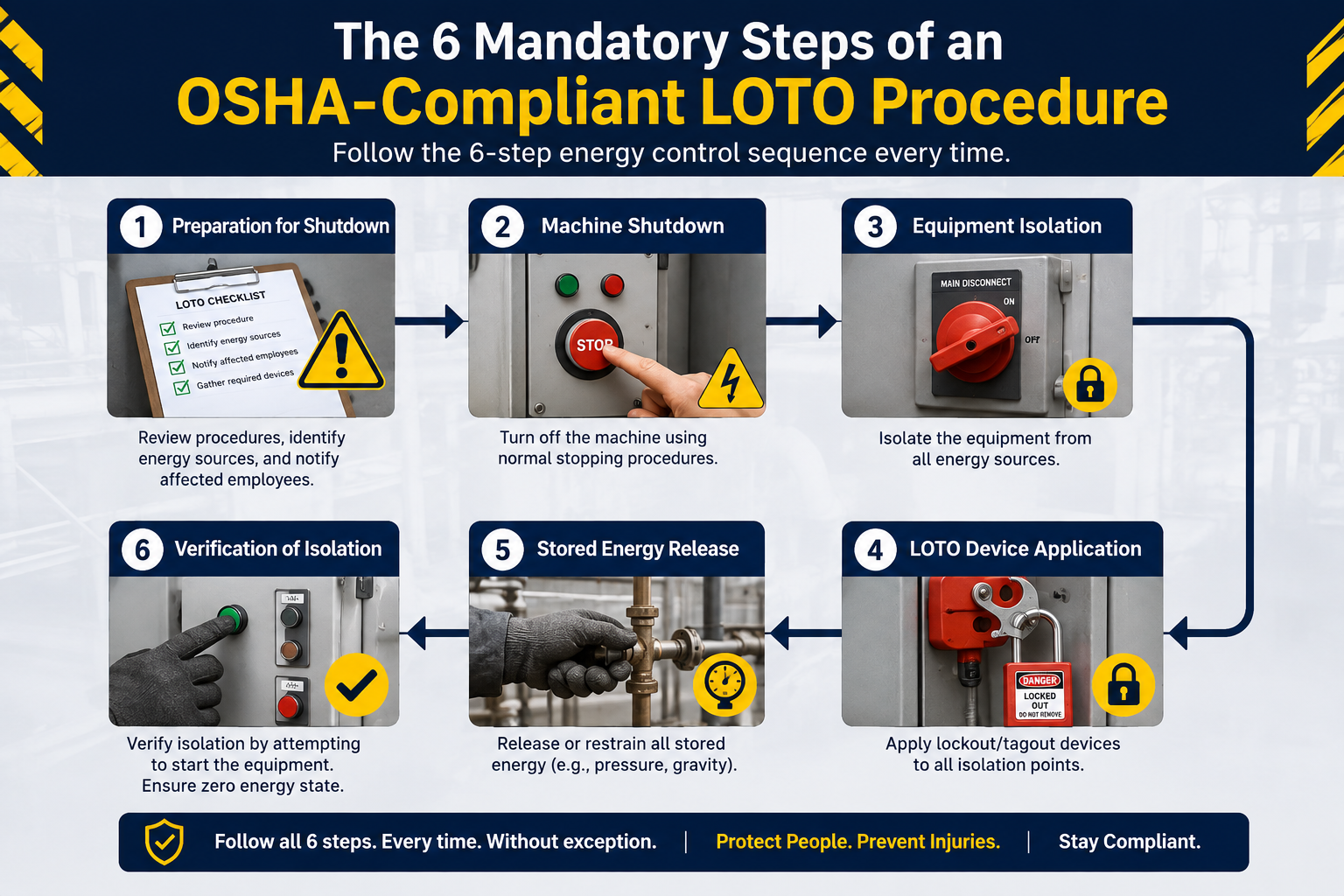
Mandatory Steps of an OSHA-Compliant LOTO Procedure by Kriya Stack
- Preparation for Shutdown: Identify all energy sources, magnitude, and hazards associated with the machine.
- Machine Shutdown: Turn off equipment using normal operational controls (stop button, switch).
- Equipment Isolation: Disconnect or isolate the machine from all primary and secondary energy sources (flip disconnect switch, close line valves).
- Application of Lockout/Tagout Devices: Attach standardized padlocks, lockout haps, and tags to each energy isolating device.
- Stored Energy Dissipation: Bleed hydraulic pressure, discharge electrical capacitors, block elevated mechanical parts, and vent pneumatic lines.
- Verification of Isolation (Try-Start): Attempt to restart the equipment using normal controls to confirm zero-energy state, then return controls to "off" before beginning work.
Solving the LOTO Training Challenge in Modern Industrial Facilities
Pulling entire shifts of maintenance technicians and operators off the production line for long classroom lectures creates severe operational bottlenecks and halts output.
However, relying on outdated paper sign-in sheets or informal "on-the-job" instruction leaves your organization vulnerable to heavy OSHA penalties during sudden safety audits.
The Turnkey Solution: Off-the-Shelf SCORM Courses
Modern manufacturing L&D teams solve this dilemma by deploying interactive, ready-made SCORM courses. LOTO is one piece of a complete safety program, see our full OSHA Workplace Safety Fundamentals course for broader plant-floor compliance.
Deploying pre-built digital LOTO training offers clear operational advantages:
- Instant Audit Compliance: Automatically track completion rates, quiz scores, and time-on-task for both authorized and affected employee tracks.
- Gamified Scenario Drills: Replace passive video watching with interactive decision games—such as selecting the correct lock for a pneumatic line or performing virtual zero-energy verification.
- 100% LMS Integration: Seamlessly export standard SCORM packages that upload into any system, including Moodle, Workday, Cornerstone, and Docebo.
How to Deploy LOTO Training in Your LMS (Step-by-Step)
OSHA's own reference materials explain what LOTO compliance requires. They don't explain how to actually get that training in front of your workforce, tracked, and audit-ready inside the LMS your facility already uses. Here's the practical deployment path.
Step 1: Separate your training tracks before uploading. OSHA 1910.147(c)(7) requires different training content for Authorized, Affected, and Other Employees. Most LMS platforms let you assign the same SCORM package to different learner groups, but the content itself needs to reflect each tier's actual responsibilities, not a single generic module for everyone. Confirm your SCORM package includes distinct tracking for each employee category before upload.
Step 2: Set completion criteria that match your audit needs. A LOTO course should require both content completion and a passing quiz score, typically 80% or higher, since attendance alone doesn't demonstrate an employee can actually execute the 6-step sequence. In your LMS's course settings, configure completion to require both, not content viewed OR quiz passed, but both together.
Step 3: Upload and verify before rolling out. Once your SCORM 1.2 or SCORM 2004 package is uploaded, test it with a single user account first. Confirm the course launches correctly, tracks time-on-task, and records the quiz score accurately in your LMS's reporting dashboard. This five-minute check prevents a facility-wide rollout of a module that silently fails to track completion.
Step 4: Set your retraining trigger. OSHA requires retraining whenever a new hazard is introduced, a procedure changes, or periodic inspections reveal a gap in employee performance, not on a fixed annual calendar alone. Most LMS platforms allow automated reassignment rules; set one to reassign the LOTO course to a role or department whenever a new energy-control procedure is added to your written program.
Step 5: Track authorized vs. affected completion separately in reporting. When an OSHA inspector asks for training records, they'll expect to see that authorized employees received the deeper isolation and verification training, not the same shorter awareness-level content given to affected or other employees. Structure your LMS reporting views or tags now, so this distinction is easy to pull during an audit, not something you have to reconstruct after the fact.
Deploy OSHA LOTO Safety Training Today
Whether you need to complete annual LOTO retraining before an upcoming audit or upgrade your facility's safety onboarding, Kriya Stack provides two rapid deployment options:
Option 1: Buy Off-the-Shelf LOTO SCORM Training
Skip the development wait entirely. You can purchase and instantly download our pre-built, WCAG 2.1 AA compliant Lockout/Tagout (LOTO) Safety Compliance Training Module from the Kriya Stack Course Library. Upload the SCORM 1.2 or SCORM 2004 package directly to your LMS and begin enrolling workers immediately.
Option 2: Customize with Facility-Specific SOPs
Have machine-specific energy control procedures, custom lock coloring standards, or site maps? Use the AI-powered Kriya Stack Course Builder to convert your internal SOPs, equipment manuals, and PDFs into customized, SCORM-compliant courses in minutes—no coding or instructional design expertise required.
(Need help ensuring your LMS tracks SCORM completion statuses accurately? Read our technical guide on SCORM 1.2 vs. SCORM 2004 LMS Compatibility or check our Complete SCORM Export Guide.)
FAQ
Frequently asked questions
Related Articles

5 Signs Your Team Needs AI Literacy Training Before Rolling Out AI Tools
Adopting AI tools without workforce readiness leads to data privacy risks, unverified outputs, and Shadow AI. Here are 5 clear signs your organization needs foundational AI literacy training before expanding AI tool adoption across your teams.

Soft Skills Training for Employees: Types, Courses, and How to Build a Program in 2027
A practical guide to soft skills training for employees, what counts as training, which skills to prioritize, and how to choose between ready-made courses and custom programs.