OSHA HazCom & Chemical Safety Compliance Guide for Manufacturing
OSHA's Hazard Communication standard is the #2 most cited standard in general industry. Here's what EHS teams need to know about GHS labeling, SDS management, and training requirements.
OSHA HazCom & Chemical Safety Compliance Guide: Mandatory GHS Standards & Training for Manufacturing
Key Takeaways
- Persistent Citation Risk: OSHA's Hazard Communication Standard (29 CFR 1910.1200) ranked #2 on OSHA's Top 10 most cited standards in FY 2025, with 2,546 violations, resulting in steep financial penalties for missing Safety Data Sheet (SDS) records or unlabeled containers.
- GHS Alignment: Modern chemical safety mandates strict alignment with the Globally Harmonized System (GHS), requiring standardized 16-section Safety Data Sheets and official 9-pictogram warning labels.
- Core Program Pillars: An audit-proof HazCom program requires a written facility chemical plan, a complete hazardous chemical inventory, accessible SDS management, and documented employee training.
- Mandatory Training Triggers: OSHA requires employee training upon initial job assignment and whenever a new chemical hazard is introduced into their work area.
- Turnkey SCORM Solution: Industrial EHS teams can instantly fulfill annual and onboarding chemical safety mandates using off-the-shelf SCORM modules that integrate directly into any LMS.
Handling toxic solvents, corrosive acids, flammable liquids, and compressed gases is a daily reality in modern manufacturing and industrial processing. Chemical exposure, accidental spills, and chemical reactions cause thousands of severe burns, respiratory illnesses, and facility fires every year, and the financial exposure from a single missed label or outdated Safety Data Sheet can compound quickly once an OSHA inspector is on-site.
To protect workers from hazardous substances, the US Occupational Safety and Health Administration (OSHA) enforces 29 CFR 1910.1200- Hazard Communication (HazCom), often referred to as the "Right-to-Know" standard. Unlike more narrowly scoped standards, HazCom touches nearly every facility that stores, uses, or transfers chemicals, which is part of why it consistently ranks among the most cited standards year after year, the requirements are broad, and compliance gaps are easy to miss during routine operations.
For EHS directors, plant managers, and safety coordinators, maintaining a compliant HazCom program is mandatory for operational safety and audit readiness. Operating heavy machinery alongside hazardous materials? Read our complete OSHA Lockout/Tagout (LOTO) Compliance Guide to cover hazardous energy isolation standards across your facility.
This guide breaks down OSHA 1910.1200 compliance requirements, details GHS labeling standards, and demonstrates how to deploy interactive SCORM training to your Learning Management System (LMS) in minutes.
Understanding OSHA 29 CFR 1910.1200: The Core Requirements
OSHA's HazCom standard ensures that information about chemical hazards and necessary protective measures is properly communicated to workers, from the loading dock to the plant floor. Unlike training that only needs to happen once, HazCom is an ongoing operational discipline: new chemicals enter a facility, suppliers update Safety Data Sheets, and shift turnover means new workers need the same information the day they start.
An audit-proof chemical hazard control program relies on four interconnected pillars:
Written Hazard Communication Plan: A fully documented facility program outlining how chemical container labeling, SDS management, and employee training are executed on-site. Inspectors typically ask for this document first, since its absence signals the rest of the program likely isn't systematic either.
Hazardous Chemical Inventory: An updated list of every hazardous substance present in the facility, cross-referenced directly with active Safety Data Sheets. A chemical without a matching, current SDS is one of the fastest paths to a citation.
Safety Data Sheets (SDS): Maintaining immediate, unrestricted employee access to standardized 16-section SDS documents for every chemical on the plant floor, digital or physical, as long as workers can reach it without barriers during a shift.
Comprehensive Employee Training: Structured instruction ensuring workers recognize chemical pictograms, read container labels, and understand necessary Personal Protective Equipment (PPE) requirements, not just once at onboarding, but whenever a new hazard is introduced.
The 9 GHS Hazard Pictograms Present in Industrial Plants
Under the Globally Harmonized System (GHS), chemical hazard warnings are categorized visually. OSHA mandates that workers recognize these 9 standardized pictograms immediately, without needing to read the full label text first, since recognition speed matters in an emergency.
GHS Pictogram Hazard Classification Common Industrial Examples Primary Control & Isolation Method
| GHS Pictogram | Hazard Classification | Common Industrial Examples | Primary Control & Isolation Method |
|---|---|---|---|
Health Hazard | Carcinogen, mutagen, reproductive toxicity, respiratory sensitizer | Benzene, silica dust, lead, formaldehyde | Local exhaust ventilation, full-face respirators |
Flame | Flammable liquids, pyrophorics, self-heating substances | Acetone, isopropyl alcohol, gasoline, solvents | Grounding/bonding, explosion-proof storage cabinets |
Exclamation Mark | Irritant (skin/eye), acute toxicity (harmful), narcotic effects | Bleach, ammonia solutions, degreasers | Chemical splash goggles, nitrile/neoprene gloves |
Gas Cylinder | Gases under pressure | Compressed air, nitrogen tanks, acetylene cylinders | Chain restraints, valve caps, upright storage |
Corrosion | Skin corrosion, serious eye damage, corrosive to metals | Hydrochloric acid, sodium hydroxide, battery acid | Emergency eyewash stations, acid-resistant aprons |
Exploding Bomb | Explosives, self-reactives, organic peroxides | Peroxide catalysts, blasting agents | Temperature-controlled storage, spark-free tools |
Flame Over Circle | Oxidizers | Nitric acid, hydrogen peroxide, oxygen tanks | Separate from flammables, dedicated secondary containment |
Environment | Aquatic toxicity (non-mandatory under OSHA, but enforced by EPA) | Pesticides, heavy metal waste, petroleum distillates | Secondary containment bunds, spill kits |
Skull & Crossbones | Acute toxicity (fatal or toxic) | Cyanide salts, chlorine gas, hydrofluoric acid | Isolation rooms, specialized chemical suits |
Looking for Pre-Built Industrial Safety Courses?
Skip weeks of content creation. Access WCAG 2.1 AA compliant, LMS-ready SCORM modules covering LOTO Procedure and Safety Training, Chemical Handling & Hazard Communication Safety Training, Workplace Health and Safety Training, POSH Awareness Training, and OSHA Workplace Safety fundamentals Training instantly.
👉Browse the Full Kriya Stack Course Library
OSHA Container Labeling: Secondary & Workplace Containers
A frequent compliance failure during OSHA inspections is unlabeled secondary containers, such as spray bottles, squeeze jugs, or buckets filled from bulk chemical drums. This is one of the easiest violations for an inspector to spot, and one of the easiest for a facility to miss, since secondary containers often get filled in a hurry without anyone thinking to grab a label.
Every chemical container leaving the original manufacturer, and every secondary container filled on-site, must feature a GHS-compliant label containing 6 key elements:
Product Identifier: Chemical name, code, or batch number matching the SDS.
Signal Word: Indicates hazard severity, "DANGER" for severe hazards or "WARNING" for less severe hazards.
GHS Pictograms: Black hazard symbols surrounded by a distinct red diamond border.
Hazard Statements: Standardized phrases describing the nature and degree of the hazard (e.g., "Causes severe skin burns and eye damage").
Precautionary Statements: Mandatory prevention, response, storage, and disposal measures (e.g., "Wear protective gloves. Keep away from heat").
Supplier Identifier: Name, address, and emergency phone number of the manufacturer or distributor.
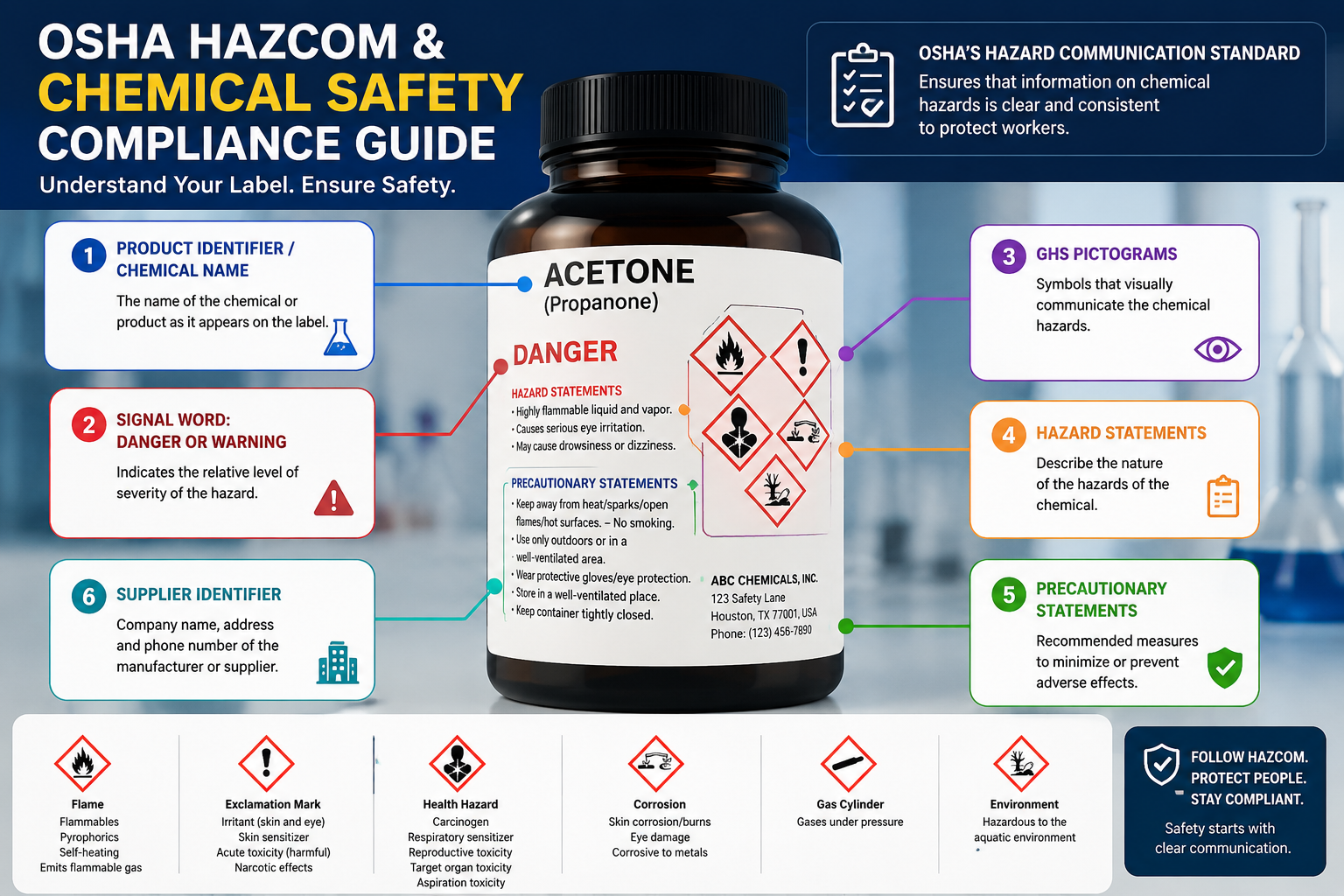
The 6 mandatory elements required on GHS chemical container labels under OSHA 1910.1200
Whether inspecting original manufacturer bottles or secondary transfer containers, every workplace chemical label must include these 6 core GHS elements
Required 16-Section Safety Data Sheet (SDS) Structure
OSHA requires employers to provide workers with instant access to Safety Data Sheets. Standardized under GHS, every SDS uses an identical 16-section format, which means a worker trained on reading one SDS can navigate any SDS from any supplier without relearning the structure.
Sections 1–8: Contain general information, hazard identification, composition, first-aid, fire-fighting, accidental release, handling, storage, and exposure controls/PPE.
Sections 9–11 & 16: Contain technical and scientific properties, reactivity, toxicological information, and preparation details.
Sections 12–15: Cover ecological, disposal, transport, and regulatory information (governed by EPA and DOT).
Solving the HazCom Training Challenge in Modern Operations
Managing chemical safety training across rotating shifts, multi-lingual workforces, and high-turnover plant floors creates massive administrative friction. A worker trained six months ago on one shift may never overlap with the safety coordinator who ran that session, and tracking who has and hasn't seen updated hazard information across three shifts becomes its own full-time job.
Relying on generic PowerPoint lectures or paper sign-in logs leaves organizations open to citations when inspectors ask operators to explain a GHS pictogram on the shop floor. A signed attendance sheet proves someone was in the room, not that they can recognize a corrosion symbol or know where the nearest eyewash station is when it matters.
The Turnkey Solution: Off-the-Shelf SCORM Courses
Modern industrial EHS teams solve this challenge by deploying interactive SCORM courses directly through their Learning Management System, replacing one-time lectures with training that's consistent across every shift and easy to reassign whenever a new hazard enters the facility.
100% Audit Readiness: Automatically track completion timestamps, quiz scores, and course completions across all production teams, giving EHS directors a real answer, not a guess, when an inspector asks who's current on training.
Interactive Scenario Drills: Engage workers with virtual decision-making drills, such as identifying secondary container label requirements, selecting correct PPE, or executing emergency chemical spill response procedures, so recognition becomes reflexive rather than theoretical.
Universal LMS Integration: Seamlessly export standard SCORM packages that upload into Moodle, Workday, Cornerstone, Docebo, or any LMS, without needing a new system just to run chemical safety training.
Deploy Chemical Handling & HazCom Safety Training Today
Whether you need to clear an upcoming audit or upgrade your facility's safety onboarding, Kriya Stack provides two rapid deployment options:
Option 1: Buy Off-the-Shelf HazCom SCORM Training Skip development delays. Purchase and download our pre-built, WCAG 2.1 AA compliant Chemical Handling & Hazard Communication Safety Compliance Training module. Upload the SCORM 1.2 or SCORM 2004 package directly to your LMS and start enrolling workers instantly.
Option 2: Customize with Plant-Specific Chemical SOPs Have facility-specific chemical inventories, site maps, or specialized PPE rules? Use the AI-powered Kriya Stack Course Builder to convert your internal SDS binders and plant SOPs into custom SCORM-compliant courses in minutes.
Need a Bespoke Safety Training Built for Your Facility?
Have site-specific machinery, custom plant layouts, or unique safety protocols? Our instructional design team will convert your internal SOPs, equipment manuals, and brand guidelines into fully interactive, audit-ready SCORM modules.
Request Custom Course
Need a course built specifically for your plant floor? Let our design experts build a bespoke SCORM module from your existing SOPs
Contact usDeploy OSHA Safety Compliance in Minutes
- Single Course:Buy Chemical Handling SCORM Module— Flat price, unlimited learners.
- Industrial Safety Bundle: Need LOTO, Chemical Safety, and OSHA Induction together? Get our multi-course compliance bundle.
👉Request an Industrial Safety Bundle
Related Safety & Compliance Resources
Building an audit-proof facility goes beyond chemical safety alone. To strengthen your organization's overall safety program and keep your workforce protected across all operational touchpoints, explore our related compliance guides in the Kriya Stack Resource Hub. If your facility operates heavy machinery or automated processing lines alongside hazardous materials, read our comprehensive guide on OSHA Lockout/Tagout (LOTO) Compliance Training to master energy control procedures and protect maintenance personnel from severe industrial hazards.
Related Articles

5 Signs Your Team Needs AI Literacy Training Before Rolling Out AI Tools
Adopting AI tools without workforce readiness leads to data privacy risks, unverified outputs, and Shadow AI. Here are 5 clear signs your organization needs foundational AI literacy training before expanding AI tool adoption across your teams.

Soft Skills Training for Employees: Types, Courses, and How to Build a Program in 2027
A practical guide to soft skills training for employees, what counts as training, which skills to prioritize, and how to choose between ready-made courses and custom programs.