AI Acceptable Use Policy: Free Template and How to Train Employees on It
A clear AI acceptable use policy tells employees which tools they can use and what data stays out. Get a free template and learn how to train staff and track acknowledgments in your LMS.
Key Takeaways
- An AI acceptable use policy is a short, plain-language document: It lists approved tools, data that must stay out of AI, when human review is required and who to ask.
- Publishing the policy is not enough: Employees need training and a recorded acknowledgment for the policy to change behavior.
- Eight sections cover the essentials: Purpose and scope, definitions, tools, data rules, human review, disclosure and IP, incident reporting, and consequences and review.
- A three-tier data rule keeps it simple: Never enter, ask first, and OK in approved tools.
- Rollout is five steps: Agree, publish, train, acknowledge and track, then review.
- Standards and laws raise expectations: ISO/IEC 42001 and the EU AI Act both point toward documented policy and employee awareness.
What Is an AI Acceptable Use Policy?
An AI acceptable use policy is a short internal document that tells employees which AI tools they may use at work, what data must never be entered into them, when human review is required and who to ask when they are unsure. It sets clear boundaries so teams can use AI safely and productively.
Many organizations also call it an AI use policy or AI usage policy. The label matters less than clarity: employees should be able to read it once and know what to do.
Most employees are already using AI at work. Without written rules, each person decides alone which tools to use and what data to paste in. An AI acceptable use policy fixes that, but only if employees read it, understand it and acknowledge it. This guide gives you a free template and a 5-step plan to roll it out and prove it worked.
Why a Policy Alone Is Not Enough
Most AI policies are published as a PDF on the company intranet. Employees rarely read them in full, and nobody can show that they understood the rules.
That gap is where shadow AI grows. When rules are unclear or hard to find, employees choose their own tools and paste in whatever they need to finish the task. A recruiter summarizing resumes in an unapproved tool is a typical example. Read more in our guide on shadow AI in the workplace.
A policy works when three things are true:
- Employees know it exists and where to find it.
- They have been trained on what it means for their role.
- You can show a record that they acknowledged it.
For the training side, see AI literacy training: what HR teams need to know in 2026.
What to Include in an AI Acceptable Use Policy: 8 Sections
A good policy covers eight areas. Keep each one short and use examples employees recognize.
| # | Section | What it covers |
|---|---|---|
| 1. | Purpose and scope | Why the policy exists and who it applies to: employees, contractors and vendors |
| 2. | Definitions | What counts as AI, generative AI, an approved tool and confidential data |
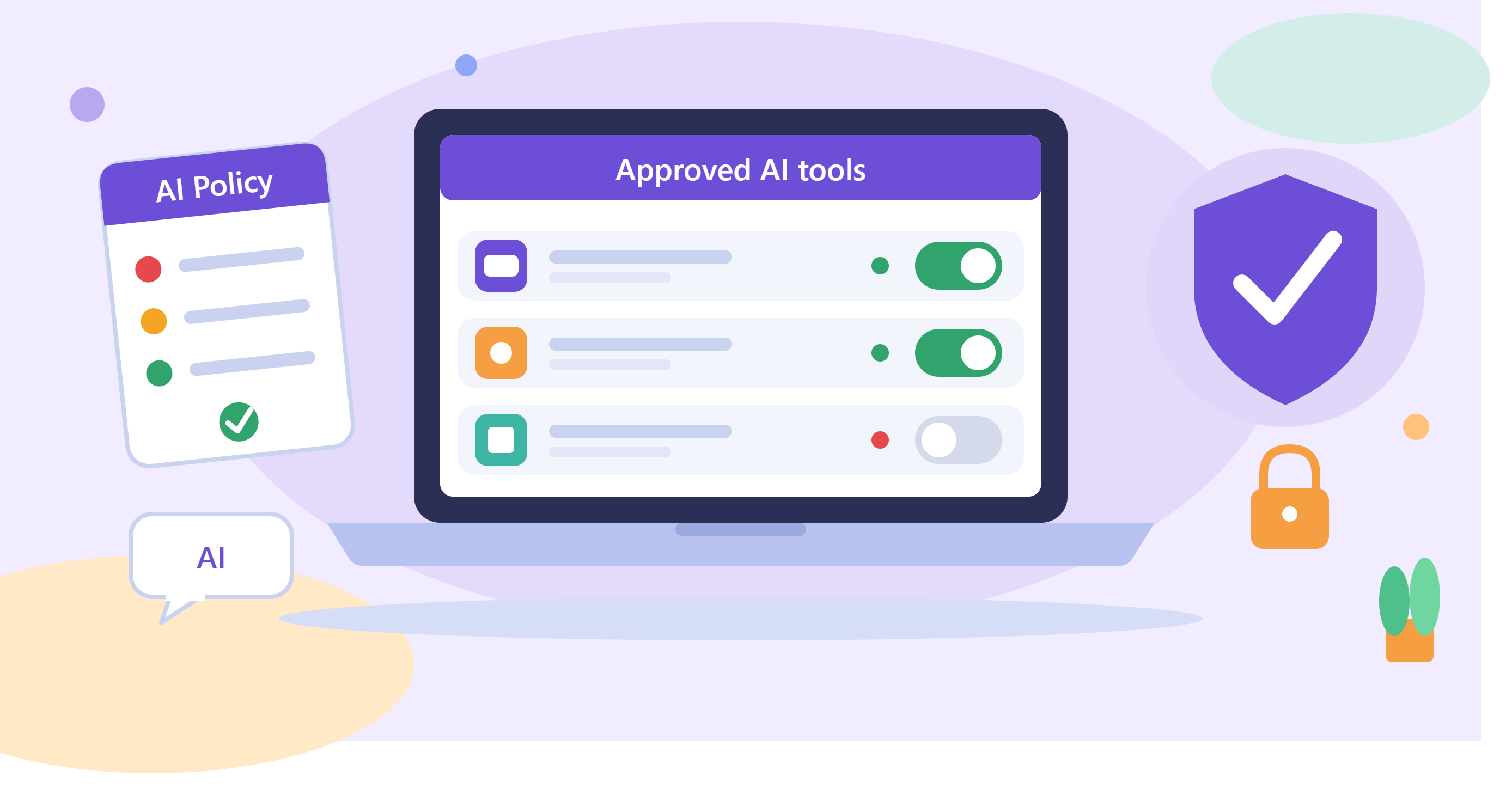
| 3. | Approved and prohibited tools | The list of approved tools and how to request a new one |
| 4. | Data rules | What can never be entered into AI tools, and what needs approval first |
| 5. | Human review and verification | When a person must check AI output before it is used or shared |
| 6. | Disclosure and IP | When to say AI was used, and how copyright and ownership are handled |
| 7. | Incident reporting | How to report suspected data exposure or misuse, ideally without blame |
| 8. | Consequences and review | How the policy is enforced, who owns it and when it is reviewed |
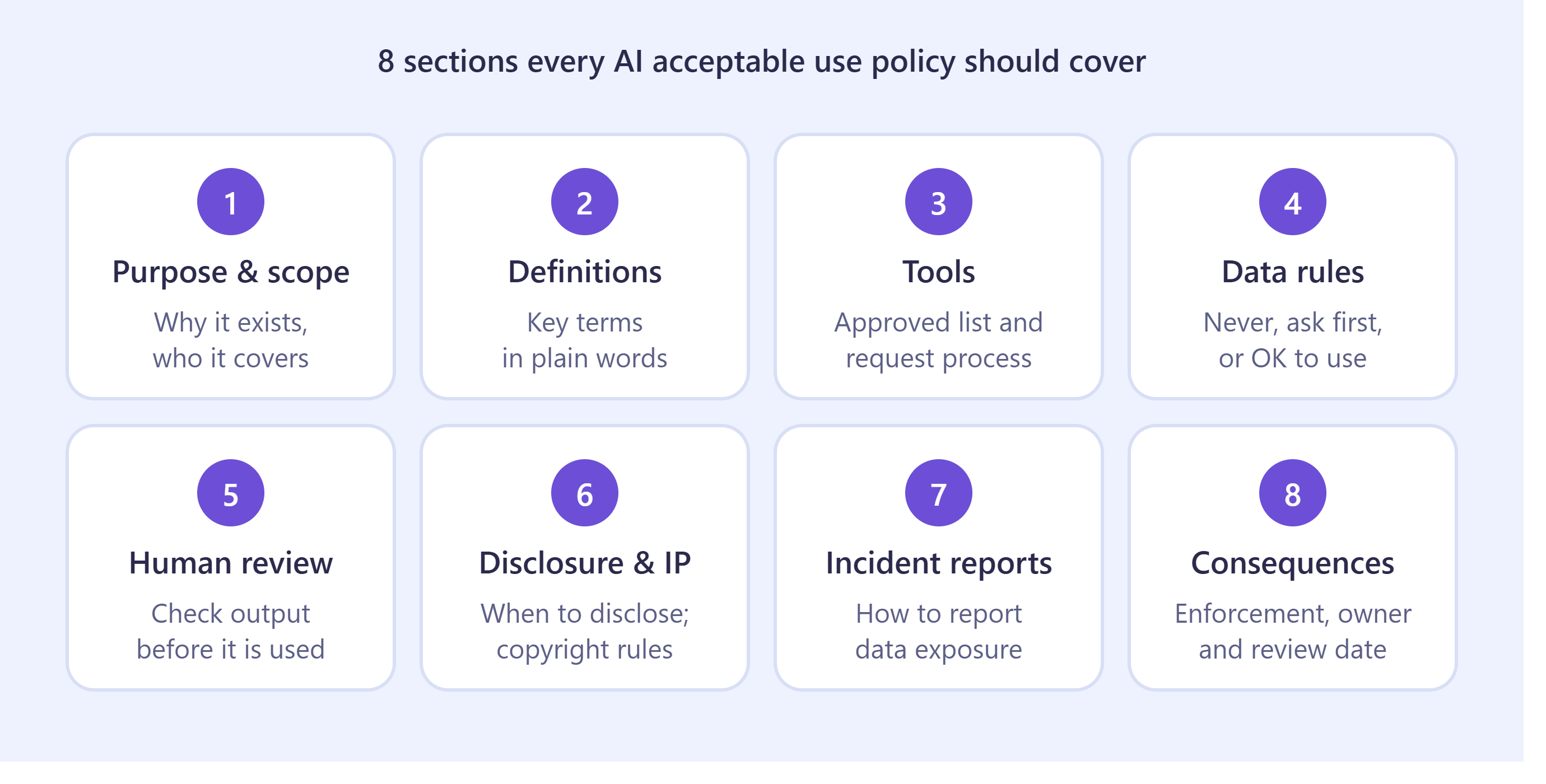
The eight sections every AI acceptable use policy should cover. Source: Kriya Stack
Data Rules: A Simple Three-Tier Approach
Data rules are the part employees need most. A three-tier approach removes guesswork. Base the tiers on your existing data classification policy.
| Tier | Meaning | Examples |
|---|---|---|
| Never enter | Prohibited in any AI tool unless IT has approved that specific use | Personal data of employees, candidates or customers; passwords; unreleased financials; trade secrets; confidential source code |
| Ask first | Allowed only in company-approved tools, after checking with the owner | Internal documents, draft contracts, non-public project plans |
| OK in approved tools | Low-risk use | Public information, general questions, brainstorming with no company data |
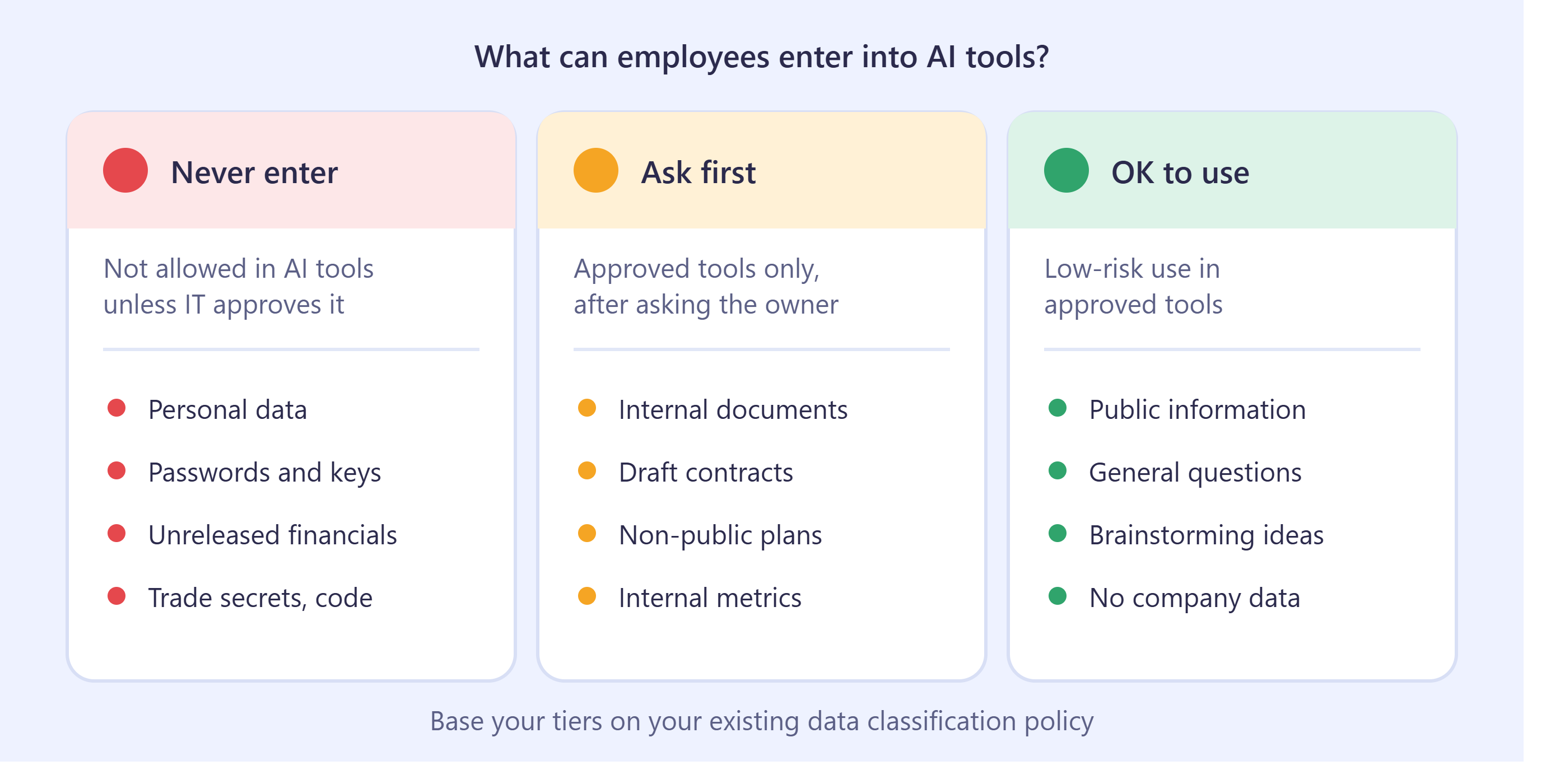
A simple three-tier rule for what employees can enter into AI tools. Source: Kriya Stack
Sample wording you can adapt:
Employees must not enter personal data, confidential company information or customer data into any AI tool that has not been approved by [IT/Security]. If you are unsure, ask [contact] before you paste.
Free AI Acceptable Use Policy Template
We built an editable Word template that follows the eight sections above. It includes:
- Bracketed placeholders for your company name, owner and review date.
- A three-tier data rules table.
- An approved-tools list you can fill in.
- A one-page employee acknowledgment form.
Download the free AI Acceptable Use Policy template Editable Word file. Replace the bracketed placeholders and share it with your team. Download the Free Template
This template is a starting point, not legal advice. Have your legal or compliance team review it before you publish.
How to Roll Out Your AI Acceptable Use Policy in 5 Steps
Step 1: Agree the policy and name an owner
Involve HR, IT or security, legal or compliance and business leaders. Name one owner and set a review date. Ownership is the most common gap.
Step 2: Publish the approved-tools list and a request path
Employees need to know which tools are approved today and how to ask for a new one. Without a request path, people will use unapproved tools instead of waiting.
Step 3: Turn the policy into short training
Replace the 20-page PDF with scenario-based microlearning: short real-life situations where employees decide what to do. You can use ready-made courses such as AI Ethics & Acceptable Use Policy and Using AI Tools Responsibly at Work, or convert your own policy with the Kriya Stack AI Course Builder.
Turn your AI policy into an interactive course. Upload your AI Acceptable Use Policy and build training your team can complete and you can track with the Kriya Stack AI Course Builder. Try the AI Course Builder | Explore the Course Library
Step 4: Collect acknowledgments in your LMS
Deploy the course as a SCORM package so your LMS records completion, quiz scores and the employee's confirmation that they have read and accepted the policy.
Step 5: Track, review and refresh
Monitor completion and incident reports. Review the policy at least every six months, and whenever approved tools, vendor terms or regulations change. Short refresher modules between reviews keep the policy current.
[IMAGE 4: place here, after Step 5] ai-acceptable-use-policy-rollout-5-steps.jpg · Alt: Five steps to roll out an AI acceptable use policy: agree, publish, train, acknowledge and review · Caption: From policy document to documented employee acknowledgment in five steps.
How the Policy Connects to Standards and Regulations
An AI acceptable use policy supports several frameworks, but it does not replace compliance with them.
- ISO/IEC 42001: The standard expects an AI policy (Clause 5.2) and requires people to be aware of it (Clause 7.3). Read more in ISO/IEC 42001 Explained: What HR and Compliance Leaders Need to Know.
- EU AI Act, Article 4: Providers and deployers must take measures to support AI literacy among their staff. The Digital Omnibus on AI (Regulation (EU) 2026/1744), in force since 27 July 2026, changed the duty from ensuring a specific literacy level to taking measures to support it.
- India: The Digital Personal Data Protection Act, 2023 may apply when employees enter personal data into AI tools.
- United States: There is no single federal AI law. Requirements vary by state and city, and the NIST AI Risk Management Framework is a voluntary reference.
Confirm your specific obligations with legal counsel.
Role-Based Examples to Include
Generic rules are hard to apply. Add short examples for each team.al
| Team | Typical Risk | Rule to Include | ||
|---|---|---|---|---|
| All employees | Pasting company data into public tools | Use approved tools only, check the data tier first | AI Literacy for Non-Technical Employees | |
| HR and recruiting | Resumes uploaded to unapproved screening tools | Approved tools only for candidate data, with human review of results | Using AI Tools Responsibly at Work | |
| Finance and legal | Confidential reports shared with AI | Keep confidential data out, verify AI calculations | AI Ethics & Acceptable Use Policy | |
| Marketing and sales | Unclear copyright and brand voice | Review AI-generated content and follow disclosure rules | Prompt Engineering Basics for Business |
Common Mistakes to Avoid
- Writing in legal language: If employees can't follow it, they won't.
- Banning everything: A total ban pushes AI use out of sight. A clear approved-tools list works better.
- No named owner or review date: Tools and vendor terms change quickly.
- Publishing without training: A PDF alone rarely changes behavior.
- No acknowledgment records: You can't show employees accepted the policy.
- No way to ask for a new tool: People use unapproved tools instead.
Where to Start
Start small: download the template, fill in your approved tools and data tiers, and agree an owner. Then turn it into training and collect acknowledgments, so the policy is understood, not just published.
Download Free Template
Download NowReady to turn your AI policy into training your team completes? See how Kriya Stack helps L&D, HR and Compliance teams deliver, track and document AI training at scale. Book a Demo | Talk to our team
Related Articles
Related Articles
ISO/IEC 42001 Explained: What HR and Compliance Leaders Need to Know
ISO/IEC 42001 sets the framework for AI governance, but it only works if people understand it. Learn how HR, L&D and Compliance teams can build AI competence and awareness, step by step.

7 Leadership Training Areas Every Manager Should Master
7 leadership training areas every manager should master, from delegation and feedback to psychological safety, conflict resolution, mental health and harassment prevention.