AI Literacy Training: What HR Teams Need to Know in 2026
AI literacy training enables HR teams to eliminate unauthorized shadow AI usage, protect corporate data, and establish compliant workforce adoption through structured, interactive SCORM e-learning.
Key Takeaways
- Static AI policy PDFs fail to prevent data leaks; interactive training is required for retention.
- Core AI literacy focuses on prompt safety, output verification, tool selection, and policy ethics.
- Unmonitored Shadow AI creates major legal, compliance, and corporate security risks.
- Tracking course completion and quiz scores inside your LMS ensures audit readiness.
- Multi-tiered training paths ensure departments receive relevant, role-specific guidance.
What is AI literacy training?
AI literacy training equips employees with the knowledge and practical skills to use Artificial Intelligence safely, responsibly, and effectively in the workplace. It goes beyond teaching employees how to use tools like ChatGPT or Microsoft Copilot. Instead, it helps them understand when AI should be used, when human judgment is essential, how to write effective prompts, verify AI-generated content, protect confidential company data, and comply with organizational AI policies. As AI adoption accelerates across every business function, AI literacy is becoming a foundational workplace skill alongside cybersecurity awareness and data privacy training.
Why Is AI Literacy Training Critical for HR Leaders in 2026?
HR leaders face unprecedented pressure as workforce AI adoption outpaces official policy enforcement. Employees frequently paste internal company information, sensitive employee records, and proprietary operational data into consumer-facing generative AI tools to speed up their daily tasks.
This unmonitored use creates massive security vulnerabilities and exposes companies to regulatory penalties. At the same time, forcing a total ban on AI tools limits organizational productivity and causes employee frustration.
HR teams must move away from static PDF policies and implement active training programs. Educating the workforce on safe usage protects company assets while allowing staff to build modern digital skills.
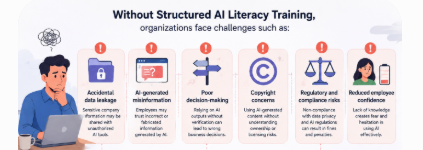
Without structured AI literacy training, organizations face challenges such as:
- Accidental data leakage
- AI-generated misinformation
- Poor decision-making
- Copyright concerns
- Regulatory and compliance risks
- Reduced employee confidence in using AI responsibly
Organizations that educate employees early are more likely to achieve safe AI adoption while improving productivity and innovation.
Why is AI Literacy training essential for employees
Read more about 5 Signs Your Compliance Training Isn't Actually Working here.
What Should Be Included in an Employee AI Literacy Training Program?
Workforce AI literacy requires four foundational skills: prompt safety, output verification, tool selection, and ethical compliance.
Training programs must go beyond basic technical instructions. Staff need practical decision-making frameworks to navigate daily tasks safely.
- Prompt Safety and Data Protection: Employees must learn what information is strictly forbidden from being typed into external LLMs. This includes customer personal identifiable information (PII), trade secrets, and financial reports.
- Output Verification and Bias Detection: Generative tools frequently produce plausible fabrications, known as hallucinations. Staff must learn how to fact-check AI-generated text, review code for errors, and audit outputs for hidden demographic bias.
- Tool Selection and Authorization: Workers need clear guidance on using company-approved enterprise tools versus public web applications.
- Ethical Compliance and Intellectual Property: Teams must understand copyright boundaries when generating marketing images, external reports, or commercial source code using automated tools.
Training programs must go beyond basic technical instructions. Staff need practical decision-making frameworks to navigate daily tasks safely using off-the-shelf AI & Digital Skills SCORM Courses.
A comprehensive AI literacy program should include:
- AI fundamentals and common terminology
- Understanding Generative AI
- Responsible AI use
- Data privacy and confidentiality
- Prompt writing basics
- AI bias and hallucinations
- Human verification of AI outputs
- Company AI policies
- Copyright and intellectual property awareness
- Ethical AI decision-making
For example, instead of simply teaching employees how to write prompts, organizations should also explain why confidential financial reports, employee records, or customer information should never be entered into public AI tools.
How Do HR Teams Prevent Shadow AI Data Leaks in the Workplace?
HR teams prevent Shadow AI data leaks by replacing static policy documents with mandatory, trackable e-learning modules.
When HR teams do not provide clear guidelines or accessible training, employees seek out their own automated solutions to handle high-volume workloads.
Consider a corporate recruiter who uploads candidate resumes into an unauthorized third-party tool to generate interview summaries. If that third-party platform uses uploaded data to train public models, candidate data is compromised. This action violates global data privacy mandates and exposes the firm to severe legal liability.
Read more about Shadow AI: Shadow AI in the Workplace: The Urgent Need for Responsible AI Employee Training
Providing structured e-learning modules eliminates shadow AI. It replaces risky, secret workarounds with clear, sanctioned workflows.
Some of the most common risks include:
Shadow AI
Employees using unauthorized AI tools without company approval.
Data Privacy
Uploading confidential documents into public AI platforms.
AI Hallucinations
AI generating incorrect or fabricated information that employees assume is accurate.
Bias in AI
AI-generated recommendations may unintentionally reinforce bias if not reviewed carefully.
Copyright Risks
Using AI-generated images, content, or code without understanding ownership or licensing implications.
These risks highlight why AI literacy should become part of every organization's compliance and digital transformation strategy.
How to Move from Static AI Policy PDFs to Interactive SCORM Modules
Interactive SCORM modules achieve significantly higher completion rates and knowledge retention than static policy documents.
Most HR departments publish AI governance policies as 20-page PDF documents stored on a corporate intranet. Employees rarely read these files thoroughly, leaving the company legally unprotected.
- Convert text guidelines into scenario-based microlearning: Replace passive text blocks with short video scenarios illustrating real workplace dilemmas.
- Embed interactive decision checkpoints: Present learners with realistic prompts containing hidden security risks, forcing them to identify the error before advancing.
- Deploy directly through your Learning Management System (LMS): Use standard SCORM 1.2 or SCORM 2004 packages to automatically track completion rates, quiz scores, and employee sign-offs for audit readiness.
- Schedule quarterly refresher micro-modules: Keep pace with rapid software updates by deploying 5-minute refresher courses every three months.
Want to know more about SCORM Guide: Read our latest blog on SCORM 1.2 vs SCORM 2004 LMS Guide here.
How to Measure the ROI and Compliance Impact of AI Training?
HR leaders measure AI training ROI by tracking LMS completion rates, pass rates on prompt safety quizzes, and reductions in IT security tickets.
According to a 2025 enterprise security report by Gartner, organizations that deploy interactive compliance microlearning experience have fewer data handling violations compared to companies relying on static policy documents.
To demonstrate clear value to executive leadership, HR teams should track key performance indicators before and after training deployment:
- Policy Sign-off Rate: The percentage of staff who have completed required training and acknowledged usage rules inside the LMS.
- Shadow AI Incident Reduction: The drop in unauthorized software detection tickets logged by internal IT security teams.
- Assessment Passing Rates: Employee performance on scenario-based prompt safety quizzes.
- Helpdesk Query Trends: Shifts in support tickets from basic tool questions to advanced workflow integration requests.
How Should HR Structure Role-Based AI Training Across Departments?
HR should structure AI training using a two-tiered approach that separates general workforce awareness from role-specific technical execution.
A single, generic training course cannot serve every department effectively. HR managers must structure learning paths based on daily job functions and access levels.
- General Workforce Tier: Focuses on foundational usage rules, enterprise privacy boundaries, basic prompt structure, and output verification. This is mandatory for all onboarding employees.
- HR and Recruiting Tier: Focuses on ethical candidate screening, algorithmic bias prevention, candidate data protection, and compliant performance review draft tools.
- Finance and Legal Tier: Focuses on strict data isolation, non-disclosure compliance, regulatory reporting accuracy, and auditing automated calculation errors.
- Marketing and Sales Tier: Focuses on brand voice alignment, copyright compliance, and foundational concepts like Machine Learning Concepts for Teams
Elevate Your Workforce Training with Kriya Stack
Building custom, compliant e-learning modules from scratch takes months of instructional design resources. Kriya Stack provides off-the-shelf, high-engagement video SCORM courses designed for instant LMS deployment.
Our interactive AI literacy and corporate compliance modules feature real-world scenarios, gamified knowledge checks, and full SCORM 1.2/2004 compatibility across all major platforms like Cornerstone, Docebo, and Moodle. Deploying specialized modules like AI Literacy for Non-Technical Employees, Cloud Security Basic Training for Employees or Responsible AI Training allows teams to replace passive text blocks with interactive 25-minute microlearning experiences.
Explore our enterprise course library to deploy plug-and-play e-learning that protects your organization and upskills your workforce today.
Explore Course Library
Launch engaging employee training in minutes with ready-to-deploy, interactive video courses built for corporate learning and seamless LMS integration.
Access Course LibraryFAQ
Frequently asked questions
Related Articles
5 Signs Your Team Needs AI Literacy Training Before Rolling Out AI Tools
Adopting AI tools without workforce readiness leads to data privacy risks, unverified outputs, and Shadow AI. Here are 5 clear signs your organization needs foundational AI literacy training before expanding AI tool adoption across your teams.

Soft Skills Training for Employees: Types, Courses, and How to Build a Program in 2027
A practical guide to soft skills training for employees, what counts as training, which skills to prioritize, and how to choose between ready-made courses and custom programs.