ISO/IEC 42001 Explained: What HR and Compliance Leaders Need to Know
ISO/IEC 42001 sets the framework for AI governance, but it only works if people understand it. Learn how HR, L&D and Compliance teams can build AI competence and awareness, step by step.
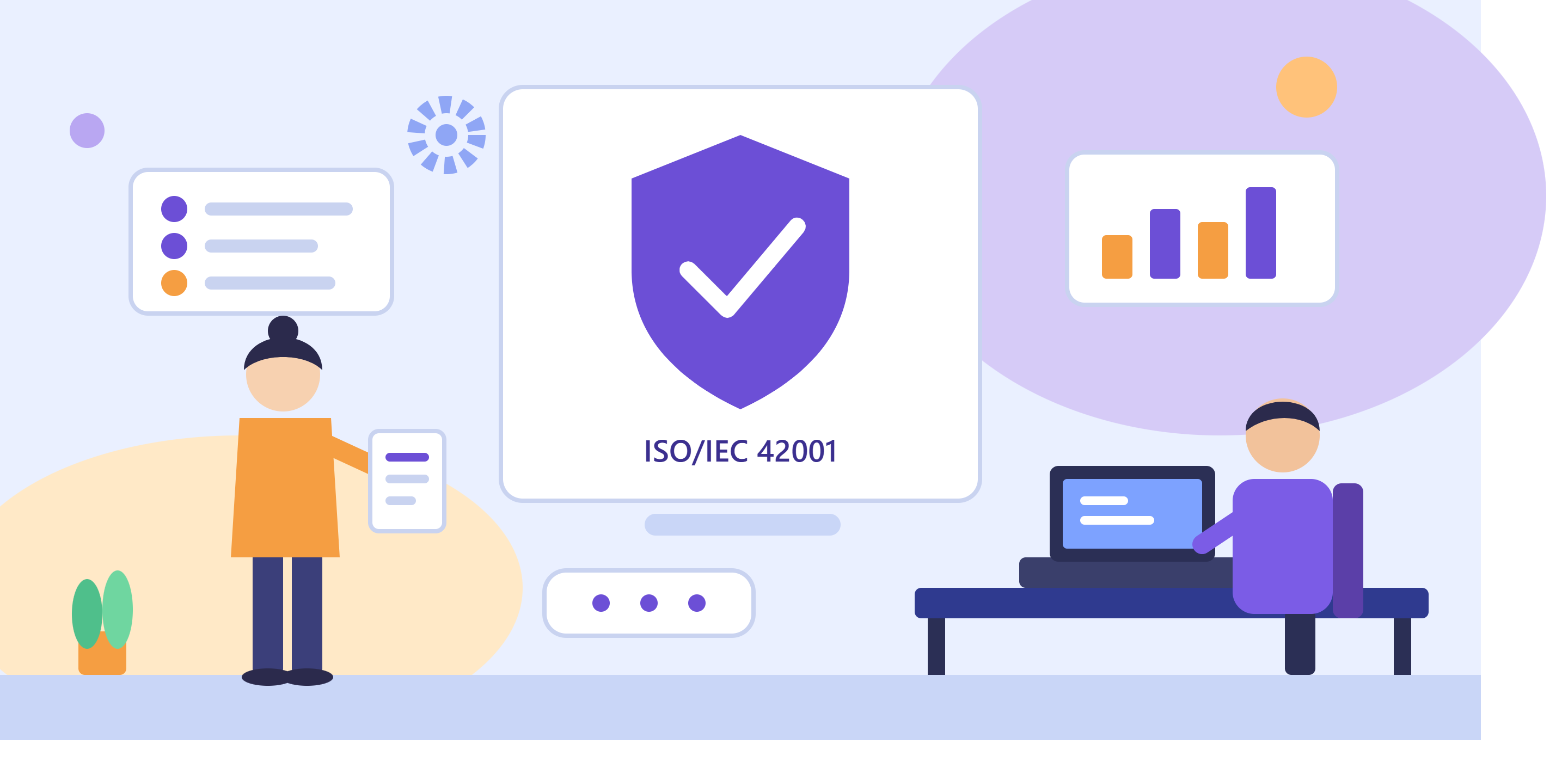
AI is now part of everyday work, from recruiting tools to writing assistants. ISO 42001 gives organizations a framework to govern it, but a framework only works if people understand it. This guide explains what ISO/IEC 42001 means for HR, L&D and Compliance teams, and how to turn it into practical training.
Key Takeaways
- ISO/IEC 42001 is an organization-wide standard: It provides a framework for establishing and maintaining an Artificial Intelligence Management System (AIMS).
- HR plays an important enabling role: HR and L&D teams can support workforce competence, employee awareness and responsible AI practices.
- Clauses 7.2 and 7.3 address different needs: Clause 7.2 focuses on competence for people whose work affects AI performance, while Clause 7.3 addresses awareness among personnel working under the organization's control.
- AI in HR processes requires oversight: Recruitment, performance analytics and workforce management tools can introduce risks that organizations need to assess and manage.
- Training supports AI governance: Role-based learning, policy awareness and documented evidence can help organizations put their AI governance framework into practice.
What Is ISO/IEC 42001?
Published in December 2023 by the International Organization for Standardization (ISO) and the International Electrotechnical Commission (IEC), ISO/IEC 42001:2023 specifies requirements for establishing, implementing, maintaining and continually improving an Artificial Intelligence Management System (AIMS).
It is designed for organizations that develop, provide or use AI-based products and services. Rather than prescribing specific AI technologies or algorithms, the standard establishes a management framework for addressing the risks and opportunities associated with AI.
An AIMS helps organizations approach AI governance systematically. It brings together policies, responsibilities, risk assessments, operational controls, monitoring and continual improvement.
This is important because AI-related risks extend beyond technical failures. They can include algorithmic bias, inadequate transparency, inaccurate outputs, privacy concerns, intellectual property exposure and unintended impacts on individuals.
ISO/IEC 42001 provides a structured approach to identifying and managing these risks throughout the AI system lifecycle.
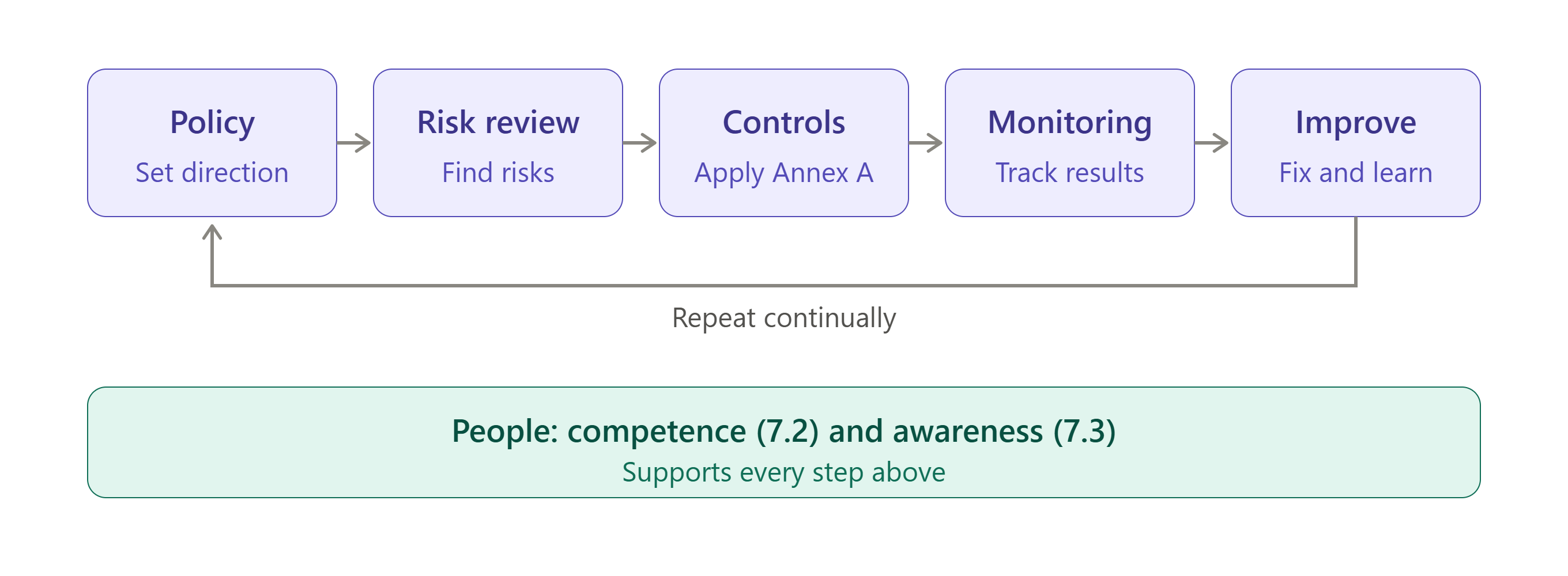
The AIMS cycle, with people competence supporting every step.
Where Do HR and Compliance Fit into ISO/IEC 42001?
ISO/IEC 42001 is not an HR regulation, nor is it exclusively an IT or cybersecurity standard. It applies across the organization.
The responsibility for an AIMS may sit with senior management, an AI governance committee, risk, legal, IT or another designated function. However, its implementation requires participation from the departments that develop, procure, manage or use AI systems.
HR and Compliance teams have two important areas of contribution.
1. Enterprise-wide workforce readiness
Employees need to understand the organization's AI policy, the tools they are permitted to use and the responsibilities associated with using AI at work.
HR and L&D can work with Compliance and IT to support employee awareness, identify role-specific competence needs, coordinate training and maintain relevant learning records.
2. Responsible AI use within HR operations
HR departments increasingly use AI-enabled tools for recruitment, CV screening, workforce analytics, employee engagement and performance management.
These applications can affect individuals and therefore need appropriate risk assessment, oversight and governance. HR teams should understand how these systems work, what decisions they influence and where human review is necessary.
ISO/IEC 42001 Clause 7: Competence and Awareness
For HR, L&D and Compliance professionals, Clause 7 (Support) is particularly relevant because it addresses the people-related capabilities needed to operate an effective AIMS.
Two requirements deserve special attention: Competence and Awareness. Although they are related, they serve different purposes.
Competence vs. Awareness at a Glance
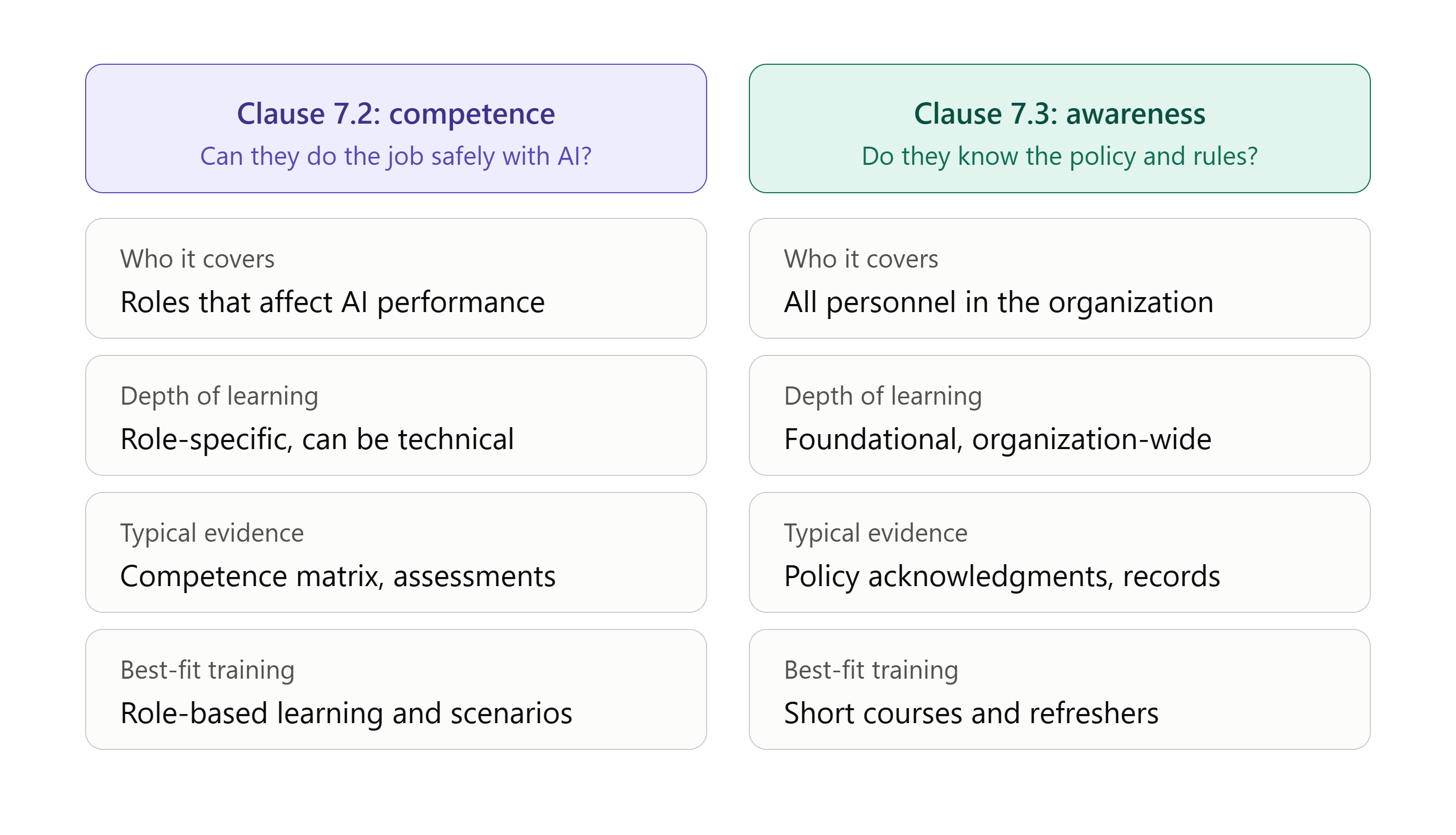
Competence covers specific roles. Awareness covers everyone.
Clause 7.2: Competence
Clause 7.2 requires organizations to determine the necessary competence of people whose work affects AI performance, ensure that they are competent through appropriate education, training or experience, and take action where additional competence is needed.
Organizations must also evaluate the effectiveness of those actions and retain appropriate documented information as evidence of competence.
For example, consider two employees:
- A recruiter using an AI-powered candidate screening tool needs to understand its intended use, limitations, potential bias and the need to review recommendations appropriately.
- An AI developer working on a recruitment model needs deeper technical competence in areas such as model performance, testing, risk assessment and system monitoring.
Both roles interact with AI, but their competence requirements are different.
What organizations can do:
- Define competence requirements based on job responsibilities and the AI systems employees work with.
- Identify gaps through assessments, experience reviews or role-based evaluations.
- Provide suitable training, mentoring or other development opportunities.
- Evaluate whether the actions taken have addressed the identified competence gaps.
- Maintain relevant evidence, such as role-based competence matrices, assessment results and training records.
Completing a course alone does not necessarily demonstrate competence. Organizations should consider whether employees can apply what they have learned in their actual work.
Clause 7.3: Awareness
Clause 7.3 has a broader scope. It requires people doing work under the organization's control to be aware of:
- The organization's AI policy.
- Their contribution to the effectiveness of the AI management system.
- The implications of not conforming with AIMS requirements.
This matters because AI-related risks are not limited to technical teams.
An employee who pastes confidential company information into an unapproved AI tool, relies on an inaccurate AI-generated answer or shares sensitive information through an unauthorized application can create organizational risks.
What organizations can do:
- Communicate the AI policy and make it accessible to employees.
- Explain which AI tools are approved and which uses are restricted.
- Train employees to recognize risks involving confidential information, personal data, bias and inaccurate AI outputs.
- Explain how to report suspected misuse or AI-related incidents.
- Reinforce awareness through onboarding, periodic learning and policy updates.
The objective is not to turn every employee into an AI specialist. It is to help people understand their responsibilities when AI is part of their work.
Other Clauses HR and Compliance Teams Should Know
Clause 7 is not the only place people-related requirements appear. These clauses also matter when you plan training and evidence:
- Clause 5.2 (AI policy): The policy employees need to be aware of under Clause 7.3.
- Clause 5.3 (Roles, responsibilities and authorities): Clarifies who is responsible for what, which feeds your competence requirements.
- Clause 7.4 (Communication): Covers what the organization communicates about the AIMS, to whom and when.
- Clause 7.5 (Documented information): Covers the records you keep, including training and competence evidence.
Governing AI Within HR Operations
HR teams should pay particular attention to AI systems used in people-related processes. These tools can influence decisions that affect candidates and employees, making appropriate governance essential.
ISO/IEC 42001 includes reference controls in Annex A that organizations can consider when selecting and implementing controls based on their context and risk assessments.
Four areas are especially relevant:
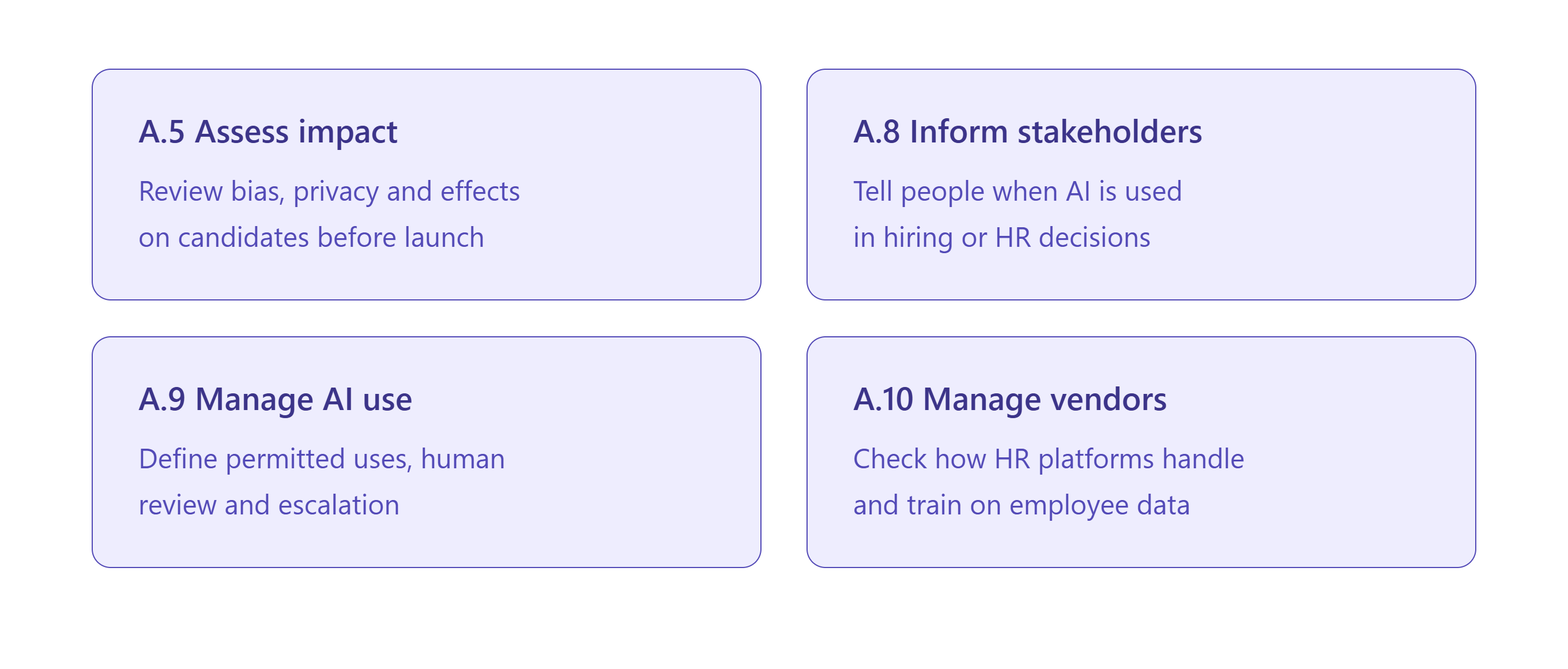
Four Annex A areas HR teams should look at first.
1. Assessing the impact of AI systems (Annex A.5)
Before introducing AI-powered recruitment screening, candidate scoring or workforce analytics, organizations should consider the potential effects on individuals.
This includes examining possible bias, unfair exclusion, privacy implications and the consequences of inaccurate recommendations.
2. Providing information to interested parties (Annex A.8)
Organizations should consider what information relevant stakeholders need about AI systems. In HR, this may include communicating when AI is used in recruitment or other employee-related processes, where appropriate.
3. Managing the use of AI systems (Annex A.9)
Organizations need appropriate arrangements for the use of AI systems. For HR, this may involve defining permitted uses, responsibilities, review processes and escalation procedures.
For high-impact employment decisions, meaningful human review can be an important safeguard. AI-generated recommendations should not automatically replace informed human judgment.
4. Managing third-party relationships (Annex A.10)
Many HR platforms now include embedded AI capabilities. Before adopting them, organizations should assess how vendors collect, process, store and use employee or candidate information.
This may involve reviewing data retention practices, access controls, contractual commitments and whether submitted information can be used for model training.
Related course: Third-Party Vendor Risk Management Training.
How ISO/IEC 42001 Connects with AI Laws and Frameworks
Organizations operating across multiple markets may need to consider ISO/IEC 42001 alongside applicable laws and regulations.
European Union
EU AI Act Article 4 requires providers and deployers to take measures to support AI literacy among their staff.
India
AI systems that process employee or candidate data may fall under the Digital Personal Data Protection Act, 2023. Awareness of data handling and approved tools helps reduce avoidable risk.
United States
There is no single federal AI law. Requirements vary by state and city, and rules on AI in hiring continue to evolve. Check current requirements with your legal team. The voluntary NIST AI Risk Management Framework is often used alongside ISO/IEC 42001.
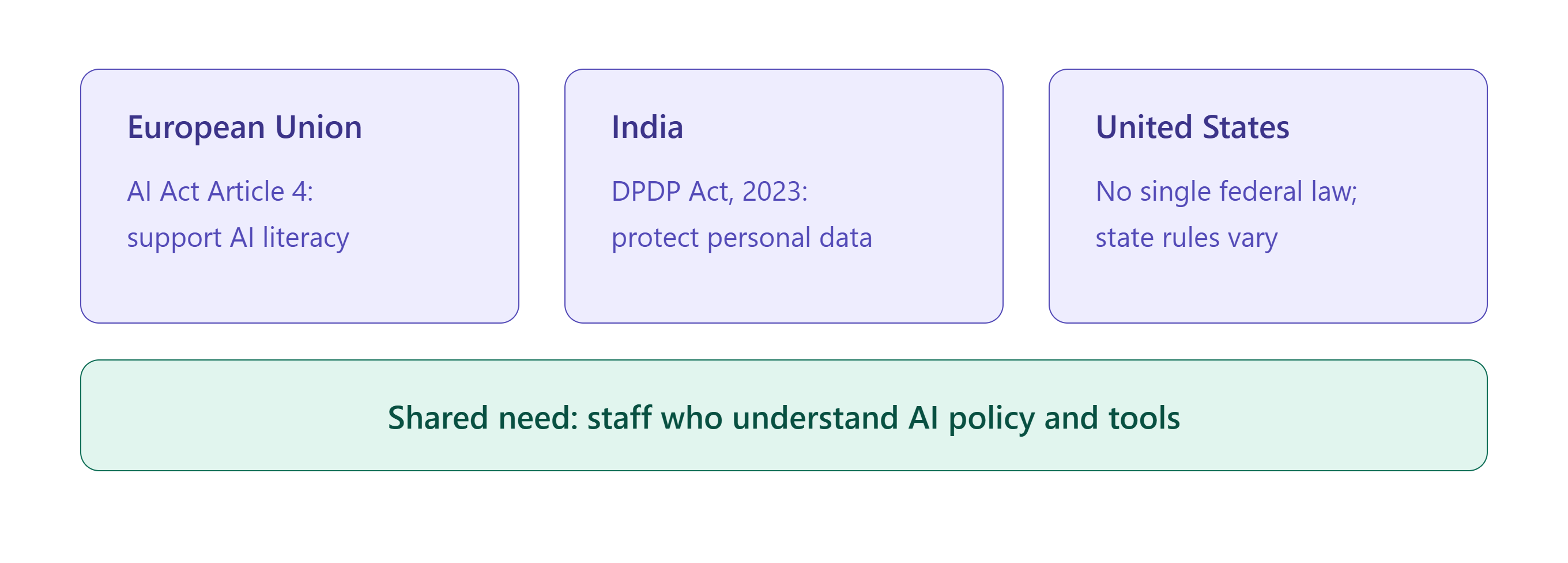
Rules differ by region. The workforce need is the same.
EU AI Act: Article 4 (AI Literacy)
Article 4 requires providers and deployers of AI systems to take measures to support the development of AI literacy among their staff and other people dealing with the operation and use of AI systems on their behalf.
The requirement takes account of people's technical knowledge, experience, education and training, as well as the context in which the AI systems are used.
The Digital Omnibus on AI (Regulation (EU) 2026/1744), which entered into force on 27 July 2026, amended Article 4. It no longer requires organizations to ensure a specific level of AI literacy. Instead, organizations must take measures to support AI literacy.
ISO/IEC 42001's competence and awareness requirements can support an organization's approach to workforce readiness. However, implementing ISO/IEC 42001 does not automatically establish compliance with Article 4. Organizations need to assess their applicable obligations and ensure their AI literacy measures are appropriate.
Data protection frameworks
AI systems may process personal information, including employee records and candidate data. Organizations should therefore consider relevant data protection requirements, such as the GDPR in the European Union and India's Digital Personal Data Protection Act, 2023, where applicable.
Employee awareness of data handling, approved AI tools and information-sharing restrictions can help reduce avoidable risks. AI governance and data protection should be considered together rather than treated as separate workplace concerns.
Related course: GDPR Compliance Training.
Regulations change faster than management systems. A role-based training program built on your own AI policy stays useful as the rules evolve.
Four Steps to Build an AI Governance Training Program
Once an organization has established its AI policy and identified the people and processes within its AIMS, training can help translate governance requirements into everyday workplace practices.
Here are four practical steps HR, L&D and Compliance teams can consider.
Step 1: Map Roles to Competence and Awareness Needs
Start by identifying how different groups interact with AI.
All employees
AI policy awareness, approved tools, data protection and reporting procedures
Policy acknowledgments, course completion
Functional AI users
Responsible prompting, output verification, bias awareness and appropriate human review
Assessment results, role-based assignments
Technical and governance teams
AI risk assessment, system lifecycle management, monitoring and governance responsibilities
Competence matrix, assessments, follow-up actions
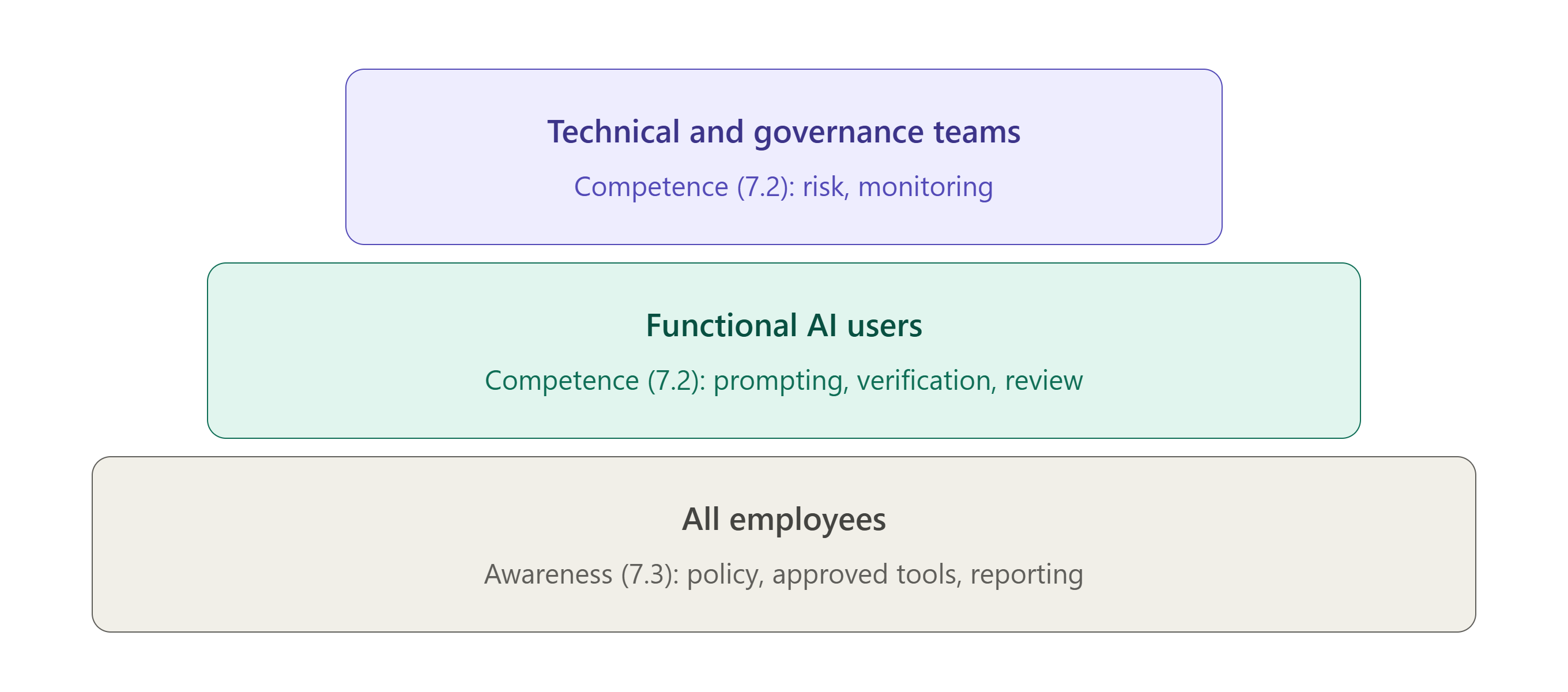
Match training depth to each group’s role.
These are suggested learning groups, not categories prescribed by ISO/IEC 42001. The organization should determine requirements based on actual roles and responsibilities.
Step 2: Combine Foundational AI Learning with Internal Policies
Employees need both general AI knowledge and an understanding of how their organization expects them to use AI.
A foundational course can cover AI ethics, bias, hallucinations, data privacy and responsible AI use. This can then be supplemented with training based on the organization's own AI Acceptable Use Policy, approved tools and reporting procedures.
For example, Kriya Stack offers ready-made off the shelf SCORM courses such as AI Literacy for Non-Technical Employees, Using AI Tools Responsibly at Work and AI Ethics & Acceptable Use Policy.
Explore Ready Made SCORM Course Library for instant deployment
For role-based learning, Kriya Stack also offers Prompt Engineering Basics for Business for everyday AI users and Introduction to Machine Learning Concepts for teams that need a deeper grounding.
Organizations can also build training modules on their own using the Kriya Stack AI Course Builder and turn their internal AI policies and guidance documents into interactive learning modules in minutes.
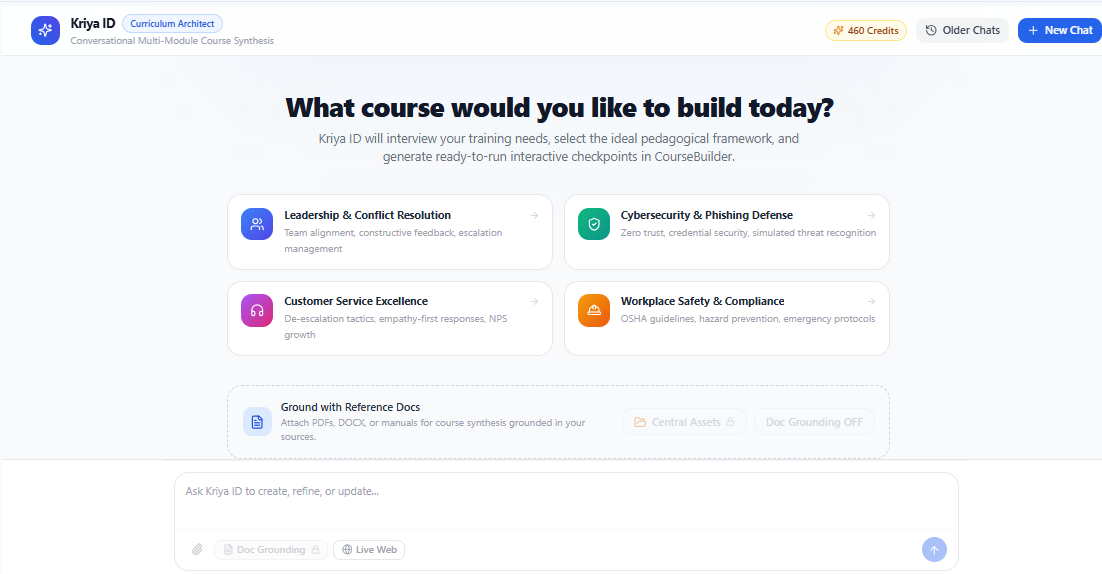
Turn your AI policy into interactive learning modules with the Kriya Stack AI Course Builder.
Explore AI Course Builder
See how organisations are using Kriya Stack's Course Builder to build interactive trainings across different verticals
Free TrialTurn your AI policy into an interactive course. Upload your AI Acceptable Use Policy and guidance documents, and build training your team can complete and you can track with the Kriya Stack AI Course Builder.
Step 3: Use Practical Scenarios to Reinforce Learning
Employees are more likely to understand AI governance when they can apply it to realistic workplace situations.
Training scenarios could include:
- An employee entering confidential information into an unapproved AI tool.
- A recruiter relying on an AI-generated candidate ranking without reviewing the results.
- An employee sharing an AI-generated answer without checking its accuracy.
- A team member identifying and reporting a possible AI-related incident.
Quizzes, scenario-based exercises and practical assessments can help organizations evaluate learning. Assessment criteria should be appropriate to the role and the competence being evaluated; ISO/IEC 42001 does not prescribe a universal passing score.
Step 4: Maintain Training Records and Review Them
Organizations should maintain relevant evidence of competence and consider how they demonstrate employee awareness.
Depending on the training program, useful records may include course completion, assessment results, policy acknowledgments, role-based training assignments and follow-up actions.
Learning Management Systems (LMS) can help coordinate assignments, monitor completion and retain learning records. Training should also be reviewed when AI policies, approved tools, employee responsibilities or relevant risks change.
Building AI Governance Through Workforce Readiness
An effective AI management system requires more than policies, technical safeguards and documented procedures. People across the organization need to understand how AI is used, what responsibilities they hold and when they should question or escalate a potential issue.
For HR, L&D and Compliance leaders, this means connecting AI governance with practical employee awareness and role-specific competence.
ISO/IEC 42001 provides a framework for that work. With appropriate policies, risk assessments, training and ongoing review, organizations can move towards more responsible and accountable AI use.
The goal is not simply to introduce AI governance rules. It is to help employees understand and apply them in the work they do every day.
Ready to build role-based AI governance training?
See how Kriya Stack helps L&D, HR and Compliance teams deliver, track and document AI training at scale
Book DemoRelated articles that might interest you:
Third-Party Risk Training for Employees: A Practical Compliance Checklist
5 Signs Your Team Needs AI Literacy Training Before Rolling Out AI Tools
Soft Skills Training for Employees: Types, Courses, and How to Build a Program in 2027
Related Articles
7 Leadership Training Areas Every Manager Should Master
7 leadership training areas every manager should master, from delegation and feedback to psychological safety, conflict resolution, mental health and harassment prevention.
5 Signs Your Team Needs AI Literacy Training Before Rolling Out AI Tools
Adopting AI tools without workforce readiness leads to data privacy risks, unverified outputs, and Shadow AI. Here are 5 clear signs your organization needs foundational AI literacy training before expanding AI tool adoption across your teams.