Beyond the Course Catalog: Building a True Skills Ontology for L&D
Discover why the traditional course catalogue model is broken. Learn the three pillars for building a skills ontology that transforms L&D into a strategic business driver, prepared for the future of work.
Beyond the Course Catalogue: Building a True Skills Ontology for L&D
The modern workforce is defined by speed, agility, and continuous change. Yet, for too long, Learning and Development (L&D) has been operating under an outdated model: the course catalog. This system tracks completion, not competence, leading to a critical disconnect between the training delivered and the skills the business actually needs.
As L&D leaders, we are tasked with driving organizational agility, but we can't do that if we don't speak the same language as the business. The solution lies in a fundamental shift from counting courses to mapping capabilities—it requires adopting a skills-based learning strategy and building a true skills ontology.
A skills ontology L&D defines and maps every skill, competency, and proficiency level required across your organization. It is a hierarchical, standardized language for talent. Crucially, the ontology goes beyond a simple list (a taxonomy); it shows the relationships between skills—how "Python" is a required skill for the "Data Scientist" role, which sits within the "Digital Transformation Competency." By making this transition, you move L&D from a reactive cost center to a strategic business partner that directly influences internal mobility and competitive advantage.
Phase 1: The Three Pillars of Ontology Design
Building an ontology is a structured initiative, not a one-time project. It requires meticulous planning across three core pillars.
Pillar 1: Define the Language (Taxonomy and Hierarchy)
Before you can build an ontology (the map showing all relationships), you must first define the building blocks using a taxonomy. A taxonomy is essentially a hierarchical list or classification system.
We must standardize the vocabulary to ensure everyone—from HR to the business unit—agrees on the definitions of the fundamental components:
- Skill: A specific, teachable ability (e.g., SQL Querying, Email Marketing Automation).
- Competency: A combination of skills, knowledge, and behaviors required for successful job performance (e.g., Customer Relationship Management).
- Ability: An innate trait or aptitude (e.g., Critical Thinking, Resilience).
How Taxonomy and Ontology Differ:
- Taxonomy: Tells you what exists and how it's classified (e.g., Skill A belongs under Competency B).
- Ontology: Tells you how everything is related (e.g., Skill A is required for Role X, which reports to Department Y, and has a prerequisite of Skill Z).
Standardizing this language ensures that when HR mentions a "Customer Service Competency," L&D and every department understand the exact set of skills required to achieve it. This foundation is key for building competency frameworks that are useful across the entire talent lifecycle.
Pillar 2: Data Source Mapping
You already have fragmented skill data residing across your tech stack. The second pillar involves gathering and synthesizing this information to validate the ontology.
- HRIS: What formal roles and titles exist, and what are their high-level requirements?
- Performance Reviews: What skill gaps do managers currently flag? Use this qualitative data to refine skill definitions.
- LXP/LMS Tags: Which tags are already being used, and how can they be standardized to match your new taxonomy?
This data source mapping allows you to validate and enrich your initial skill definitions, moving from theoretical ideals to real-world requirements. This process is essential for building competency frameworks that are useful across the entire talent lifecycle.
Pillar 3: Proficiency Models
A skill is useless without context. The final design pillar involves establishing clear, measurable proficiency levels. The simplest approach uses a scale like Novice, Practitioner, and Expert.
- Novice: Requires constant supervision; understands basic concepts.
- Practitioner: Can perform the skill independently; handles routine challenges.
- Expert: Coaches others; handles complex, non-routine challenges; sets strategy.
This tiered model provides Instructional Designers with the clear objectives needed to build targeted learning interventions, rather than relying on generic content.
Phase 2: From Map to Action: The L&D Workflow Change
Once your skills ontology is built, the way L&D operates fundamentally changes—for the better. This is the heart of L&D transformation planning.
Shifting Curation and Personalization
Instead of offering a generic "Course A," L&D now recommends the three microlearnings needed to close the gap on 'Cloud Security' Level 2. The system can proactively guide employees based on their current role, desired career path, and measured proficiency gaps.
Impact on Instructional Design (ID)
ID shifts focus dramatically. Designers are no longer primarily responsible for building content for broad subjects. Instead, their role elevates to:
- Creating Targeted Assessments: Designing objective, validated ways to measure whether a skill has actually been acquired.
- Building Validation Tools: Establishing criteria for external credentialing or on-the-job evidence gathering.
- Curation: Sourcing external content and tagging it perfectly to the ontology map.
Measuring Success with New Metrics
The skills-based approach replaces vanity metrics with true business impact:
- Internal Mobility Rate: How quickly can employees pivot to new roles or projects by closing skill gaps?
- Time-to-Competency: How fast does L&D get a new hire or promoted employee to "Practitioner" level?
- Skills Gap Reduction: Direct measurement of organizational risk based on high-priority skill deficits.
Conclusion: The Future-Proof L&D Team
Building a true skills ontology is not a quick fix; it's a long-term strategic investment in your organization's human capital. It requires significant collaboration between L&D, HR, and business leaders.
The return, however, is immense. By abandoning the ineffective course catalog model and speaking the language of talent, your L&D function stops being a necessary overhead and officially becomes the driver of talent strategy, prepared for the rapid demands of the future workforce.
Read more Best Interactive Employee Training Tools 2025 here. Visit Kriya Stack for more details.
Related Articles
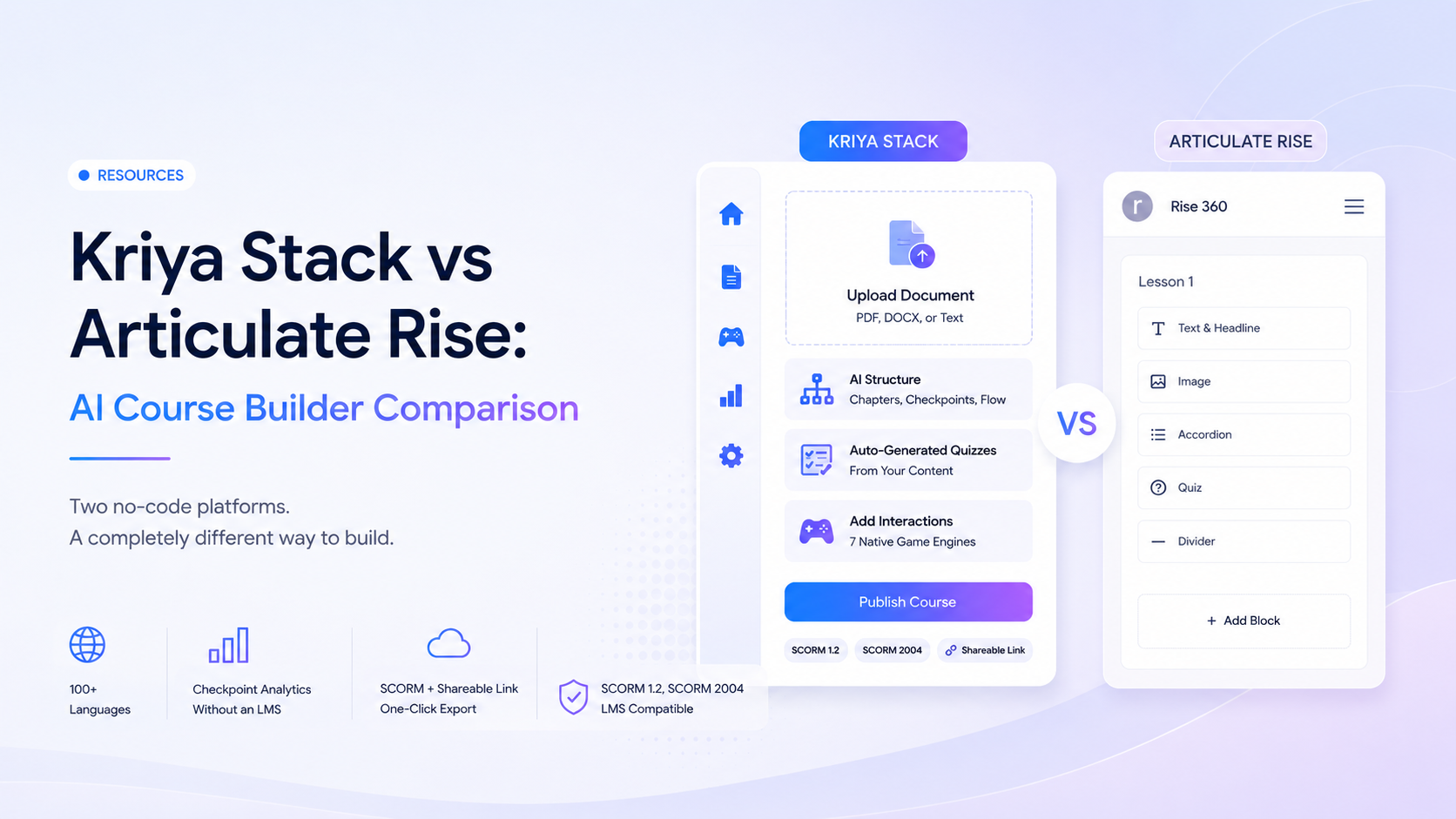
Kriya Stack vs Articulate Rise: AI Course Builder Comparison
Kriya Stack vs Articulate Rise: which AI course builder actually saves you time? We compare features, ease of use, and how fast each gets you from document to published SCORM course, no coding, no add-ons for languages or gamification.

Why Gamification Fails in Corporate Training and How To Fix It
Most gamification initiatives don’t fail because the idea was wrong, they fail because the training infrastructure couldn’t support it. This blog breaks down the real reasons gamification falls flat in corporate training and what teams can do to fix it.