
Fixing the Low Adoption Problem: 7 Tactics to Drive Engagement in Your LXP/LMS
Discover the 7 tactical strategies L&D leaders use to turn a passive LMS into a high-value, active tool and dramatically increase user participation
Fixing the Low Adoption Problem: 7 Tactics to Drive Engagement in Your LXP/LMS
You’ve invested heavily in an expensive Learning Management System (LMS) or Learning Experience Platform (LXP). It’s powerful, it’s feature-rich, and it houses thousands of hours of content. Yet, you log in to check the dashboard and the user adoption rate hovers stubbornly between 20% and 30%. Sound familiar?
The low adoption problem isn't a failure of your technology; it's often a failure of your strategy. Employees won't use a platform if it feels like a repository for compliance mandates or another tedious chore. They need it to be a tool that solves an immediate job problem.
This article outlines 7 tactics to drive engagement in your LXP/LMS today, moving your platform from a compulsory system to a high-value daily resource.
Tactics 1-3: Improving User Experience (UX)
User experience is the first barrier to successful platform adoption. If it’s hard to find, hard to navigate, or looks outdated, users will immediately abandon it.
Tactic 1: The 15-Second Rule (Focus on Search)
If a user cannot find the answer or content they need within 15 seconds or three clicks, the content effectively does not exist. Too many platforms are optimized for the administrator (easy upload) but not the user (easy discovery).
- Action: Audit your search function. Ensure content is tagged with job roles, common internal terminology, and problem statements (e.g., "How to reset password," "Q3 Sales update"), not just course titles. Focus on making the search bar the most prominent feature.
Tactic 2: Curation over Catalog (The Netflix Approach)
Stop presenting users with a generic, endless catalog of thousands of courses. Instead, use AI and human curation to create specific, immediate Learning Paths or "Featured Channels" that mimic services like Netflix or Spotify.
- Action: Dedicate the homepage to "Trending Now" (popular content), "Assigned for Your Role," and "Skills to Advance Your Career." Hide the deep catalog and only surface the content that solves their most pressing needs right now.
Tactic 3: Mobile-First Strategy
Busy professionals consume content on the go. If your LXP/LMS requires a desktop login or offers a clunky mobile web interface, you are instantly limiting usage. A significant portion of low engagement is simply a failure to meet users where they are.
- Action: Prioritize ensuring all essential content (job aids, microlearnings, short videos) and core functions (completion tracking) are optimized for a smooth, app-like mobile experience.
Tactics 4-7: Injecting Value and Motivation
Once the platform is usable, you need to provide compelling reasons for users to return and engage voluntarily.
Tactic 4: Social Proofing and Peer Review
People trust their peers more than they trust corporate assignments. Leverage social principles to build community and trust around your content.
- Action: Implement simple features like star ratings, user reviews, and internal discussion forums for popular content. When a course has a five-star rating and dozens of positive comments from colleagues, the internal motivation to complete it increases dramatically.
Tactic 5: The Managerial Link (Integration, not Separation)
Learning should be integrated into an employee’s performance goals, not seen as an extra task outside of work. The manager is the most critical driver of LMS usage.
- Action: Train managers to assign specific, relevant content as part of a performance review follow-up or a project kick-off. When managers talk about learning content during team meetings, user participation skyrockets.
Tactic 6: Micro-Incentives and Recognition
Use lightweight gamification to create low-stakes, visible motivation. This is especially effective for voluntary learning.
- Action: Implement points, badges (e.g., "Data Expert Level 1"), and team leaderboards for visible, non-critical learning paths. The goal is recognition, not prizes. Make these achievements easily shareable on internal profile pages.
Tactic 7: Contextual Push Notifications
Stop generic email blasts announcing new courses. The most effective way to increase user participation is through "just-in-time" (JIT) learning triggers.
- Action: Use push notifications that trigger only when a user needs a specific job aid, perhaps tied to a process start or a common mistake. If a user tries to submit an incomplete expense report, the system should push a notification linking to the 3-minute video on "Expense Report Checklist." This turns the platform into a vital daily work tool.
Conclusion: Measure and Iterate
Low LMS/LXP adoption is a fixable problem rooted in design and strategy. By applying these seven LXP engagement tactics, you can shift your platform from a passive repository to an active, essential part of the employee workflow.
Remember to continually measure and iterate. Test which of these tactics drives the highest click-through and completion rates in your environment, and double down on what works to maximize your investment.
For more such insights on L&D read here. Visit Kriya Stack for more details.
Related Articles
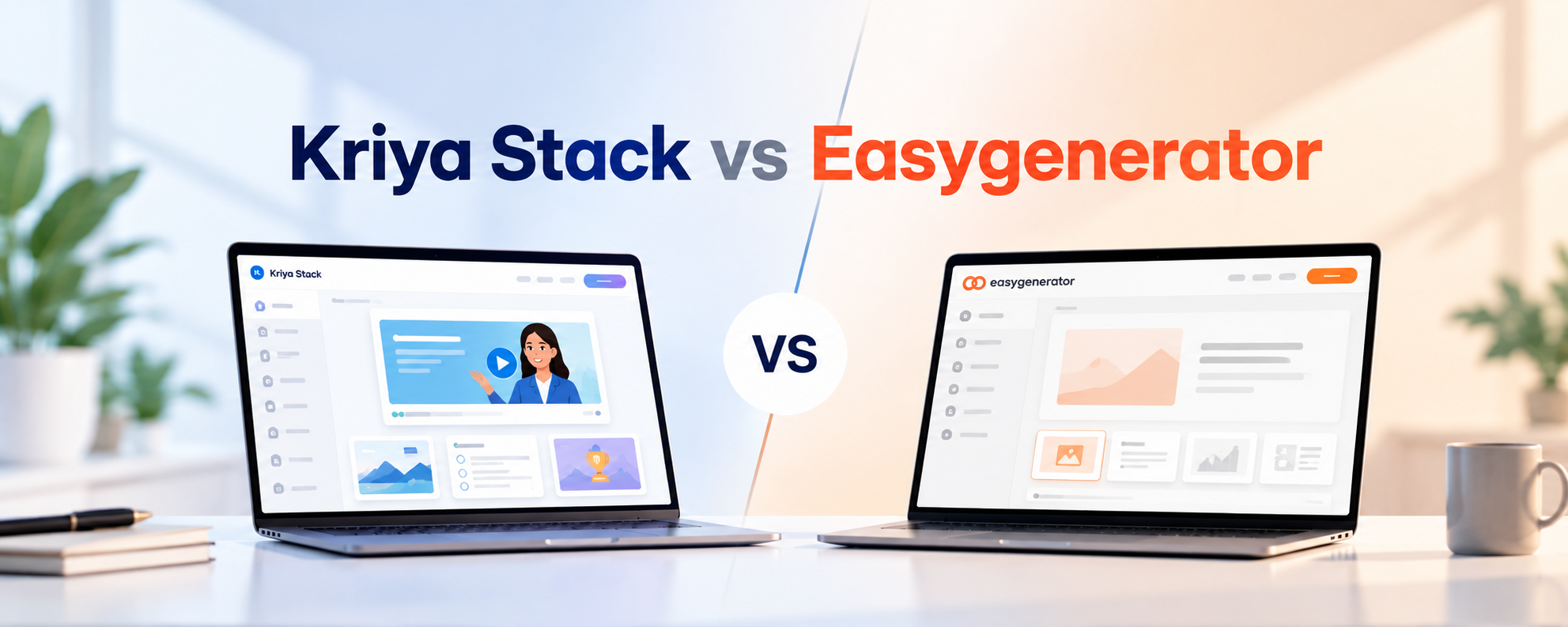
Kriya Stack vs Easygenerator: AI Course Authoring Tool Comparison
Compare Kriya Stack vs Easygenerator across AI course creation, no-code authoring, video, gamification, SCORM, analytics and multilingual learning.
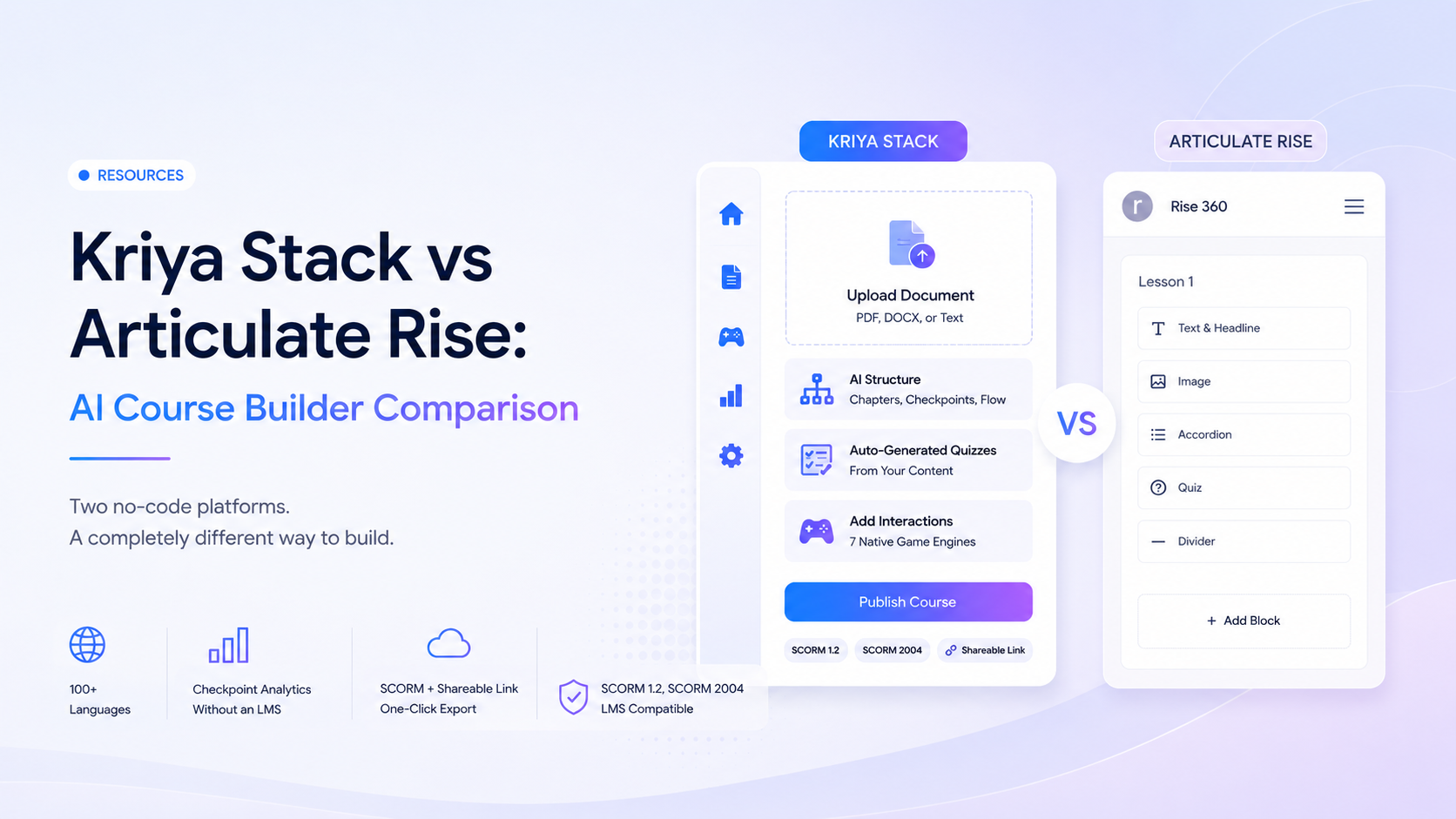
Kriya Stack vs Articulate Rise 360: AI Course Builder Comparison
Kriya Stack vs Articulate Rise: which AI course builder actually saves you time? We compare features, ease of use, and how fast each gets you from document to published SCORM course, no coding, no add-ons for languages or gamification.