How to Train a Distributed Manufacturing Workforce on Safety Compliance
A practical guide for training managers, EHS leads, and L&D teams running safety programs across multiple plants, shifts, and contractor crews.
Key Takeaways
- Manufacturing's injury and illness rate ran at 2.7 cases per 100 full-time workers in 2024, higher than the 2.3 average across all private industry.
- Employers pay roughly $1 billion per week in direct costs for serious nonfatal workplace injuries nationwide.
- The most-cited OSHA standards on manufacturing floors year after year are Hazard Communication, Lockout/Tagout, Powered Industrial Trucks, and Machine Guarding, and nearly all of them trace back to gaps in training, not equipment.
- A distributed workforce (multiple shifts, sites, and contractor crews) breaks the classroom-training model because you can't get everyone in a room at once.
- Standardized, role-based training that travels with the worker, delivered consistently across every shift and site, closes this gap without pulling people off the floor for a full day.
The Problem: Safety Training Doesn't Scale the Way Manufacturing Does
Every plant manager knows the theory: train people well, and injuries go down. The harder problem is logistics. A single facility might run three shifts, rotate in seasonal contractors, and onboard new hires every week. A multi-site operation multiplies that by every additional plant, often with a different EHS lead, a different induction process, and no easy way to confirm that everyone actually received the same training.
This gap shows up directly in the numbers. Manufacturing workers experienced a total recordable case (TRC) rate of 2.7 injuries and illnesses per 100 full-time workers in 2024, compared with 2.3 across all private industry, according to the U.S. Bureau of Labor Statistics' Survey of Occupational Injuries and Illnesses. Manufacturing also consistently posts a higher rate of job transfer or restriction cases (0.8 per 100 workers versus 0.5 for private industry overall), reflecting how physically demanding recovery from an injury can be on a production floor.
The Real Cost of Skipping (or Rushing) Training
Safety training is often the first thing deprioritized when a line is behind schedule. The financial case against that decision is stark.
| Cost Category | Figure | Source |
|---|---|---|
| Direct cost of serious nonfatal workplace injuries, nationwide | ~$1 billion per week | U.S. Department of Labor, OSHA Business Case for Safety and Health |
| Average cost per medically consulted injury | ~$43,000 | National Safety Council, Injury Facts (2023 data) |
| Total national cost of work-related deaths and injuries (2022) | ~$1.2 trillion | National Safety Council |
| Most common cause of injury claims | Material handling (32% of claims) | Travelers Insurance, five-year claims analysis |
Indirect costs compound the direct ones: hiring and training a replacement worker, investigating the incident, repairing damaged equipment, and the drop in morale and productivity that follows an on-the-floor injury.
Where the Gaps Actually Show Up
OSHA's list of most-cited standards barely changes from year to year, and manufacturing floors account for a large share of it. Four standards show up consistently, and all four are training-dependent, not equipment-dependent:
- Hazard Communication (29 CFR 1910.1200) — Employers must train workers on the chemicals in their specific work area at the time of initial assignment, and again whenever a new hazard is introduced.
- Lockout/Tagout (29 CFR 1910.147) — Workers who service or maintain machinery need documented training on de-energization procedures before they ever touch a control panel.
- Powered Industrial Trucks (29 CFR 1910.178) — Forklift operators need both initial training and periodic refresher evaluations, not a one-time certificate.
- Machine Guarding (29 CFR 1910.212) — Most citations here are for failing to guard points of operation, a hazard that's usually caught by proper training long before an inspector shows up.
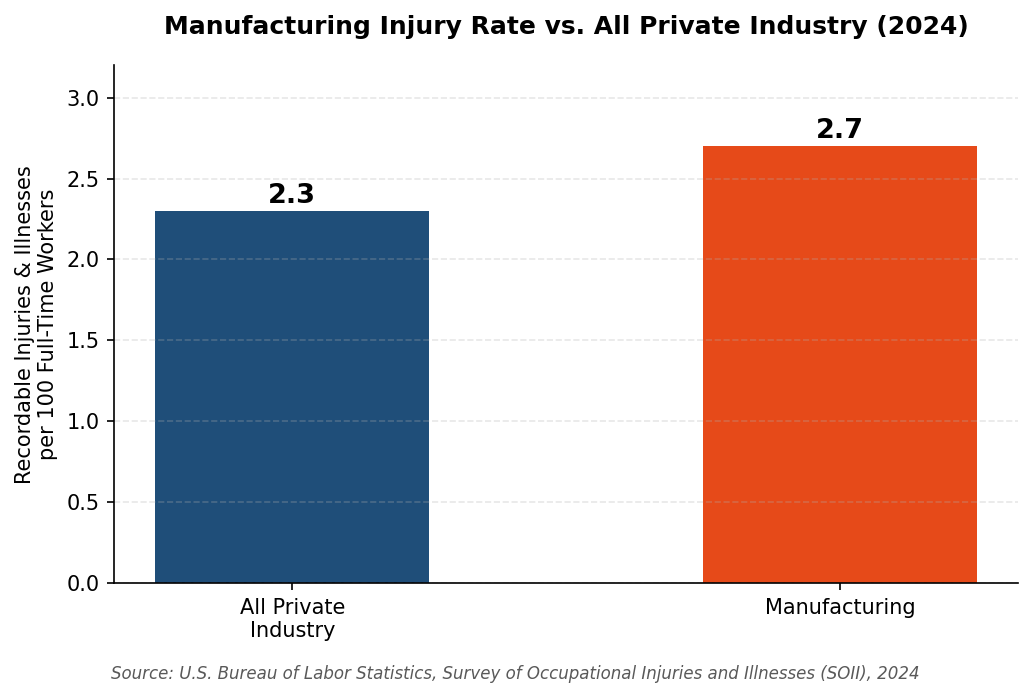
Manufacturing's injury and illness rate ran above the all-industry average in 2024, according to BLS data.
Why a Distributed Workforce Breaks the Old Training Model
Traditional classroom or instructor-led training assumes something that's rarely true in modern manufacturing: that everyone can be in the same room, at the same time, with the same instructor. A distributed workforce breaks that assumption in a few predictable ways:
- Shift coverage: Night and weekend shifts routinely get lower-quality or delayed training because the instructor works days.
- Multi-site consistency: Plant A and Plant B may be teaching "the same" HazCom training with two different slide decks and two different levels of detail.
- Contractor and seasonal turnover: Temporary workers often get the least training, despite frequently working the highest-risk tasks.
- Language and literacy gaps: OSHA's Hazard Communication standard specifically requires training "in a language that workers can understand," which a single English-only session doesn't satisfy.
- Audit trail gaps: When an incident happens, "we told them in a meeting" isn't documentation. Regulators and insurers want a record of who was trained, on what, and when.
What Effective Safety Training Looks Like at Scale
Programs that hold up across shifts, sites, and turnover tend to share a few traits:
- Role-based tracks, not one-size-fits-all modules. A machine operator, a forklift driver, and a maintenance technician need different depth on different standards.
- Consistent content delivered the same way everywhere. The training a night-shift worker in Plant B receives should match what a day-shift worker in Plant A receives, word for word.
- Short, focused sessions instead of half-day blocks. Workers retain more from a 10-15 minute module they can complete between shifts than from a rushed annual marathon session.
- Built-in refreshers tied to real triggers. New chemical introduced, new machine installed, or a near-miss reported: each of these should trigger a short refresher, not wait for the annual cycle.
- A verifiable completion record for every worker, every site. This is what turns "we did trained them" into evidence during an audit or after an incident.
| Metrics | Instructor-Led Classroom | Standardized Video-Based Training |
|---|---|---|
| Consistency across shifts/sites | Depends on the instructor | Identical content everywhere |
| Scheduling | Requires pulling workers off the floor at a set time | Completed on the worker's own schedule |
| Contractor/seasonal onboarding | Often delayed or skipped | Assigned automatically at onboarding |
| Language support | Limited to instructor's fluency | Can be built once per language and reused |
| Completion records | Manual sign-in sheets | Automatic, timestamped, audit-ready |
| Refresher training | Requires re-scheduling a session | Reassigned instantly when triggered |
This is exactly the gap that interactive, video-based SCORM courses are built to close: the content is built once, tracks completion automatically through your LMS, and plays the same way whether it's watched on a shop-floor tablet at 6 a.m. or a laptop in the office at 2 p.m.
Building the Program: A Practical Starting Point
- Start with an audit of your current top 4 OSHA-cited standards (HazCom, LOTO, Powered Industrial Trucks, Machine Guarding) and confirm every site is teaching them the same way.
- Map every role on the floor to the specific standards that role is exposed to, rather than assigning the same generic module to everyone.
- Standardize your new-hire and contractor induction so a temp worker on day one gets the same core safety training as a five-year employee.
- Set a refresher cadence tied to real triggers (new equipment, new chemical, a near-miss) rather than only an annual calendar date.
- Keep a timestamped completion record for every worker at every site, so you can produce it in minutes if OSHA or your insurer asks.
Bottom Line
Manufacturing's injury rate is higher than the private-industry average for a structural reason: the workforce is distributed across shifts, sites, and contractor rosters in a way that classroom training was never built to handle. The fix isn't more training, it's more consistent training that travels with the worker instead of requiring the worker to travel to it.
Explore More on Manufacturing Safety Compliance
If you're building out a broader safety training program, these resources go deeper on specific pieces of it:
OSHA HazCom Guide: a closer look at what the Hazard Communication standard actually requires and how to structure training around it
Lockout/Tagout (LOTO) Safety Training Guide: a step-by-step breakdown of LOTO procedures and how to keep training current as equipment changes
EHS Compliance for Manufacturing: how to structure a full environmental, health, and safety training program across multiple sites
Corporate Training Programs: how role-based training tracks work when you're managing training across different departments, not just the floor
Chemical Handling & Hazard Communication SCORM Course: a ready-to-deploy course covering the exact standard discussed above
Permit to Work Training for High-Risk Industrial Tasks: for teams managing contractor and high-risk task authorization on top of general safety training
References:
- U.S. Bureau of Labor Statistics, Employer-Reported Workplace Injuries and Illnesses, 2024: https://www.bls.gov/news.release/osh.nr0.htm
- U.S. Department of Labor / OSHA, Business Case for Safety and Health: https://www.osha.gov/businesscase
- U.S. Department of Labor / OSHA, Hazard Communication Standard, 29 CFR 1910.1200: https://www.osha.gov/laws-regs/regulations/standardnumber/1910/1910.1200
- National Safety Council, Injury Facts – Work Injury Costs: https://injuryfacts.nsc.org
FAQ
Frequently asked questions
Hazard Communication and Lockout/Tagout consistently rank among the top standards cited in general industry, alongside Machine Guarding and Powered Industrial Trucks.
Manufacturing safety training depends on the hazards and tasks workers are exposed to. Common OSHA-covered areas include Hazard Communication, Lockout/Tagout, Machine Guarding, and Powered Industrial Trucks. Training should be role-specific and aligned with the hazards present at each workplace
There is no single OSHA-mandated annual schedule for all manufacturing safety training. Frequency depends on the applicable standard, employee role, workplace changes, and triggering events. For example, OSHA requires Lockout/Tagout retraining when job assignments, equipment, processes, or procedures change or when deficiencies are identified
A distributed manufacturing workforce can be trained using standardized, role-based eLearning that employees can access across plants, shifts, and locations. An LMS can centralize assignments and completion records, while SCORM courses can provide trackable training delivery across compatible LMS platforms.
Companies can standardize training by using consistent, role-based courses across plants and shifts, while allowing site-specific procedures to be added where necessary. Centralized LMS delivery also makes it easier to assign training and maintain completion records across locations.
Online training can effectively deliver safety knowledge, procedures, and awareness, but it does not automatically replace required hands-on training, practical demonstrations, evaluations, or site-specific instruction. For example, OSHA's Lockout/Tagout requirements include training appropriate to the employee's role and the hazardous energy controls used at the workplace
Training should be provided in a form employees can understand. For example, OSHA's Hazard Communication standard requires employers to provide information and training in a manner and language that employees can understand.
An LMS can assign training by role or location and maintain centralized completion records. SCORM-compatible courses can also send completion and assessment data to compatible LMS platforms, helping L&D and EHS teams maintain a consistent training record.
Related Articles

7 Leadership Training Areas Every Manager Should Master
7 leadership training areas every manager should master, from delegation and feedback to psychological safety, conflict resolution, mental health and harassment prevention.

5 Signs Your Team Needs AI Literacy Training Before Rolling Out AI Tools
Adopting AI tools without workforce readiness leads to data privacy risks, unverified outputs, and Shadow AI. Here are 5 clear signs your organization needs foundational AI literacy training before expanding AI tool adoption across your teams.